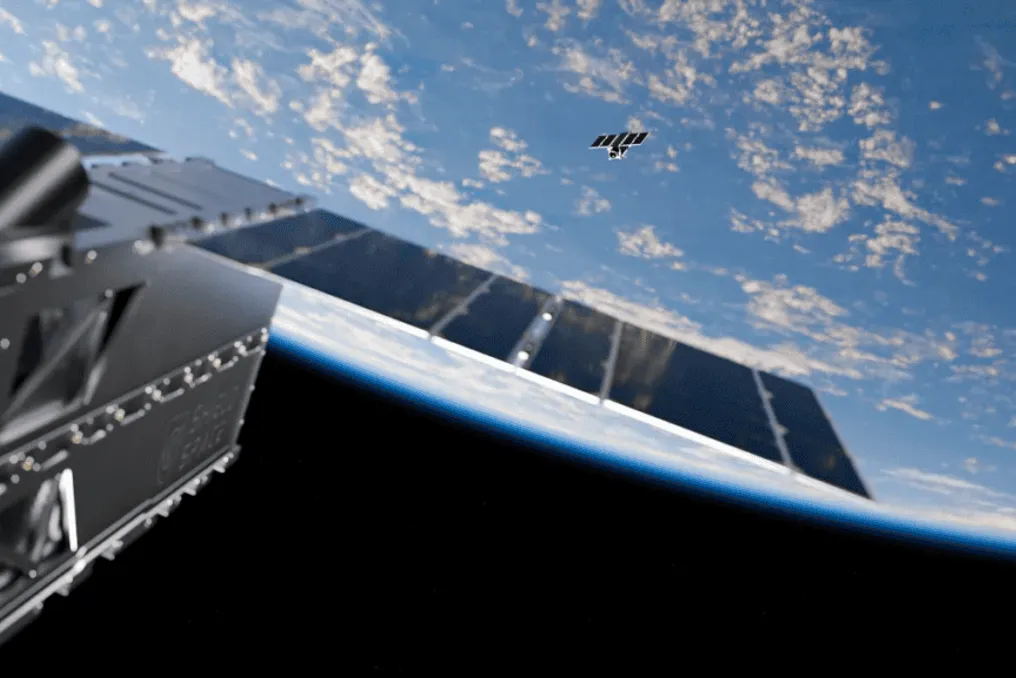
A British company is developing a proposal to convert small satellites into a type of orbital defense squadron. This initiative aims to launch groups of autonomous spacecraft, equipped with technologies such as lasers, microwaves, and physical interception methods, to protect Western satellites against potential threats.
Shield Space is the company responsible for this plan, seeking to adapt drone warfare concepts observed in terrestrial conflicts to the space environment. The central idea is to place dozens of small satellites, known as CubeSats, into orbit that would have the capacity to operate in a coordinated manner, even if they lose contact with ground operators.
Interest in this type of technology gained prominence after an incident in May 2026. On that date, four Russian military satellites approached the ICEYE-X36, a commercial synthetic aperture radar satellite widely considered a crucial intelligence source for Ukraine on the battlefield.
This approach was interpreted as a risky and potentially intimidating maneuver. Nearby satellites can cause interference in the signals of other equipment, blind them with lasers, damage them, or force them to change their course, consuming fuel.
In October, one of these same Russian satellites came within just 500 meters of the ICEYE-X36. This event reinforced concerns about the security of equipment in orbit and spurred the development of space defense systems.
The first stage of this project will be Project Broadsword, which is scheduled to be demonstrated in the fourth quarter of 2027. The mission is expected to be launched using SpaceX's shared flight service, called Transporter-21.
This experiment will involve two devices: an 8U CubeSat and a smaller 3U one that will serve as a target. The team plans to prove the ability to bring these two spacecraft from an initial distance of one hundred kilometers to only one hundred meters.
The test will also cover the evaluation of four levels of autonomy, starting with human participation in control and progressing to a level that the company describes as almost fully autonomous. For comparison, each unit of a CubeSat, designated as U, is equivalent to a cube with a ten-centimeter edge; thus, an 8U model has a volume equivalent to eight of these units.
The notion of satellites operating together is not new. In 2023, NASA launched the civilian Starling project, which demonstrated how a group of four small satellites can collaborate and function autonomously in scientific missions. However, the distinction lies in the fact that Shield Space intends to apply this principle to military operations, which require more intricate decisions and threat response capabilities.
Despite the grand ambitions, realizing this proposal into an operational defense system represents a major challenge. The small satellites need to incorporate propulsion systems, sensors, cameras, computational capacity for Artificial Intelligence (AI), and defense equipment in an extremely restricted space.
Shield Space itself recognizes obstacles related to dimensions, weight, and power consumption. Another critical point is the training of autonomous systems: according to its founders, there is a scarcity of real space operation data, and current simulations are not yet sufficient to replicate all necessary conditions.
There is also concern regarding engagement guidelines. An autonomous system designed for military scenarios must be able to adhere to predefined limits and instructions for the use of force.
Professor Bleddyn Bowen, an astropolitics expert at the University of Durham (England), expressed caution regarding the project. He drew an analogy with Brilliant Pebbles, a Cold War program that envisioned thousands of autonomous interceptors in orbit to neutralize Soviet ballistic missiles.
For Bowen, although many technologies are achievable with adequate investment, several years of development and testing will still be required. Among the difficulties mentioned is the need to evaluate kinetic weapons in space without generating orbital debris.
Shield Space is already planning subsequent phases to the first test. The company aims to evolve to demonstrations with two larger 16U CubeSats, followed by a mothership capable of carrying ten satellites, and eventually, a configuration with ten of these motherships distributed in different orbits.
The ultimate goal is to establish a network capable of protecting vast areas of orbital space. Ritchie terms this vision 'space-based carrier strike', referencing the aircraft carrier groups used in terrestrial military operations. However, at the moment, the proposal is far from being a proven capability, depending on future tests to confirm whether small autonomous satellites can operate together and respond to real threats without introducing new risks to the orbital environment.