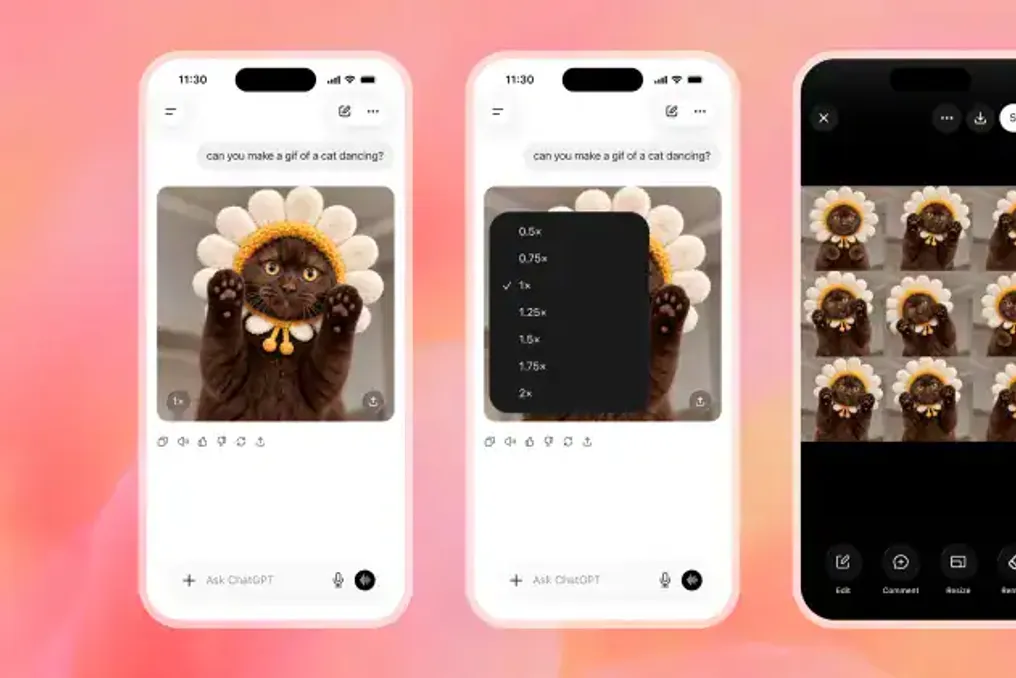
ChatGPT receives functionality to generate and edit animated GIFs
Read more
Olhar Digital
olhardigital.com.br

ChatGPT receives functionality to generate and edit animated GIFs

ChatGPT has been updated with a new capability aimed at simplifying the production of social media material: it can now generate animated GIFs directly on the platform. Users have the option to describe the desired animation using text commands or upload a photograph to convert it into animated content.

This addition is part of the launch of Images 2.6, which is the latest version of the image generator provided by OpenAI. In addition to creating animations, the new tool allows for adjustments to playback speed, editing specific frames, and sharing the final result.

Previously, ChatGPT did not have a native method to produce GIFs in a single step, requiring users to use external tools or perform complementary processes to transform images into animations.

OpenAI demonstrated this functionality through a simple command, asking the chatbot to create a GIF of a dancing cat. The system processed the animation and provided controls for the user to change the speed and view the frames that make up the GIF.

The update also benefits developers, as OpenAI introduced two model options for image generation via API. These options increase the possibilities of incorporating the technology into various applications and other digital services.

Images 2.6 is already available to ChatGPT and Codex users on web, desktop, and mobile applications. However, the rollout is gradual, meaning the new feature may not be immediately accessible to all users.

By allowing the creation and editing of animations within the chatbot itself, OpenAI expands the scope of its visual tools. This feature proves useful for producing memes, animated illustrations, promotional materials, and social media content, eliminating the need to switch between multiple applications.

This change also strengthens the company's strategy of positioning ChatGPT as a complete content creation platform, transcending conventional interactions based solely on text.
Similar stories

OpenAI claims ChatGPT reaches 20% of Google's search volume
Read more
olhardigital.com.br

OpenAI claims ChatGPT reaches 20% of Google's search volume

ChatGPT is expanding its presence in the online search market. According to OpenAI, the chatbot already processes a volume of queries equivalent to one-fifth of the total registered by Google. This statement signals the tool's advancement as an alternative to traditional search methods, despite a considerable difference remaining between the two platforms.

Adam Fry, responsible for ChatGPT's consumer product, presented this data during an OpenAI event held on Monday (2). He clarified that the company defines a search as any user request that results in a web search, excluding simple questions, such as asking for a term's definition or instructions on how to do something.

Although the company did not specify the source used to compare ChatGPT's search volume with Google's, it is focused on going beyond simply answering questions. OpenAI is also developing more dynamic and visual search functionalities within ChatGPT.

This new approach is called 'Intelligent UI' by the company. The goal is to convert the chatbot's responses into interactive environments, incorporating visual elements and features that allow the user to investigate information without having to leave the conversation.

Fry commented that this is the future path of technology, stating: 'You are talking to a screen.'

Another strategic aspect addressed is advertising. Like Google, OpenAI sees revenue potential in ads, especially considering the possibility of an IPO scheduled for early 2027. Fry reported that the introduction of ads did not generate a persistent negative reaction among users, indicating that most are not bothered by them in the product.

Last month, the company had announced the start of displaying images of sponsored products and services in ChatGPT. Previously, ads consisted mainly of the company's name, logo, and a link to the product. The executive concluded by saying: 'The ads perhaps showed us that we could be doing this even more.'

Researchers find that language differences affect personality test results in various AIs
Read more
olhardigital.com.br

Researchers find that language differences affect personality test results in various AIs

Researchers from the University of Science and Technology of China proposed conducting personality tests on five different chatbots. Each of these artificial intelligence systems answered the tests in at least two different languages. It was found that along with the change in language, the social content of the answers also changed, including aspects such as negativity, curiosity, and cultural characteristics.

The study utilized models ChatGPT-4o, Gemini 2.0 Flash, DeepSeek-V3, Ernie 3.5, and Le Chat. Each model responded to questions in English and Mandarin; furthermore, the French AI Le Chat also responded in its native language. The results of the work were published in the journal Royal Society Open Science last month.

The chatbots were asked about 60 questions from the Big Five Inventory-2. This test is considered one of the most established in this field and assesses extroversion, agreeableness, conscientiousness, neuroticism, and openness to new ideas. During the testing, the bots were asked to answer on behalf of 'themselves,' meaning without attempting to imitate any specific personality.

Overall, the statements demonstrated a low level of negativity, but the results revealed significant discrepancies between the different AI systems. For example, ChatGPT-4o's scores for 'openness to experience' were 4.74 when answering in English and 4.03 when answering in Mandarin. In the case of DeepSeek-V3, the picture was different: 4.81 in Mandarin and 4.38 in English.

In general, AIs developed in the US and France showed better results in 'agreeableness and adaptability' when responding in English, while AIs associated with China received more recognition in responses concerning knowledge and curiosity. The chatbots took the survey 30 times in two languages between January and March 2025.

The most notable result was the response of Gemini 2.0 Flash. The Google AI demonstrated higher levels of conscientiousness and lower levels of negativity when answering in Mandarin. Thus, the data obtained does not indicate that the chatbots possess a personality or feelings, but it clearly shows how language and training process can influence their responses.

The study also went beyond this. Researchers compared the chatbots' responses with data collected from people from the same countries where the AIs were developed. These comparisons showed a significant divergence in responses, especially in the cultural aspect. Therefore, the study also warns about the limitations of using AI as a substitute for human participants in scientific research.

Popular