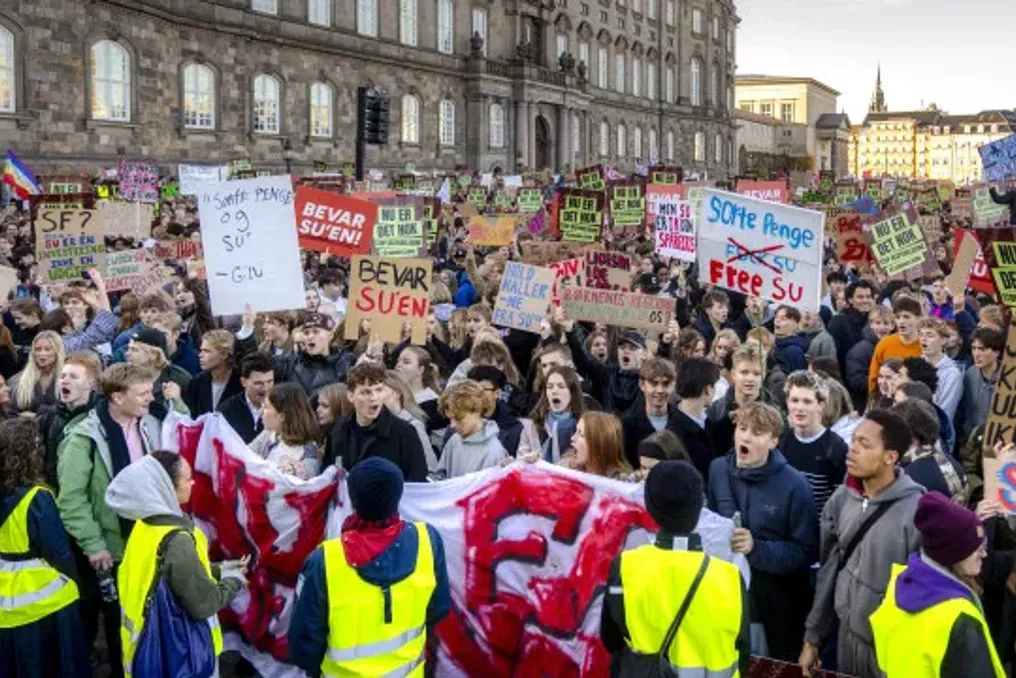
Thousands of students protest in Copenhagen against cuts to student allowances
Read more
Noticias ao Minuto
noticiasaominuto.com

Thousands of students protest in Copenhagen against cuts to student allowances

Thousands of Danish students took to the streets today to demonstrate in front of the Folketing (parliament) to oppose the plans of the centrist left coalition government to cut the financial aid system. Simultaneously, strikes were taking place in dozens of educational institutions across the country.

The executive branch, led by social democrat Mette Frederiksen, intends to abolish the monthly financial assistance—which is currently available to all students over 18 living with their parents whose combined annual income exceeds 710,077 Danish kroner (€95,000).

The proposed reform also stipulates that the benefit amount will vary progressively for students living with their parents if their total income falls between 419,589 and 710,077 Danish kroner (€56,139 to €95,000).

According to organizers, the demonstration gathered over 10,000 students and proceeded without incidents. The march went through the center of Copenhagen to the parliament, where slogans such as 'We will save SU' (monthly allowance, Danish abbreviation) and 'Enough' were chanted.

The amount of SU ranges from 1,154 to 7,426 Danish kroner (€154 to €994) monthly, depending on whether students live with their parents or are already independent. Over the past two decades, successive governments, both right-wing and left-wing, have made changes to the SU system and reduced its duration.
Similar stories

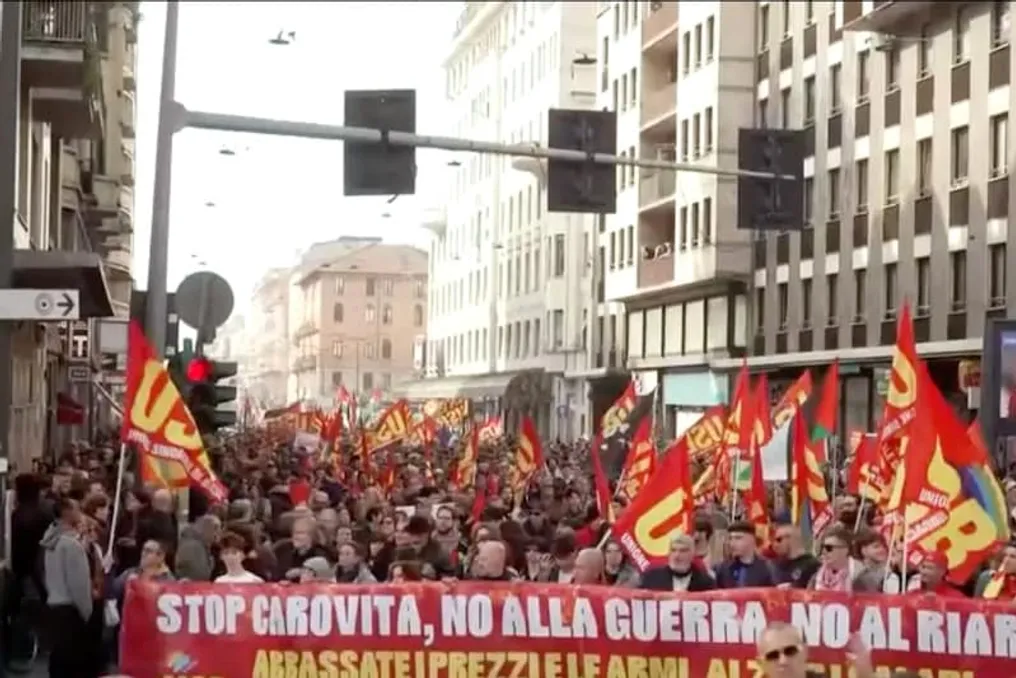
Thousands protest in Italy against inflation and military spending
Read more
www.aajtak.in

Thousands protest in Italy against inflation and military spending

On Friday, thousands of students, workers, and trade union members took to the streets in various Italian cities to protest. Demonstrators demanded better wages, improvements in public services, and relief from rising inflation. Additionally, they strongly opposed the increase in military spending and the use of ports for sending weapons to conflict zones.

This nationwide demonstration was part of a 24-hour national strike organized by the trade union 'Unione Sindacale di Base' (USB), during which protests took place in over 40 cities across Italy. Although most demonstrations remained peaceful, tensions arose in some locations.

Police used water cannons to control the crowds and prevent demonstrators from breaking security barriers. It is noteworthy that these protests occurred several weeks after violent clashes at the beginning of the month, where demonstrators clashed with the police and also vandalized shops.

In Turin, police used water cannons to push back students and left-wing activists who were approaching the security barriers near the prefecture building. In Rome, a large procession of demonstrators passed near the Colosseum, where they announced that they would continue their protest by camping there over the weekend. Some demonstrators placed trash cans on the streets and set them on fire.

Tensions escalated in the evening when a large number of people attempted to march towards parliament. According to the Italian news agency, police resorted to water cannons to disperse the crowd. Furthermore, eight individuals attempting to break the barriers were detained.

A large demonstration was also observed in the port city of Genoa, where approximately 15,000 port workers, students, and other protesters entered the port area. Their protest was part of a broader movement underway in Europe and other regions, wherein demonstrators opposed the use of commercial ports for shipping arms to war-torn areas. Demonstrators also raised the issue of sailors dying in conflicts spanning from the Gulf to the Black Sea.

Popular