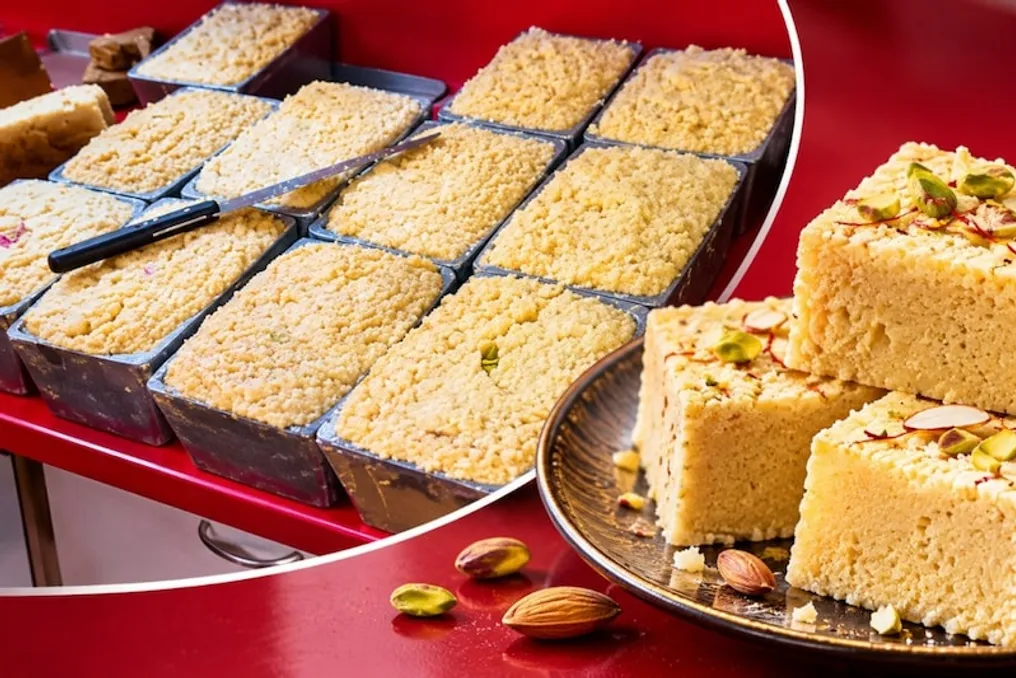
During the Diwali festival, people greatly enjoy the milk cake from Alwar. Its grainy texture distinguishes it from other sweets. The milk cake, which is made from milk, sugar, and saffron, is supplied not only within the country but also abroad, including Europe, America, Saudi Arabia, Canada, Nepal, Bhutan, and other countries. Furthermore, there is a growing demand for dried fruit sweets, as consumers prefer them to dairy products to avoid impurities in milk and whey.
Although the demand for all types of sweets is always high during festivals, the Lakkand from Alwar is considered particularly special. This Lakkand is exported not only across different states of the country but also internationally. It has a light brown outer shell, while the inside is tender and sweet.
Lakkand merchant Ashish Taneja shared the recipe for this dessert, which can be made at home. It requires 2 liters of milk, two hundred fifty grams of sugar, three to four tablespoons of ghee, lemon juice, and cardamom powder, as well as dried fruits. He explained that to prepare the Lakkand, the milk must first be brought to a boil. The milk is continuously boiled in an iron or steel pot. Then, it is curdled by adding lemon juice or khatkiri to form light granules. After this, sugar is added, and the mixture is cooked for a long time until it thickens. When the mass becomes sufficiently thick, it is placed in a setting mold.
Today, hundreds of vendors in Alwar prepare milk cake. This sweet was first introduced in 1947. Baba Takurdas, who arrived in Alwar after migrating from Pakistan, once heated milk. During the process, it curdled, and he added sugar to it, after which he prepared and allowed it to set in a container. When he tasted it after cooling, the flavor was significantly improved. Over time, this sweet was named Lakkand. Politicians, actors, and businessmen visiting Alwar come here to taste and highly appreciate the milk cake. Today, the third generation of Baba Takurdas is involved in making this milk cake.