Brazil receives panel to monitor future climate changes
Read more
Olhar Digital
olhardigital.com.br

Brazil receives panel to monitor future climate changes

The federal government and the National Network of Education and Research (RNP) launched a panel on Tuesday (the 3rd) that allows for the visualization of climate change forecasts, such as changes in temperature and precipitation patterns in Brazil and Latin America over the coming decades.

The tool, integrated into the AdaptaBrasil platform, displays maps with various global warming scenarios. This data can help identify climate risks and guide the planning of adaptation measures.

AdaptaBrasil aggregates climate risk indicators for 5,570 municipalities in Brazil, taking into account climate threats, exposure, and vulnerability. The new panel expands the available information, including temperature and precipitation forecasts, as well as indicators related to extreme events.

The maps allow for the comparison of four levels of global warming, demonstrating how projected changes are geographically distributed. According to Christian Mizyara, RNP solutions manager, presenting these indicators in a single interface helps to understand how climate threats may manifest as global temperatures rise.

Access to this information is viewed as a starting point for planning adaptation measures. During the launch, Marcio Rohas da Cruz, General Coordinator for Climate at the Ministry of Science, Technology and Innovation (MCTI), emphasized the importance of knowing possible climate scenarios. He stated: 'This is the first necessary information to start thinking about adaptation. You cannot think about adaptation before imagining our future from a climate perspective.'

Jean Ometto, senior researcher at the National Institute for Space Research (INPE), also noted the fundamental nature of the forecasts for risk calculation. However, he reminded that this data contains uncertainties, and science strives to provide increasingly clear, reliable, and transparent information to support planning.

According to INPE researcher Gilvan Sampaio, who was responsible for presenting the panel, its first version features a simple navigation interface. The institute is working on the ability to load climate data by territory and biome. The platform will also need to include other variables such as relative humidity, wind, and radiation. Sampaio believes this information will be valuable for researchers, research groups, and other users, including the public.

During the presentation, Aloisio Melo, Secretary for Climate at the Ministry of Environment, linked this initiative to the government's efforts to make climate adaptation a priority. He highlighted the update to the Climate Plan and the development of a more comprehensive adaptation plan, structured into 16 sectoral and thematic plans. This work aims to overcome historical socio-economic vulnerabilities exacerbated by climate change.
Similar stories

Weather forecast for today in São Paulo: cloudy with a chance of drizzle all day
Read more
g1.globo.com

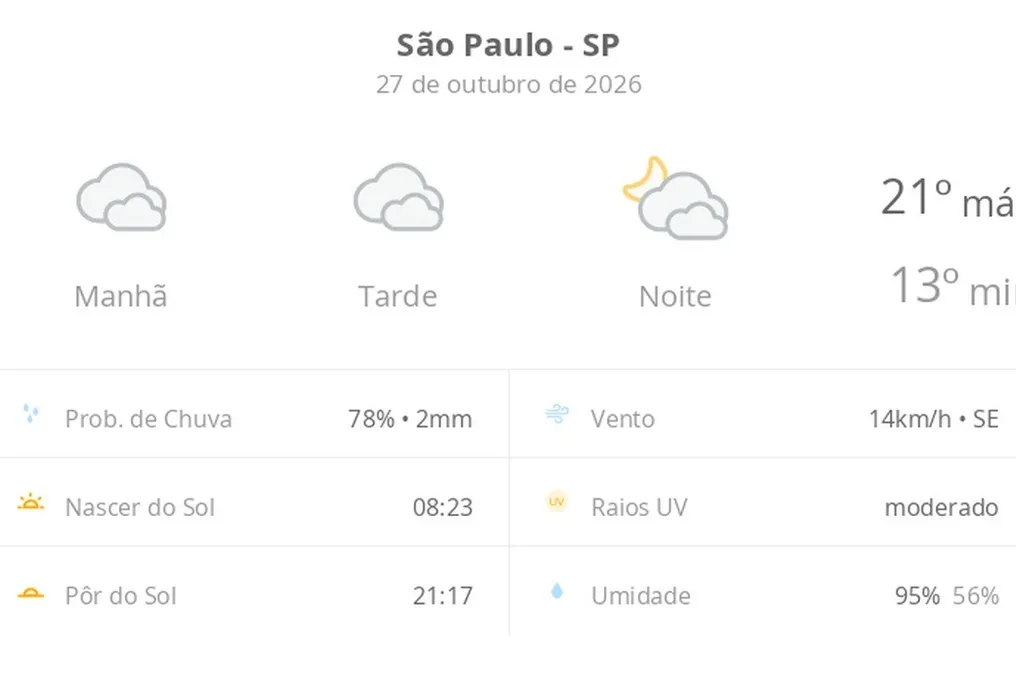
Weather forecast for today in São Paulo: cloudy with a chance of drizzle all day

According to the weather forecast for this Tuesday (the 27th) for São Paulo (SP), cloudy weather is expected with a probability of drizzling rain throughout the day. By evening, cloudiness will begin to gradually decrease. The maximum temperature will be 21ºC, and the minimum will be 13ºC.

The weather will be cloudy during the morning and after noon. At night, a large amount of clouds is expected to persist.

Regarding the forecast for tomorrow, Wednesday (the 28th), it is expected to be sunny with many clouds, and showers are possible in the afternoon and at night.

This report was automatically generated using data provided by Climatempo.

Climate change alters distribution and favors infectious diseases in Brazil
Read more
olhardigital.com.br

Climate change alters distribution and favors infectious diseases in Brazil

Climate changes are modifying the dissemination of infectious diseases across Brazilian territory. A study conducted by the Oswaldo Cruz Foundation (Fiocruz) revealed that between 2006 and 2024, the number of microregions with epidemic levels of dengue increased from 110 to 292.

Experts express concern over the potential impacts of extreme weather events and rising temperatures on other pathologies, including Oropouche fever, leptospirosis, hantavirus, and fungal infections.

In 2024, Rio Grande do Sul reported nearly 210,000 confirmed cases of dengue, resulting in 281 deaths. Concurrently, in Bahia, a state with an estimated population about 3 million larger, approximately 163,000 cases and 188 deaths were recorded.

The Fiocruz survey indicated that 292 microregions, corresponding to 54% of the country, presented epidemic levels of the disease. The main climatic factor that best explained the long-term increase in incidence was the greater occurrence of thermal anomalies, meaning temperatures significantly different from usual.

Researchers warn about the difficulty of reversing this expansion, stating that the process of expanding the transmission area of dengue appears to be irreversible. They argue that after the introduction of the virus and vector, it becomes unlikely to return to a scenario without transmission.

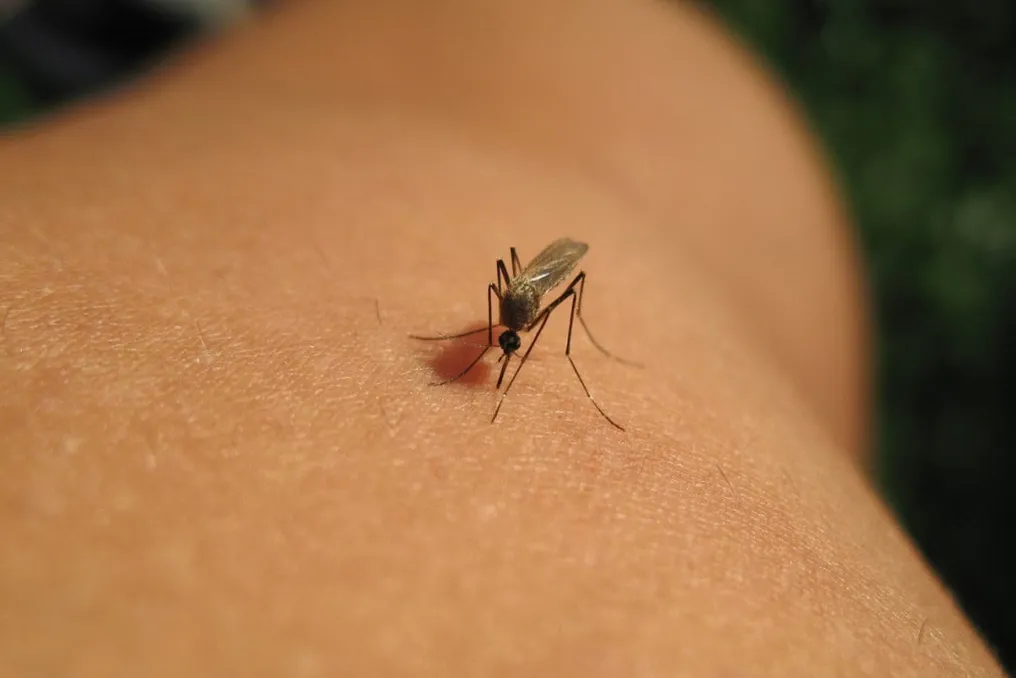
Infectologist Celso Granato, who is part of the Brazilian Society of Clinical Pathology and Laboratory Medicine, clarifies that heat affects the behavior of the Aedes aegypti mosquito. Under high temperatures, these insects need to consume more energy to fly and consequently feed more frequently.

Granato explains that when the heat is intense, mosquitoes need to beat their wings faster to maintain flight, which implies greater energy expenditure and the need to bite more often to nourish themselves, thus increasing disease transmission.

Oropouche fever, which was previously concentrated mainly in the Amazon, caused over 12,000 infections in 23 states and the Federal District during 2024. Although the link with climate change is still under investigation, changes in rainfall and temperature patterns, combined with environmental degradation, may have contributed to its expansion.

Extreme weather events also potentiate other health threats. According to Granato, the frequency of leptospirosis increased considerably after the floods in Rio Grande do Sul. Additionally, hantavirus can trigger a severe cardiopulmonary syndrome; since 2016, Brazil has confirmed 530 cases and 212 deaths from this disease, showing a lethality rate of 40%.

Environmental modifications can also benefit fungi capable of thriving in conditions that were previously unfavorable for human infections. Sarah Gonçalves Tavares, a professor at the Federal University of Espírito Santo (Ufes), points out that rising temperature is one of the factors driving this adaptation.

A notable example is Candida auris, which demonstrates resistance to high temperatures and can remain in the environment for long periods. The first Brazilian record of this species occurred in 2020, in Bahia. Since then, 24 occurrences have been documented in 15 states, all in healthcare facilities. In these cases, 56 patients colonized by the fungus died, and the lethality reached 82% in bloodstream infections, posing a particularly high risk to immunocompromised individuals.

Other concerns include Trichophyton indotineae, linked to antifungal-resistant skin infections, and Aspergillus, which benefits from humid and warm environments, potentially spreading to new areas due to changes in humidity and temperature patterns.

Storms advance across Brazil, affecting Center-West, Southeast, and South, according to forecast
Read more
olhardigital.com.br

Storms advance across Brazil, affecting Center-West, Southeast, and South, according to forecast

Intense rains are spreading across parts of the Center-West, Southeast, and South this Thursday, the 22nd, and are expected to continue on Friday, the 23rd. There is an expectation of showers, thunderstorms, and risk of storms in these areas.

While instability moves across the national territory, the North and Northeast regions remain under the predominance of heat. The National Institute of Meteorology (Inmet) is monitoring the possible formation of an extratropical cyclone between Rio Grande do Sul and Uruguay.

Precipitation is expected to reach a vast area extending from Amazonas to Rio Grande do Sul, also covering Mato Grosso, Mato Grosso do Sul, and São Paulo. How the intensity and distribution of the rains occur will vary depending on the location.

On Thursday, yellow warnings were issued indicating potential danger of storms in areas of the North, Center-West, Southeast, and South regions. For Friday, the alert level will be raised to orange in parts of Paraná, Santa Catarina, and Rio Grande do Sul, as well as in southern Mato Grosso do Sul.

The forecast for Friday also points to the chance of a low-pressure area forming in eastern Argentina. This system tends to move towards the Atlantic Ocean, potentially generating an extratropical cyclone between the coast of Rio Grande do Sul and Uruguay.

The formation of this extratropical cyclone off the coast of Rio Grande do Sul and Uruguay may intensify instability in the South Region starting Friday (23rd), with impacts being felt mainly on Saturday.

Heat remains strong in various parts of the country. In Teresina, the maximum temperature forecast is 39°C for both Thursday and Friday. In Palmas, thermometers may reach 38°C on Friday, and Cuiabá is expected to record 36°C on both days.

In the Southeast, the greater cloud cover and occurrence of rain help moderate temperatures. São Paulo has a forecasted maximum of 25°C on Thursday and 24°C on Friday. In Rio de Janeiro, the maximum may reach 27°C on Friday, equaled by Vitória. In Belo Horizonte, the expected maximum is 26°C.

In the South Region, Curitiba will face a more noticeable reduction in temperatures: the forecast for Friday indicates a minimum of 15°C and a maximum of only 16°C.

Despite the heat in the interior of the Northeast, low humidity requires special attention. There are yellow warnings related to this risk in areas of Maranhão, Piauí, Ceará, Rio Grande do Norte, Paraíba, Pernambuco, and Bahia.

Popular