Ford began selling the Everest model in Argentina in 2025. This seven-seater SUV is based on the Ranger, following the same development line as the Toyota SW4 and Chevrolet Trailblazer, which are derived, respectively, from the Hilux and the S10. Although both models are sold in Brazil, the Everest is not available in the Brazilian market, despite Brazil having a significantly larger market and being a major buyer of the Ranger.
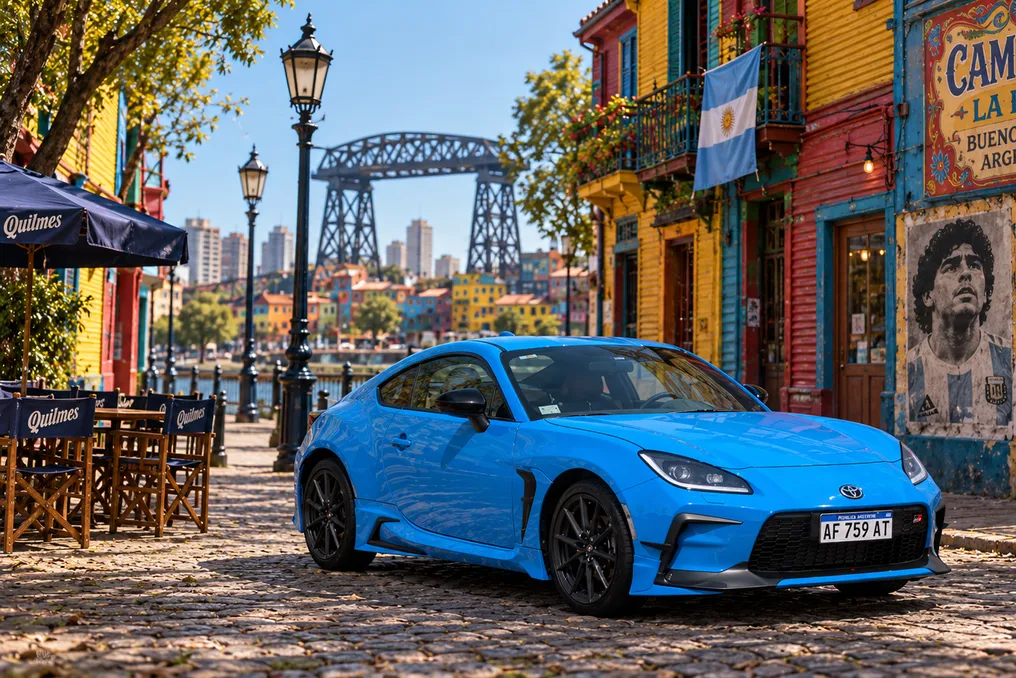
Manufacturers often make a wider range of vehicles available in the neighboring country. An example is Toyota, which sells the GR86 in Argentina but not in Brazil. Similarly, the hybrid Fiat 600 is offered to Argentinians, as previously happened with the 500X, which was displayed at the São Paulo Motor Show but never sold in Brazil. While Brazil kept the Land Cruiser FJ (which was naturalized as the Bandeirante) for 40 years, Argentinians already had the latest Land Cruiser models and received at least three generations of the Celica.
This diversity of models was not exclusive to Toyota. During the period from 1990 to 1998, the author spent all summers on the Santa Catarina coast, a popular destination for Argentinians during the hot months. Despite the vast Platine coast, the waters are cold and the beaches are considered poor, which motivated the road trip from Brazil.
During this period, it was common to see cars with old black license plates, whose characters seemed to have been painted manually. The most seen models were the Peugeot 504 diesel, with a sloping rear, and also some 505s. The predominant Renaults were the R18, although some R9s were circulating. At Ford, the most common were the 80s Falcon and the Sierra with a diesel engine. There were also Versailles, known as Galaxy, and Volkswagen Voyage, which were called Senda (or Gacel, in older models). Citroën presented the BX and ZX models, many of them diesel. Although these vehicles were generally poorly maintained and had dull paint, they represented a huge variety, distinct from the Brazilian scenario in the early years of importation.
Around 2003 or 2004, the author used to research vehicles on Mercado Libre, the Argentine classifieds platform. It was at that time that he discovered that Argentinians had access to sports cars such as the Renault Fuego Turbo, Clio Williams, and Peugeot 205 GTI. Furthermore, they also had the first-generation Mégane Coupé, the mentioned Toyota Celica, Peugeot 207 GTI, and other models that did not reach Brazil, even with open ports.
The author highlighted the disparity, citing that while Renault sold the Twingo in simple colors, Argentinians had the Clio Williams. This difference was not limited to models; often, Argentinians had versions of cars bought in Brazil that were not offered locally. For example, the Volkswagen Bora was sold in Argentina with a 1.8 Turbo engine of 180 hp, while in Brazil it was only the naturally aspirated 2.0. In the subsequent generation, Argentinians had the Jetta (named Vento in Argentina) equipped with a 2.5 five-cylinder engine and manual transmission, a configuration maintained in the sixth generation. Another case is the Chevrolet Astra GSi, which had a 2.4 16V of 150 hp in Argentina, compared to the 2.0 16V of 136 hp used in Brazil. More recently, Argentinians could acquire the third-generation Focus with a 2.0 Duratec engine and manual transmission, a combination that Ford did not offer in Brazil.
The difference persists to this day, although it has decreased. Toyota offers the GR86, GR Yaris, and Land Cruiser 300, in addition to its line of models manufactured in Mercosur. Although Brazil has the GR Corolla, it is not sold in Argentina, and the GR Yaris was recently received, but the rear-wheel-drive coupe remains unavailable in Brazil, despite being in the second generation and having been sold to Argentinians since the GT86 days.
Fiat follows a similar pattern, having had the 500X and 500L, which never reached Brazil, and now incorporating the new 600 Hybrid. In Brazil, there are the Pulse and Fastback. Although they are quality products, they meet different proposals.
It is important to note that not all manufacturers expand their offering in Argentina. The Brazilian industry is larger, has more brands, and the volume of Chinese imports has increased considerably in recent years. However, when it comes to specific niches—such as sports cars, coupes, special hatchbacks, or non-standard SUVs—the neighbors maintain options inaccessible in Brazilian dealerships.
Differences, yet similarities
A simplistic view compares Brazil, a country of continental dimensions, with Argentina, which, although not small, holds the eighth largest territory in the world. Comparing populations is complex: Brazil exceeds 210 million, while Argentina totals about 46 million, a number close to the population of the State of São Paulo.
In 2025, Brazilians purchased approximately 2,550,000 automobiles and light commercial vehicles. Argentinians bought about 580,000 vehicles in these same categories. The Brazilian sales volume is almost four times higher, but considering that the Brazilian population is almost five times larger, the sales volume is proportionally similar. Calculating per thousand inhabitants, about 12 new vehicles were sold for every thousand Brazilians and 13 for every thousand Argentinians, resulting in a technical tie.
Considering that the vehicles available in Argentina include models of higher added value, the hypothesis arises that Argentinians have greater purchasing power than Brazilians. Indeed, depending on the indicator and period, the average Argentine income may be higher. However, Brazil has a population almost five times larger, which implies a larger absolute number of rich and middle-class people.
Arguing about the 'Brazil cost' is relevant, but Argentina faces its own challenges, such as currency crises, import restrictions, and triple-digit inflation, making the acquisition of an imported vehicle a complex task. It is not an ideal environment for manufacturers.
The issue of import tax is also relevant. Both countries, being in Mercosur, generally apply the same tariff of 35% to vehicles imported from outside the bloc, although exceptions and agreements modify this taxation. Historically, Argentinians had a 'luxury tax' that taxed expensive cars more, a tax that was reduced in 2025 and abolished in 2026. Brazil, on the other hand, maintains a federal and state tax structure that makes imports more expensive.
However, taxation does not explain why Argentina sold the GT86 when taxes were more unfavorable, nor why Ford chose to bring the Everest from Thailand there, but not to Brazil. Given this, the author points to two determining factors to explain the persistence of Argentine automotive options: culture and economy.
The cultural question
In Brazil, the National Automobile Museum, an initiative by Roberto Nasser, was removed from the building in Brasília/DF and stopped operating in 2016. What remained were smaller collections, often without formal curation or own resources, maintained by vintage car enthusiasts.
Recently, there have been advances, with the inauguration of the Dream Car Museum in São Roque/SP in 2023 and, the following year, the opening of CARDE in Campos do Jordão/SP, which operates as a structured museum, using automobiles to narrate part of Brazilian history.
These initiatives are important, but the path to preserving Brazilian automotive history is still long. In contrast, Argentina has multiple automotive museums, such as the Museo Fangio in Balcarce, dedicated to the great racing idol. Meanwhile, the country of Fittipaldi, Senna, and Piquet lacks a permanent museum with the magnitude of the Museo Fangio dedicated to Senna.
A regrettable example is the fate of the Torcida Ayrton Senna, the pilot's oldest fan club. In 2014, the Senna family requested the return of the property loaned to the club, forcing members to sell about 200 of the pilot's personal items, such as photos, helmets, and clothing, due to lack of funds for rent and storage.
One of the Argentine museums is located at the Automóvil Club Argentino (ACA) in Buenos Aires. Its collection includes a 1892 Daimler, the Ferrari 166 used by Juan Manuel Fangio in 1949 and 1950, and Brabham Formula 2 monopost cars driven by Carlos Reutemann before his time in Formula 1. This museum is accessible free of charge on the first floor of the club's headquarters, on Avenida del Libertador.
This presence of a driving club with a museum reflects an Argentine peculiarity. In the early 20th century, when the automobile was new, the first motoring clubs emerged. The Automobile Club de France was founded in 1895, the British Royal Automobile Club in 1897, and the German ADAC in 1903. These associations went beyond car ownership; they organized races, promoted road construction, created maps, and defended drivers' rights in a time of little infrastructure.
In 1904, representatives of clubs from seven nations founded the International Association of Recognized Automobile Clubs (AIACR) to standardize international motorsport activities and rules. This entity would evolve, in 1946, into the Fédération Internationale de l’Automobile (FIA).
The Automóvil Club Argentino was established in the same year, 1904, and joined the AIACR in 1926.