
Experts believe new Samvat opens investment opportunities in mutual funds, stocks, and gold
Read more
Business Standard
business-standard.com

Experts believe new Samvat opens investment opportunities in mutual funds, stocks, and gold

Despite global uncertainty, geopolitical tensions, and market volatility, experts note that India's growth story remains strong. With the start of the new Samvat, coinciding with Diwali, investors may find opportunities in the mutual fund, stock, and gold sectors.

It is advised to maintain a balance between stocks, gold, and debt instruments while monitoring the improvement in large companies' profits and global events. It is necessary to carefully assess the potential of small-cap stocks and the defense sector, as well as continue using Systematic Investment Plans (SIPs) even during market downturns. Experts also emphasized the importance of understanding risks before investing in new instruments, such as Specialized Investment Funds (SIFs).

A three-session webinar organized by Business Standard Hindi was dedicated to analyzing the prospects and investment opportunities in gold, stocks, and mutual funds. Participants agree that India's long-term growth prospects remain robust, with opportunities expected in sectors such as energy, artificial intelligence, manufacturing, renewable energy, financial services, and consumption.

How SIPs have changed investor behavior

The first session focused on mutual funds. Venkat N Chalasaney, CEO of the Association of Mutual Funds in India (AMFI), stated that SIPs have played a key role in changing investor behavior, encouraging regular and disciplined investments. He noted that during market declines, investors can acquire more units at lower prices.

Chalasaney also reported that about 65 percent of India's population is under 35 years old, which could support consumption growth. Despite numerous challenges, the country's economic growth rate has held steady at 7.2–7.3 percent. He urged investors to remain confident in India's long-term growth trajectory.

Rahul Singh, Chief Equity Investment Officer at Tata Mutual Fund, pointed to signs of improving profit metrics in large-cap companies. Although profit growth in such companies was weak for some time, an acceleration is now expected, which could positively impact the market.

Jitendra Shriram, Senior Equity Fund Manager at Baroda BNP Paribas Mutual Fund, added that consistent participation from domestic investors has helped maintain market liquidity and partially offset the impact of foreign investor selling. He also noted that the profits of small companies have recovered well in recent years.

Large-cap stocks can provide growth

The second session focused on the stock market. Harendra Kumar, Managing Director at Elara Securities, forecasts positive market prospects for the next three years. In the long term, large-cap stocks could potentially yield around 12 percent annually.

Kumar suggested that with the return of foreign investors to the market, large private banks, as well as stocks in the automotive, discretionary consumer goods, internet, and energy sectors, could benefit. He advised that holding a combination of large and mid-cap stocks could constitute approximately 75–80 percent of an equity portfolio.

Jinesh Desai, Chief Executive Officer for Institutional Equities at Centrum Broking, believes that large-cap stocks look attractive from a valuation perspective. The average valuation of the Nifty index over the last ten years was around 20 times earnings, whereas it currently stands at about 18 times. According to Desai, this creates opportunities for long-term investors in high-quality, large-cap stocks.

New Samvat may offer an opportunity to buy gold

The third session was dedicated to gold. Apoorva Shet from Samco Securities indicated that the level of $4000 per ounce provides strong support for gold in the international market. He predicts that in the medium term, gold could reach $4600 per ounce, with potentially even more significant growth possible over the next three to five years.

The recent decline in gold prices created a buying opportunity for new investors, according to Shet. However, investors who already hold a sufficient share of gold in their portfolio might find stocks more appealing right now. He recommended that gold should constitute 15–20 percent of the portfolio. Investors without gold exposure can take advantage of the current correction to begin purchases, while those with adequate metal allocation may seek better opportunities in equities.

Shet also warned investors about the need to consider the higher volatility and risk associated with investing in silver.

Similar stories

Fund managers assert that value investing is relevant, but stock selection is the key factor
Read more
business-standard.com

Fund managers assert that value investing is relevant, but stock selection is the key factor

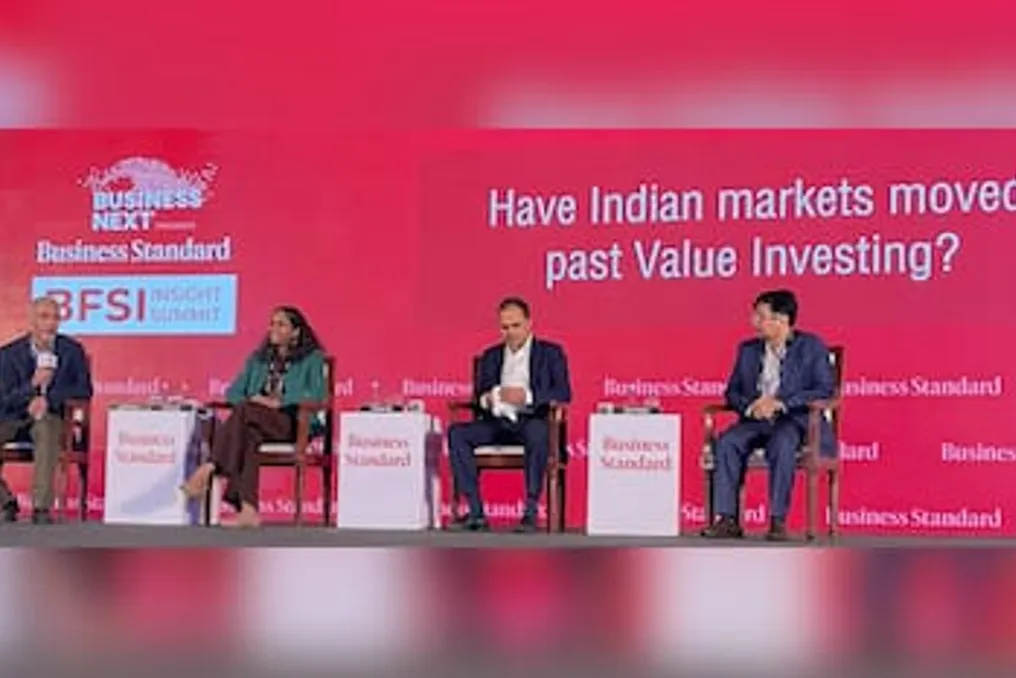
Fund managers stated at the Business Standard BFSI Summit in Mumbai that value investing remains significant in Indian markets. However, investors must be able to distinguish between stocks that are genuinely undervalued and those whose business prospects are deteriorating.

During a session moderated by Parin Palande from Business Standard, Rajiv Takkar, Director of Equity Investments and Head of PPFAS Asset Management, noted that investments should be based on comparing a company's intrinsic value with its market price, rather than applying labels such as 'value' or 'growth.'

Takkar cited an example of investing in American technology stocks where, in his opinion, the market did not reflect their true value, allowing them to be assessed using traditional methods. He explained that the difference between value and growth investing often depends on how heavily investors rely on future earnings. Growth investors tend to derive most of the company's value from cash flows expected many years later, whereas value investors prefer a clearer view of short-term cash flows.

He warned that overly long-term forecasting can make valuations vulnerable to errors, referencing the experience of Indian technology stocks. Furthermore, Takkar advised investors not to ignore corporate governance when seeking profits. Although governance standards have improved due to regulatory changes, disclosure requirements, and digital transactions, he believes investors can be overly lenient towards promoters with questionable histories.

Patience, conviction, and research

Prashant Jain, Founder and CIO of 3P Investment Managers, emphasized that holding an investment for a long period of low returns requires a deep understanding of the company's operations and the reasons why the market values it as it does. Jain stated that investing is more related to emotional intelligence (EQ) than intellectual intelligence (IQ), and such conviction must be supported by thorough research and a complete understanding of the business.

He also recounted his decision to exit the Indian technology sector in November 1999 when valuations were high, as he considered the sector's growth rates at that time unsustainable. Nevertheless, he does not see this sector losing relevance, noting that Indian technology companies continue to show positive revenue growth in dollars despite deflationary pressure that artificial intelligence might create.

AI and value seeking

Lakshmi Iyer, President of the Investment Group and CEO of Bajaj Alternate Investment Fund Managers, suggested that value investing applies to all asset classes, including fixed income. For a fund manager, the decision comes down to where the next increase in income is likely to come from—this could mean increasing investments in bonds or stocks, depending on the market cycle and the relative attractiveness of available opportunities.

Speaking about AI, Iyer noted that India's investment landscape in this area differs from the US, where most spending is directed towards building basic infrastructure and developing large language models. Activity in India, she said, has been more focused on applications. She does not consider the opportunities in AI in India to be in a bubble, as local companies have not relied on the large-scale borrowing seen in some foreign AI investments, but have mainly financed capital expenditures through cash flows.

However, regarding listed Indian technology companies, Iyer expects investors to become more selective. She cautioned: 'Everything sold at a discount does not necessarily offer value,' adding that investors must determine whether a correction reflects a temporary downturn or a sustained deterioration of the business condition.

Large companies offer relative value

Takkar observed that large-cap stocks generally trade at lower valuations compared to mid- and small-cap stocks. Referring to Price-to-Earnings ratios across indices, he pointed out that Nifty 100 is around 18–19 times earnings, Nifty Midcap 150 is at 24–25 times, and Nifty Smallcap 250 is at 31–32 times. He also noted the inflow of domestic funds into the mutual fund category for mid- and small-cap companies, even when large funds recorded outflows in some months, observing that investors seem to be over-concentrating on small stocks.

Takkar reported that the top 100 companies generate an estimated 65–70 percent of the profit generated by the leading 500 listed companies in India. This concentration of earnings underscores the importance of investors not ignoring larger enterprises just because their stocks have lagged. Jain agreed that the market may experience a mean reversion, and the relative dynamics of different segments may change over time. However, he cautioned against a uniform approach to all small and medium-sized companies. He stressed: 'There is value, there is stability, there is growth in large companies, and they cannot be ignored.' He added that smaller companies can also provide stock-picking opportunities, but investors need to be selective and conduct targeted research.

Iyer advocated for a balanced approach instead of completely abandoning any segment. She recommended that investors look beyond index movements and market narratives to find companies with solid fundamentals and reasonable valuations.

Horoscope for Pisces on October 24, 2026: New Earning Opportunities Will Appear
Read more
www.aajtak.in

Horoscope for Pisces on October 24, 2026: New Earning Opportunities Will Appear

According to the horoscope for Pisces on October 24, 2026, an improvement in financial situation is expected. New avenues for income will open up on this day.

In addition, the purchase of real estate is planned. It is also predicted that help from friends will be received, respect and prestige will grow, and there will be chances for business development.

Samarkand Declaration Calls for Increased Investment in Child Well-being
Read more
uzdaily.uz

Samarkand Declaration Calls for Increased Investment in Child Well-being

The Samarkand Declaration on Investing in Child Well-being was adopted in Samarkand on October 22. This document is the result of a two-day World Summit titled 'Investing in Child Well-being: A Path to Sustainable and Equitable Development for Future Generations,' which took place on October 21–22.

The summit was organized by Uzbekistan in collaboration with the UN Secretary-General's Special Representative on Violence Against Children, UNICEF, the World Health Organization, and the World Bank. Participants included First Ladies, ministers responsible for social protection, healthcare, education, and finance, government representatives, international organizations, civil society, academic circles, and business, as well as children and youth themselves.

In the declaration, participants affirmed their commitment to the Convention on the Rights of the Child and the principle of the best interests of the child. They emphasized that children constitute one-third of the world's population, and investing in their well-being contributes to improving education and healthcare, increasing labor productivity, strengthening social cohesion, and promoting peace.

The document identified several priority areas for public policy. These include developing social protection systems and expanding benefits for children and families, including during crises. Emphasis was also placed on strengthening measures to combat violence, abuse, and exploitation of children, including online threats.

Participants also noted the need to support early childhood development, promote inclusive education and healthcare, including strengthening the fight against childhood cancer. Special attention was given to supporting parents and guardians to prevent the unjustified separation of children from their families.

Another important area is preparing youth for the demands of the future economy. This includes developing digital and green skills, as well as expanding opportunities for decent employment, including for young people with disabilities.

A dedicated section of the declaration addresses financing issues. Governments are urged to continuously increase public investment in children and enhance the transparency of national budgets to ensure that children's interests are accounted for. International financial institutions, development partners, philanthropic foundations, and the private sector were called upon to increase funding for programs beneficial to children. Particular attention should be paid to low- and middle-income countries, as well as states facing conflicts, the consequences of climate change, and natural disasters.

The declaration recognizes children and adolescents as full participants in public life and agents of change. Participants expressed readiness to ensure that youth can participate safely and meaningfully in decision-making, including the implementation of the declaration itself.

Implementation is expected to occur through national strategies and budgets, with each country setting its own timelines and providing regular progress reports. Participants also agreed to hold a follow-up meeting to assess the achieved results. The summit organizers were asked to support countries in the practical application of the declaration.

Participants thanked the people and government of Uzbekistan for hosting the summit in Samarkand, calling the city a 'crossroads of civilizations.' The summit concluded with the renowned actor Adrien Brody, who also presented Shahnoza Mirziyoyeva with a painting created by him personally.

Popular