Frammer AI partners with Collective Newsroom to create BBC News video content in India
Read more
YourStory [india, en]
yourstory.com

Frammer AI partners with Collective Newsroom to create BBC News video content in India

AI video studio Frammer AI has partnered with Collective Newsroom, which produces content for BBC in India in nine languages. Frammer will handle the video processes for Collective Newsroom, including the adaptation of existing materials.

According to Frammer, this collaboration helps public interest journalism reach a wider audience through digital formats. The Frammer platform automates key stages of video production and distribution: it ingests content, adapts and clips it, and then publishes it across various digital platforms with a single click.

Sara Hassan, COO of Collective Newsroom, noted that thanks to Frammer and the ethical use of artificial intelligence, the collective aims to enhance its ability to deliver creative, credible, and bold journalism effectively, without compromising human judgment, editorial integrity, or public trust.

Suparna Singh, CEO of Frammer AI, commented on the news agency's approach to technology adoption, stating: 'It is impressive to see such an experienced team responsibly embracing AI while maintaining editorial rigor and strong brand safety checks at every stage.'

Collective Newsroom was founded in 2024 by four former BBC employees in India and employs over 250 journalists. It is the sole content provider for BBC News in India, covering the television channel, nine websites in Indian languages, social media platforms, and the BBC News India YouTube channel.

Frammer AI was established in 2023 by former NDTV executives. The company claims its platform allows publishers to quickly move content according to social media requirements.

Frammer collaborates with several major global publishers, including ABS-CBN in the Philippines, Media Prima in Malaysia, and Medialivre in Portugal. In India, the company has established partnerships with The India Today Group, Network 18, and other publications.

Similar stories

Fractal Analytics plans to accelerate growth through major deals and artificial intelligence partnerships
Read more
business-standard.com

Fractal Analytics plans to accelerate growth through major deals and artificial intelligence partnerships

Fractal Analytics, a company specializing in enterprise artificial intelligence (AI), anticipates leveraging large agreements and mergers to advance to the next stage of growth. This occurs as more companies integrate AI to manage and transform their workflows.

Co-founder and CEO of the group, Srikanth Velamakkani, stated in an interview with Business Standard following the release of Q2 results for fiscal year 27 that the company has two additional growth vectors. The first is major deals and partnerships, which he believes are gaining momentum, and the second is growth through Mergers and Acquisitions (M&A). He expressed hope that M&A will ensure strong growth.

Fractal reported first quarter revenue of $100 million in the second quarter of fiscal year 27. According to the investor presentation, major deals for Fractal are defined as contracts valued over $10 million. The number of clients whose annual revenue over the last 12 months exceeds $10 million increased to eight in the second quarter, up from seven a year prior. Furthermore, the number of clients with an annual contribution exceeding $20 million grew from four to six.

Although the company will start working on small AI projects, some costing only $250,000, improved client engagement opens up numerous opportunities for AI application in other operations. Velamakkani added that because AI solves more complex problems, clients enter into multi-month and multi-year agreements, creating favorable conditions for future development. He noted that while Fractal historically lacked a strong base in large deals, they are beginning to build one, and the market is moving towards solving more complex and long-term AI problems.

The first growth vector is linked to Fractal's traditional strengths, including growth in sectors such as healthcare and banking, financial services, and insurance (BFSI). The healthcare and life sciences sector demonstrated a 79 percent growth, while BFSI grew by 30 percent. Despite strict regulation, both industries are actively adopting AI due to the presence of repetitive cognitive tasks that AI can augment, automate, and redesign. Velamakkani explained that BFSI companies in the US likely invest one-third of their technology spending in AI.

When asked about the pricing of major deals, Velamakkani explained that for small projects, unit economics are not considered, whereas for large deals, it becomes the basis for problem-solving efficiency. He acknowledged that sometimes the company might appear too expensive. Fractal's AI product business, which includes the Cogentiq AI agent platform, grew by 39 percent compared to the previous year, reaching an annual revenue run rate of 150 crore rupees. Currently, the product business accounts for 4 percent of the company's revenue. Velamakkani noted that product revenue is starting to grow steadily, indicating the realization of product potential.

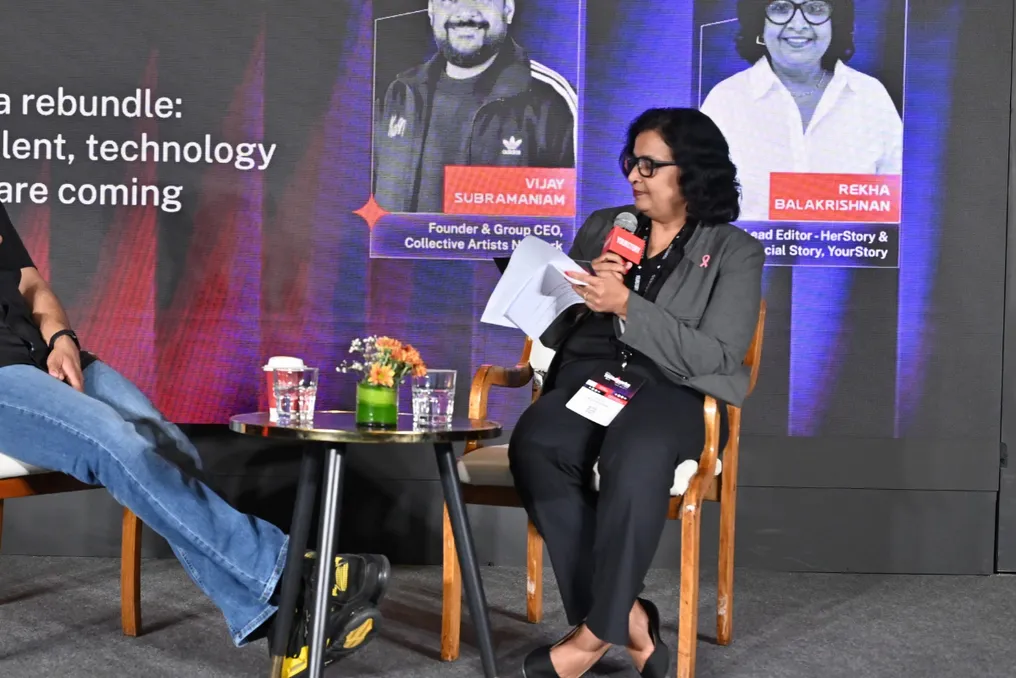
Vijay Subramaniam discusses the impact of artificial intelligence on the changing media landscape
Read more
yourstory.com

Vijay Subramaniam discusses the impact of artificial intelligence on the changing media landscape

The media industry has long functioned in isolated segments: agencies managed stars, studios created films, platforms distributed content, and brands paid for audience reach. However, these boundaries are blurring today. Creators are building their own enterprises, artificial intelligence is transforming the content creation process, and one story or character can become the starting point for films, series, and brand partnerships.

Collective Artists Network, founded by Vijay Subramaniam, operates in several such areas. During a fireside chat titled 'The Great Media Repackaging: Why Content, Talent, Technology, and Commerce Are Merging at TechSparks 2026,' Subramaniam discussed how his project integrates layers in communities of talent, marketing, and technology, as well as the role of AI in this overall scheme.

Having earned the nickname 'the AI man in the media industry,' Subramaniam stated that despite concerns, he confidently embraces this role because technology will remain here forever. He expressed the conviction that content creation should be equal in opportunity. Historically, only a few elites had the right to tell stories, but in his opinion, anyone who has a story should have the ability to tell and consume it. His company actively implements this idea, possessing, according to him, the world's largest portfolio of AI-enhanced content.

According to Subramaniam, the media business is recession-proof. He noted that during the COVID-19 pandemic, everyone was forced to stay home to consume content, meaning media risks losing nothing. The risk exists for media operators who fail to adapt to changes.

He also pointed out that the Indian media ecosystem is experiencing a decline of oligarchs for the first time. Citing successful post-pandemic projects like KGF, Mahavatar Narsimha, and Netflix shows, including the recently released Musafir Cafe, which became a Netflix hit, he emphasized that success is achieved by new faces and fresh talent, not by people who have controlled the industry for decades. He believes that these newcomers will prevail.

Regarding whether AI makes content cheaper and more profitable, Subramaniam answered affirmatively. He stated that business profitability will increase by two hundred percent, and storytelling will become democratic, allowing stories to be created from anywhere, such as Jabalpur or Coimbatore. However, he warned that this is not just about writing a prompt and getting 'AI sludge'; the same principles as in animation are required: production designer, costume artist, cinematographer. He added that AI will never replace a screenwriter and dialogue, as there must always be a person behind the project capable of conveying the director's vision.

The company built its tool G5 by working with four National Award-winning directors: Rajesh Mapushkar (for the film Ventilator), Hansal Mehta, Sanjay Puran Singh Chauhan, and Manu Anand. These directors defined what should be in the product, and this is being implemented in the current development.

Speaking about a fully AI-generated animated and visual series about the Mahabharata, set to release at the end of 2025, Subramaniam admitted that lessons were learned from the first release. He reported that they are proud to be the first in the world in this field, and thanks to technological improvements starting next month, viewers will see enhancements: the content now includes emotion, comedic timing, as well as genuine stress, grief, and other expressions.

Although creators' economies are rapidly evolving thanks to AI, new business models, and direct sales channels, the industry faces a question: what will determine success in the next five years—talent, stories, or access to the audience? For Vijay Subramaniam, the answer lies in recognizing that the audience is becoming increasingly unpredictable. He noted that any formula they try to use is inevitably broken.

Examples like Musafir Cafe challenge the belief that big-budget streaming shows must match the scale of Game of Thrones or House of the Dragon. Similarly, the success of films like Dhurandhar refutes the notion that audiences will not dedicate time to theatrical releases. In a situation where established formulas offer little guarantee, Subramaniam believes that the fundamentals of a successful creative business remain the same: finding the best storytellers, providing them with the necessary resources, and ensuring economic viability.

Fotor Agent integrates the video production process from AI generation to final editing
Read more
technode.com

Fotor Agent integrates the video production process from AI generation to final editing

Although artificial intelligence-based tools simplify the creation of visually impressive videos, transforming these materials into a finished product for commercial use remains a complex task. Issues arise related to subtitle errors, the need to update product data, or incorrect placement of brand logos, which often requires regenerating the entire video.

These shortcomings may be acceptable for informal social media content, but advertising videos, product explainers, marketing campaigns, and commercial ads require the video to be not only engaging but also accurate, visually consistent, and easily editable.

This is where Fotor Agent comes in. Launched in August, this tool leverages Fotor's expertise in photo editing and visual design, extending its AI capabilities across the entire video production cycle. Instead of simply creating clips, it helps users transform text prompts into finished videos—from content planning to final delivery.

Users begin by describing the desired video through text prompts. Then, Fotor Agent organizes the production process, combining visual elements, subtitles, audio, and animation into a single project. After this, the video can be reviewed and refined on a multi-track timeline, allowing individual components to be edited without needing to regenerate the entire clip.

In an interview, Jackson Zhang, Fotor's Chief Operating Officer, stated that Fotor Agent develops content based on users' creative goals and coordinates tasks such as asset generation, graphic rendering, subtitles, audio, and animation. It then compiles all these elements into a unified video project.

For example, for a product explainer video, the system must do more than just generate images. It needs to structure frames, text, diagrams, voiceovers, and animation into a coherent sequence. When creating commercial content, the quality of interaction between these elements can be more important than the superficial appeal of a single frame.

A key feature of Fotor Agent is its ability to create video projects that maintain their temporal structure and internal organization. Users can make edits to text, data, logos, visual assets, and animation themselves, without being forced to regenerate the entire video for the slightest change. They can also review and fine-tune details directly on the multi-track timeline.

As base models improve, products utilizing similar third-party models can generate visual content of comparable quality. For platforms focused on AI-driven content creation, building a competitive advantage on top of these models has become an increasingly important task.

Zhang noted that Fotor combines third-party AI models with its own image processing algorithms and editing tools. While third-party models handle most of the tasks, Fotor applies its proprietary technologies in specific scenarios.

He believes that the most difficult functions to replicate lie in the entire creative workflow, including autonomous planning, motion graphics production, precise editing, and the quality and effectiveness of the final product. This also explains Fotor Agent's focus on motion graphics (MG) and editable video projects, as product advertisements, data visualizations, and educational videos often require the collaboration of diagrams, text, animation, and branding elements. Users need AI for fast content creation, but they also need precise control over individual elements.

Nevertheless, workflow integration does not mean all problems are solved. Maintaining consistency among assets generated by different models, accurately interpreting complex instructions, and ensuring that local changes do not disrupt other parts of the video remain current challenges for AI video tools.

Fotor Agent targets content creators, e-commerce sellers, and branding teams. These users have clear needs for efficiency, but they also demand accuracy and high production quality.

Zhang reported that Fotor Agent has already generated revenue from paid services since its launch, although the product is still in the early stages of promotion and optimization. According to the company, Fotor has over 12 million monthly active users in more than 200 countries and regions.

These figures reflect Fotor's overall user base and should not be used as an indicator of growth or retention specifically for Fotor Agent. To attract international users, Fotor utilizes channels such as SEO, influencer marketing, community engagement, and paid advertising. The company also engages directly with local creators and brands to understand visual styles and content production needs in different markets.

Zhang emphasized that localization for video products involves more than just language; it also requires understanding visual styles, communication preferences, and real-world use cases. Fotor Agent must now demonstrate that its integrated production workflow can lead to increased efficiency that users are willing to pay for, while simultaneously forming sustainable usage habits.

AI optimizes production, while humans retain creative judgment. Zhang believes that within the next one to two years, AI agents will take on more tasks related to content planning, asset organization, and production, enabling small teams to create videos that previously required the collaboration of several specialists. However, creators will still need to define what their content should convey and assess whether the final result meets their goals.

For Fotor, the next priority is improving accuracy and editability. In commercial videos, text, data, and brand elements must be correct. The ease of making changes to these details after generation will directly impact the product's widespread adoption. The next phase of competition in AI video may not be about which tool can generate the most realistic images, but which tool can more reliably and effectively transform creative ideas into finished content.

Popular