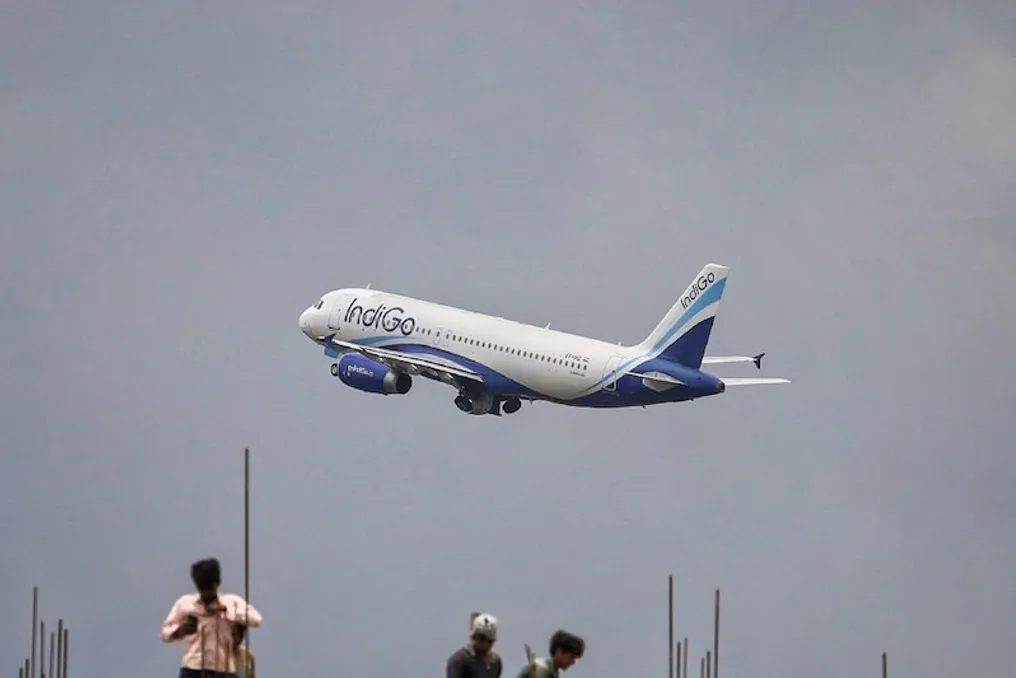
Indian airline IndiGo is negotiating with Embraer to purchase 100 regional aircraft
Read more
Business Standard
business-standard.com

Indian airline IndiGo is negotiating with Embraer to purchase 100 regional aircraft

According to information from three sources close to the situation, India's largest airline, IndiGo, is discussing the possibility of acquiring 100 regional aircraft from the Brazilian manufacturer Embraer, with a potential option for an additional 50 units. This could become one of the largest orders placed with the Brazilian manufacturer.

Sources who wished to remain anonymous emphasized that negotiations are in the early stages and the deal is not yet guaranteed. Furthermore, they noted that the aircraft model has not yet been determined, and the final order volume may change. It is anticipated that any deliveries may not begin before 2030.

This volume of discussed aircraft has come to public knowledge for the first time. No immediate responses were received from IndiGo or Embraer regarding requests for comments.

The successful sale of 100 aircraft could cost billions of dollars at base prices, although such deals often include discounts. Previously, Embraer promoted its regional aircraft among Indian airlines and concluded a non-binding agreement with Adani Defence & Aerospace this year to study the possibility of establishing an final assembly line for older E175-E1 models, which carry up to 88 passengers, in India.

The company also produces larger models, the E190-E2 and E195-E2, equipped with more modern and fuel-efficient engines capable of carrying 114 to 146 passengers, respectively.

Advantage for Embraer

A successful deal would be a significant success for Embraer in the world's third-largest domestic aviation market, where airlines are expanding their fleets to capitalize on long-term air travel demand.

Currently, Star Air, a small regional airline, is the only Indian company operating Embraer aircraft. In March, Embraer CEO Francisco Gomes Neto told Reuters that the plan to establish an assembly line in India depends on orders of at least 200 aircraft, and that aircraft assembled in India could be delivered starting in 2028 if orders are placed by the end of the current year.

The order from Embraer would allow IndiGo to increase routes to regional areas and replace some of its turboprop ATRs, which would enable it to offer more seats on existing routes.

IndiGo CEO Willie Walsh, who took over in August, stated that IndiGo will expand long-haul flights without sacrificing its low-cost short-haul business. The company plans to grow its fleet to approximately 600 aircraft by 2030, up from 442 in September. The core of the fleet consists of narrow-body Airbus aircraft, but the fleet also includes 44 turboprop ATRs.
Similar stories

What are the maximum fares airlines can set in India?
Read more
www.aajtak.in

What are the maximum fares airlines can set in India?

In India, airlines do not have a fixed, permanent upper limit on fares for normal operations. Instead, ticket prices are determined dynamically based on the carrier's operating costs, demand, seat availability, and market conditions.

Airlines typically set prices based on demand, seat availability, booking time, and various fare classes. There is no rule that fixes the maximum price for an airline ticket. However, in special or emergency circumstances, the government may intervene in airline pricing.

While answering a question posed in Parliament, the Minister of State for Civil Aviation detailed this issue in February of this year. According to his explanation, airfares are not subject to government regulation. Airlines have the right to determine their own airfares based on their operational needs, while complying with Rule 135 of the Aircraft Act of 1937.

Airfares constantly change under the influence of economic factors such as supply and demand. Current seat availability, fuel costs, aircraft capacity, seasonal changes, and other related factors significantly affect ticket prices. Furthermore, the government generally does not control airfares to maintain market competition.

Nevertheless, the government monitors the situation and intervenes in exceptional circumstances, such as a pandemic, the Mahakumbh, or an attack in Pahalgam, to make air travel affordable for passengers. For instance, at the beginning of December 2025, considering serious flight disruptions and a sharp rise in fares by one domestic airline, the government issued a notification on December 6, 2025, temporarily limiting the maximum fare charged by domestic airlines depending on the distance.

Additionally, to ensure transparency in airfares, the DGCA has created a 'Tariff Monitoring Unit' (TMU). This unit conducts monthly spot checks of airfares on 78 specified routes through airline websites. The goal is to ensure that airlines do not charge more than the limit they have declared.

As stipulated in sub-clause (2) of Rule 135 of the Aircraft Act of 1937. When the government set an emergency limit on domestic airfares in December 2025, it was specified that the one-way fare for a route up to 500 km should not exceed 7500 rupees. For routes between 1000 and 1500 km, such as Delhi-Mumbai, the maximum fare was set at 15,000 rupees.

The government has now announced the introduction of the Indian Aviation Regulations 2026, which will come into force on January 1, 2027. Under the new rules, there is also no maximum limit on airfares on normal days. Airlines will determine fares taking into account operating costs and other relevant factors and must provide this information to the DGCA. The DGCA will oversee these fares. However, in exceptional circumstances, based on public interest, the central government may intervene in pricing.

The new rules also require that all information, such as fare, taxes, fees, and cancellation charges, be stated separately during ticket booking.

Experts discuss the prospects of eVTOL flying cars by 2026 and obstacles to their mass adoption
Read more
olhardigital.com.br

Experts discuss the prospects of eVTOL flying cars by 2026 and obstacles to their mass adoption

Despite expectations that flying cars will appear by 2026, the most advanced projects are currently only prototypes undergoing testing. However, the fact that eVTOL (Electric Vertical Take-Off and Landing — electric vertical take-off and landing vehicle) is moving out of the concept stage is not in doubt.

Fernando Martini Catalano, Professor at the Department of Aerospace Engineering and Director of the School of Engineering San Carlos (EESC-USP), confirmed that this will happen. He explained how these aircraft work and what barriers prevent them from beginning full operation.

Fernando Castro Pinto, a lecturer at the Department of Mechanical Engineering of the Polytechnic School UFRJ, also participated in the discussion. Two companies dominate the sector: Joby Aviation from the USA and Eve Air Mobility, a division of the Brazilian company Embraer.

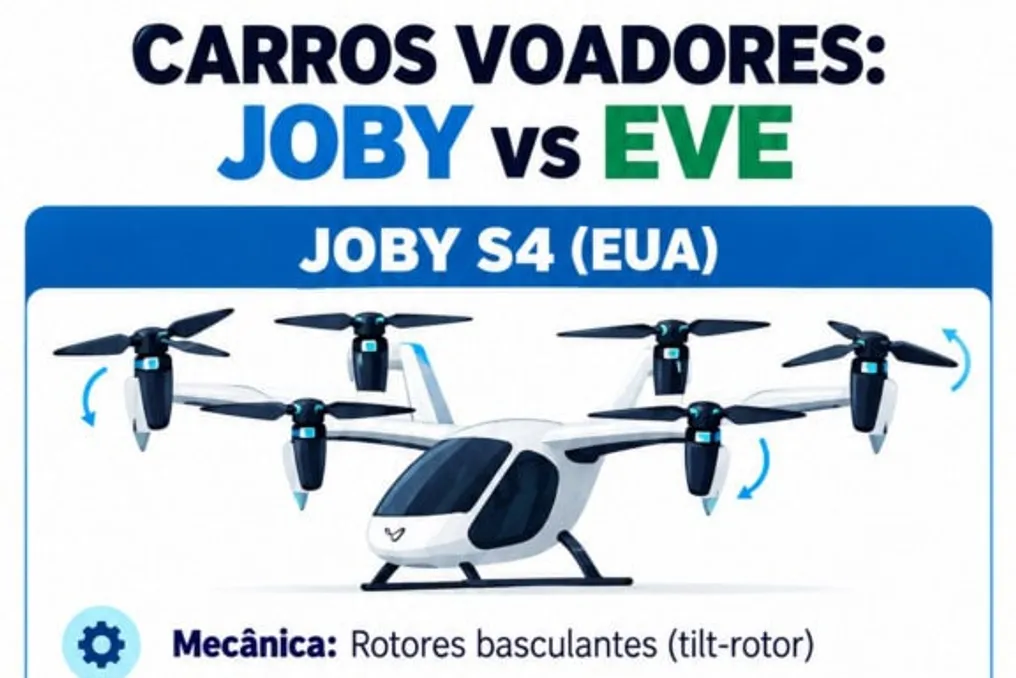
Currently, there is a race between companies to meet the requirements of aviation authorities such as Anac (National Civil Aviation Authority) and the FAA (the equivalent of Anac in the USA). Joby is focusing on conquering the American and Middle Eastern markets using the Joby S4 model, capable of carrying one pilot and four passengers with a tilt-rotor propulsion system. Eve, meanwhile, is betting on the simplicity of its mechanical design and the experience of global certification gained from Embraer.

Joby has partnered with Toyota to ensure large-scale automotive production. Demonstrative and experimental flights of the Joby S4 with passengers are expected to begin in the USA in late 2026 – early 2027. Simultaneously, commercial transport by this American company is expected to start in Dubai, United Arab Emirates.

Eve's eVTOL, codenamed Eve 100, is also designed for one pilot and four passengers. Its technical advantage lies in the 'lift + cruise' design, which uses separate rotors for vertical takeoff and a rear propeller for horizontal flight, providing simpler mechanics and lower maintenance costs compared to the Joby project.

Like Joby, the Eve project is in the testing and certification phase. Although mass production has not yet begun, the factory in Taubaté (São Paulo state), designed by Embraer, is capable of assembling up to 480 aircraft annually. Embraer and Eve management predicts final certification and the start of commercial operation by the end of 2027 or during 2028.

Morgan Stanley estimates the global eVTOL and Urban Air Mobility (UAM) market at $1 trillion (5 trillion Brazilian reais) by 2040, including passenger transport, cargo delivery, and necessary digital and physical infrastructure (vertiports). However, the bank recently lowered its 2030 forecasts by 75%, bringing them down to $12 billion (60 billion reais), because regulatory barriers proved higher than anticipated.

Technical and safety issues are the main obstacle. Fernando Castro Pinto notes that the main technological challenge is similar to the battery problem in electric vehicles: the more energy required, the larger the battery, the heavier the aircraft, and the more energy is needed. Fernando Martini Catalano adds that the weight of batteries remains too high relative to the energy they provide.

Furthermore, Fernando Pinto pointed out other obstacles to implementation in Brazil: the need to obtain a driver's license and comply with traffic rules. He emphasized that an accident at 30 meters altitude would have much more serious consequences than on the ground.

Consolidating eVTOL fleets will require not only a high level of qualification exceeding standard driving licenses but also harmonious coexistence with civil aviation and helicopters, adhering to routes and airport restrictions. The pilot must possess commercial class pilot skills, understanding all limitations related to routes, radio communication, and attentiveness.

When will flying cars become a reality? Catalano believes it will take seven to ten years, noting that the aircraft itself is only part of the problem; the entire ecosystem, including vertiports, charging logistics, noise reduction, and urban legislation, is necessary. Fernando Pinto, on the other hand, predicts decades for mass transport, as infrastructural bottlenecks such as the capacity of the urban power grid, as well as the evolution of battery technologies and the creation of a legal framework, must be resolved.

Catalano suggests considering medical emergency transport, organ transport, and cargo transport as the initial entry of eVTOL into cities, as these can become faster and more accessible solutions compared to helicopters, especially since not all hospitals are equipped with helipads, and a vertiport can be a cheaper and more urgent alternative.

The main challenge, according to experts, is to make the use of flying cars relatively inexpensive so that they do not remain a luxury item but serve a real benefit to the population.

FAA certifies new Boeing 737 MAX 10 after three-year delay
Read more
noticiasaominuto.com

FAA certifies new Boeing 737 MAX 10 after three-year delay

The United States civil aviation regulatory agency, the FAA, has granted approval for the 737 MAX 10, the largest model manufactured by Boeing intended for passenger transport, concluding a three-year waiting period.

This certificate, released on Tuesday, allows the American company to begin supplying the aircraft, which was introduced almost a decade ago, to airlines both in the US and internationally.

During a visit to a Boeing facility in Everett, near Seattle, the Secretary of Transportation commented on the long process, stating that it was remarkable to have taken almost ten years to reach this point.

Sean Duffy stated on Tuesday that the certification was achieved after extensive safety checks, which included thousands of hours of flight testing, qualifying the achievement as a major accomplishment for the North American aeronautical industry.

For airlines, the 737 MAX 10, being larger, offers the possibility of accommodating more passengers per flight, which can result in a decrease in cost per seat.

Passengers may benefit in the future from greater availability of seats on popular routes, although the effect on fares depends on the airlines' strategy and the degree of competition faced.

Stephanie Pope, CEO of Boeing, expressed during Duffy's visit that this certification 'opens the way for the delivery of an aircraft that will set a new standard in commercial aviation.'

According to Boeing itself, the 737 MAX 10 will have a capacity for between 185 and 210 passengers in a standard configuration, surpassing the 175 to 195 of the Max 9 and the 160 to 180 of the Max 8.

Pope emphasized that the day was 'very, very special,' as it crowned years of effort and dedication from many people, and represented another important milestone in the company's recovery, opening doors for its future growth. Boeing forecasts that deliveries will begin in 2027.

The 737 MAX 10 was presented at the Paris Air Show in 2017, aiming to help Boeing compete against its rival Airbus. However, technical and regulatory hurdles repeatedly postponed the obtaining of certification.

Currently, more than 30 customers globally have ordered 1,555 units of the 737 MAX 10 that have not yet been delivered, which corresponds to over 30% of the total orders for the 737 MAX family.

This family, which is Boeing's best seller, with approximately 4,400 orders, totaling about 6,800 across all its commercial models, is also the one that has generated the most problems since its debut in August 2011.

The most serious incident occurred during the Lion Air accidents in October 2018 and Ethiopian Airlines in March 2019, resulting in a total of 346 deaths. A design flaw in the MCAS anti-stall software present in the two 737 MAX 8s delivered months earlier was the determining factor.

Consequently, the entire global fleet of the 737 MAX remained grounded for a minimum period of 20 months.

Popular