Yamaha utilized the Milan fair (EICMA), held in Italy in early November, to showcase the development direction of its European lineup in the coming years. Among the new offerings are a mid-sized trail bike, a family of crossovers with automatic transmission, and two electric scooters.
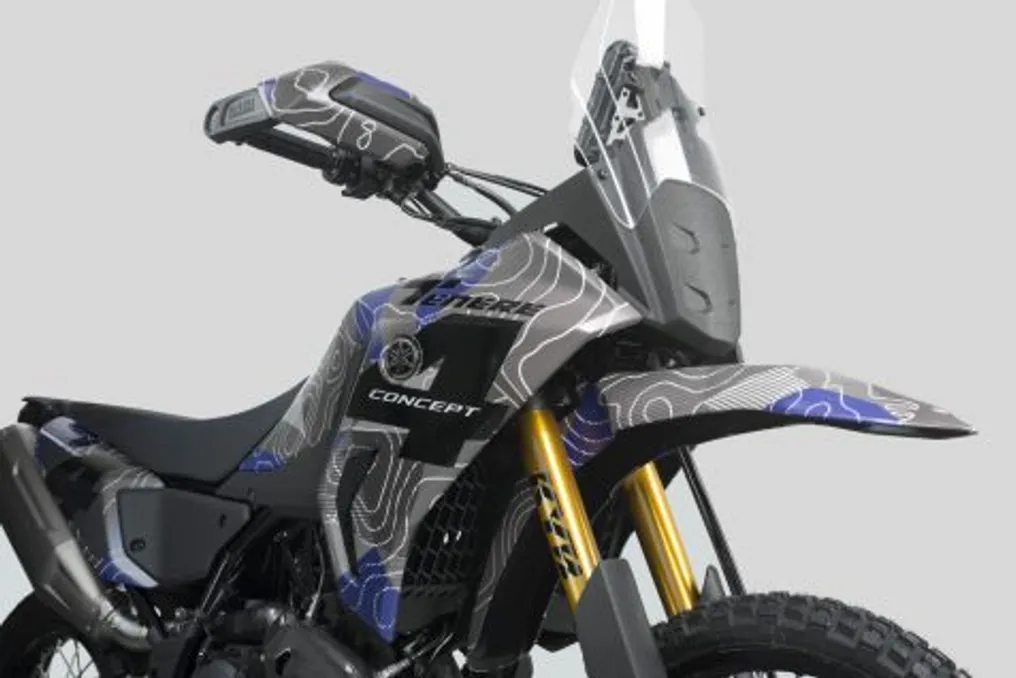
The presentation was conducted by Olivier Prevoost, President and CEO of Yamaha Motor Europe. Particular attention was drawn to the Ténéré 4 concept, which was presented at an event preceding the Fair. This study of a mid-sized adventure motorcycle equipped with a new single-cylinder engine that, according to the manufacturer, provides torque at low and mid-revs, as well as a new chassis designed for strength without increasing weight.
Yamaha has not disclosed the power, weight, or production timelines for this model; it is currently only a concept, although the brand positions it as a development project to expand the Ténéré family, whose roots trace back to the XT500, which won the first Paris-Dakar in 1979, and the XT600 Ténéré of 1982.
The new RW line includes the RW700, RW700 Explore, and RW350 models. Yamaha defines them as a hybrid between a motorcycle and a scooter and states that they open a new segment of crossovers with an automatic gearbox—a definition the company itself did not detail. The RW700 uses a two-cylinder CP2 engine, already known from other brand models, and features a steel tube frame. The Explore version retains the same base but is supplemented with touring elements: front preload suspension with adjustable damping, heated grips and seat, a center stand, illuminated controls, and exclusive colors.
The RW350 is equipped with a new 330cc engine, despite its model name. It is integrated with the Yamaha Dynamic Ride system, the functions of which the manufacturer did not explain. The brand's European pages list these three models as the 2027 lineup, with no pricing information available.
Among the electric models, the Xenter E represents a solution for urban mobility. It features 16-inch wheels, suspension adapted for uneven asphalt, a vertical riding position, and a flat floor, as well as under-seat storage for a full-face helmet, depending on size and shape. The model is equipped with a TFT display with navigation, ABS, traction control, keyless start, built-in charger, and reverse gear function for maneuvering. The claimed range is up to 108 km on the WMTC cycle—a laboratory standard that varies depending on usage. Yamaha did not disclose the battery capacity, power, or charging time. In Milan, the company also showed a combustion engine concept derived from it, simply named Xenter.
The NMax E is the electric version of the more famous sport scooter from the MAX line. It uses an eAxle powertrain with belt drive and, according to Yamaha, delivers performance equivalent to a 125cc gasoline model. The equipment specification repeats the brand's urban package: connected TFT display, riding modes, built-in charging port, illuminated under-seat storage, traction control, and ABS. As with the Xenter E, the manufacturer did not disclose the range, battery capacity, or charging time—data that determines the practical utility of the electric scooter in daily life.
There is no information in the official statement regarding the sale of these models in Brazil; all were presented for the European market. In Brazil, Yamaha's electrification is currently carried out through light hybrids Fluo ABS Hybrid Connected and ZR Hybrid Connected, as well as via Torqeedo's suspended electric motors.