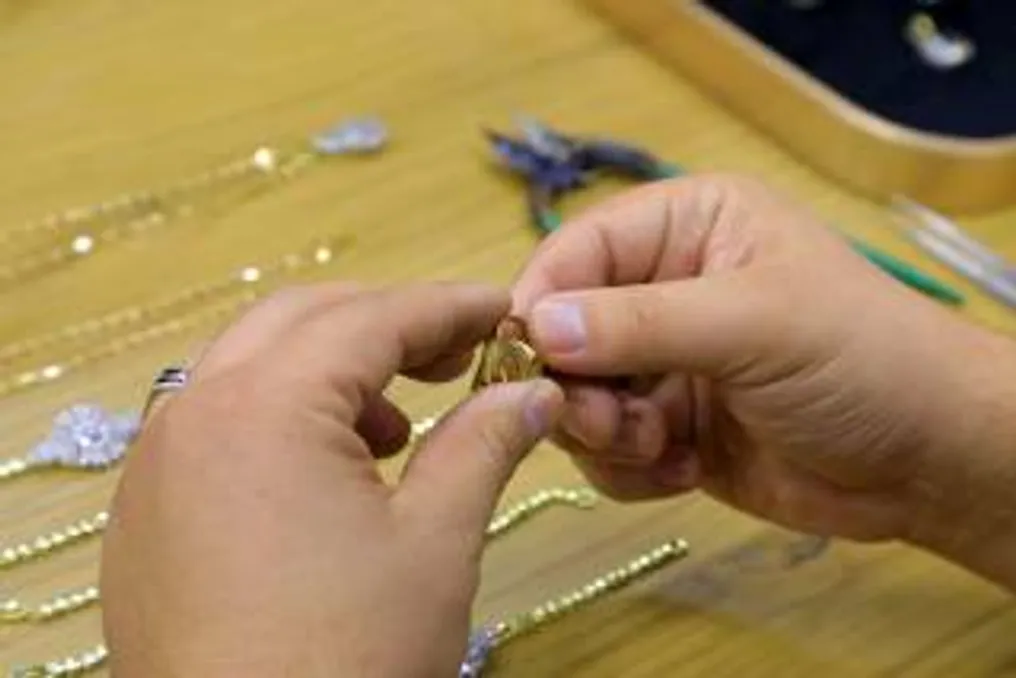
If you are planning to purchase gold for holidays such as Dhanteras and Diwali, you should not make a decision based solely on the design of the jewelry and its price. It is crucial to know the purity level of the gold being purchased, as there is a possibility of impurities or a high content of other metals in jewelry on the market. Therefore, before buying, it is strongly recommended to check for a hallmark and a HUID code.
The most reliable way to determine the true purity of gold is through laboratory testing or by contacting an accredited center. Nevertheless, there are simple home methods that can give a preliminary indication of possible problems with the jewelry. It should be remembered that these methods do not provide final confirmation of gold purity. Below are five ways to identify gold and expert testing methods.
When purchasing gold, it must have the Indian Bureau of Standards (BIS) hallmark. Jewelry with a hallmark usually has three important signs. The HUID (Hallmark Unique Identification) code ensures the unique identification of each hallmarked piece. A customer can enter this code via the BIS Care mobile application to verify the information about the jewelry and the declared purity. This helps ensure the authenticity of the information stated on the hallmark.
If you already own a piece of jewelry and doubt its purity, it can be checked at an accredited BIS valuation and hallmarking center. According to available information, the cost of such a check is 236 rupees, but the current fee must be confirmed at the center itself.
Gold is not attracted to magnets. To check this, you can bring a strong magnet near the jewelry and see if it is attracted. If the jewelry sticks quickly to the magnet, it may indicate the presence of ferromagnetic metals, such as iron or nickel. However, this test has limitations: many other metals are also not attracted to magnets. Consequently, if the jewelry is not attracted, it does not guarantee that it is pure gold.
The density of gold is higher than that of many common metals. Because of this, a gold ingot piece sinks in water. To perform the test, fill a clear glass with water and carefully lower the jewelry. If the jewelry floats, it may indicate that it is hollow or made of another material. However, this test also does not determine the purity of gold, as the result may depend on the composition of impurities and the construction of the jewelry.
Regular vinegar usually does not have a significant effect on gold. In this method, a few drops of vinegar are applied to the jewelry, and any color change is observed. If the color changes, it may indicate a reaction with another reactive metal or a coating. However, this method is not considered reliable. It is also possible that no immediate changes will occur on jewelry with a gold plating. Furthermore, vinegar or other household chemicals can damage the polish, stones, or other surface of the jewelry, so experimenting with precious items this way is not recommended.
In this method, the jewelry is lightly rubbed against a matte ceramic surface. It is claimed that real gold leaves a golden trace on the surface, whereas some other metals may leave a dark or gray trace. However, this test can scratch the jewelry, which will degrade its polish and appearance. Therefore, it should not be used on expensive jewelry, especially that inlaid with stones or diamonds.
It is important to remember: home tests, such as using a magnet, water, vinegar, and ceramics, are not conclusive proof of gold purity; they can only give an initial hint of possible counterfeiting.
Home methods only provide preliminary information. For accurate determination of the pure metal content, jewelers and accredited centers use specialized equipment and scientific methodologies.
X-ray Fluorescence (XRF) Test: In this check, the amount of gold and other metals in the composition is determined using X-rays. There is no need to melt the jewelry. However, this check mainly shows the surface structure, and differences in the internal metal can always remain unnoticed.
Acid and Touchstone Test: In this method, the jewelry is rubbed against a special stone, and then various types of acids are applied to the scratch line. The karat of the gold is presumed based on the reaction with the acid.
Fire Assay Test: This method is considered a very accurate way to determine the amount of gold. It involves processing a small sample of the jewelry, separating other metals, and then weighing the remaining gold. Although this test is accurate, it results in the destruction of the jewelry sample.
Gold purity is measured in karats. The higher the karat, the more pure metal is contained in the gold. Products of different karats are available on the market to meet various needs. 24-karat gold has a purity of 99.9% (999). Gold coins and ingots are often made from 22-karat gold, whose purity is 91.6% (916). Traditional jewelry is often made from 18-karat gold, whose purity is...