Baidu introduced the Apollo World model for training self-driving taxis in simulated environments
Read more
TechNode
technode.com

Baidu introduced the Apollo World model for training self-driving taxis in simulated environments

Baidu introduced the Apollo World model on November 3rd. This global model is designed to simulate interactive road conditions for the purpose of training and testing autonomous vehicles.

It is reported that this system is already being used to support the global development of the Apollo Go robotaxi and is capable of generating up to 100,000 kilometers of simulated driving daily.

Apollo World generates data from cameras and lidars in real time. Furthermore, virtual pedestrians and vehicles react to the actions of the autonomous car. This functionality allows transport control systems to practice full trips under changing traffic conditions and repeatedly test complex scenarios.

The release of this model comes amid the efforts of robotaxi developers to reduce costs and shorten the time required to adapt their technologies to new markets.

Similar stories

InSpatio Opens Simulation-Based Robot Data Center in Hangzhou to Process Millions of Hours Monthly
Read more
pandaily.com

InSpatio Opens Simulation-Based Robot Data Center in Hangzhou to Process Millions of Hours Monthly

InSpatio, a startup founded in 2025 by SenseTime and specializing in spatial intelligence models, opened what it calls the first simulation-based embodied AI data collection center in China in Hangzhou on October 29. This center is aimed at producing one million hours of data monthly, which equates to approximately 100,000 hours per day.

According to InSpatio, robots lack not only data volume but also diversity. For instance, a robot can reliably grasp an object on a fixed shelf, but its efficiency decreases if the shelf rotates, the target object is obscured by another row of drinks, or the robot has to reach from another side.

Data from the Chinese Academy of Information and Communications Technology indicates that over 70 robot training arenas were operational in China by the end of June, with plans for another 40. However, many of these focus on simple tasks such as folding clothes and cleaning tables. Any change in layout requires rebooking the venue and operators, leading to increased costs.

InSpatio's approach changes the calculation formula from 'people multiplied by hours' to 'environment configurations multiplied by parallel computing.' The system starts with a small number of demonstrations performed by real robots or via teleoperation, and then combines motion planning, policy runs, and automated physics checks to generate closed trajectories in hundreds of parallel environments. These trajectories are accompanied by synchronized RGB, depth, segmentation, 6D pose, and action labels.

Scene assets are sourced from two channels. One channel utilizes a partnership with Hesai's Kosmo 3D world engine, which reportedly can scan a 100 square meter room in about 15 minutes with millimeter-level 3DGS reconstruction. InSpatio then segments this static scan into individual objects with defined physical properties. The second channel uses InSpatio's proprietary world simulator, Topos Pro, which converts single images, multiple images, video, LiDAR data, or aerial photography into object-level scenes where the table, chair, and equipment properties, including collision properties, can be selected, replaced, and assigned.

Scene processing involves separating target objects into individual instances, filling in hidden geometry and restoring the background, as well as calibrating mass, center of mass, and friction for each task. The company also defines three levels of service: L1 for navigation, L2 for dexterous grasping with millimeter-level geometry and dense occlusion, and L3 for contact and articulated dynamics, such as opening drawers. It is claimed that the advantage of simulation increases at higher levels, although final policies are still verified on real robots.


Baidu develops global model to expand ambitions in autonomous driving
Read more
technode.com

Baidu develops global model to expand ambitions in autonomous driving

According to a report by STAR Market Daily on October 28, Baidu is developing a so-called global model and plans to share the results of its research soon.

Global models are capable of learning representations of physical environments and predicting changes within them, making them a potential foundation for systems that must operate in the real world.

The report noted that autonomous driving is one of the possible applications of this technology. Predicting the behavior of surrounding vehicles, pedestrians, and road surface conditions can significantly improve decision-making and route planning processes.

Baidu's Apollo Go robotaxi business has expanded to 28 cities worldwide, accumulating a significant volume of real-world driving data. However, the specific areas of application for this model and its connection to Apollo Go have not yet been disclosed.

Alibaba's Amap Model Introduces Humanoid System Learning Full-Body Tasks from Human Movements
Read more
technode.com

Alibaba's Amap Model Introduces Humanoid System Learning Full-Body Tasks from Human Movements

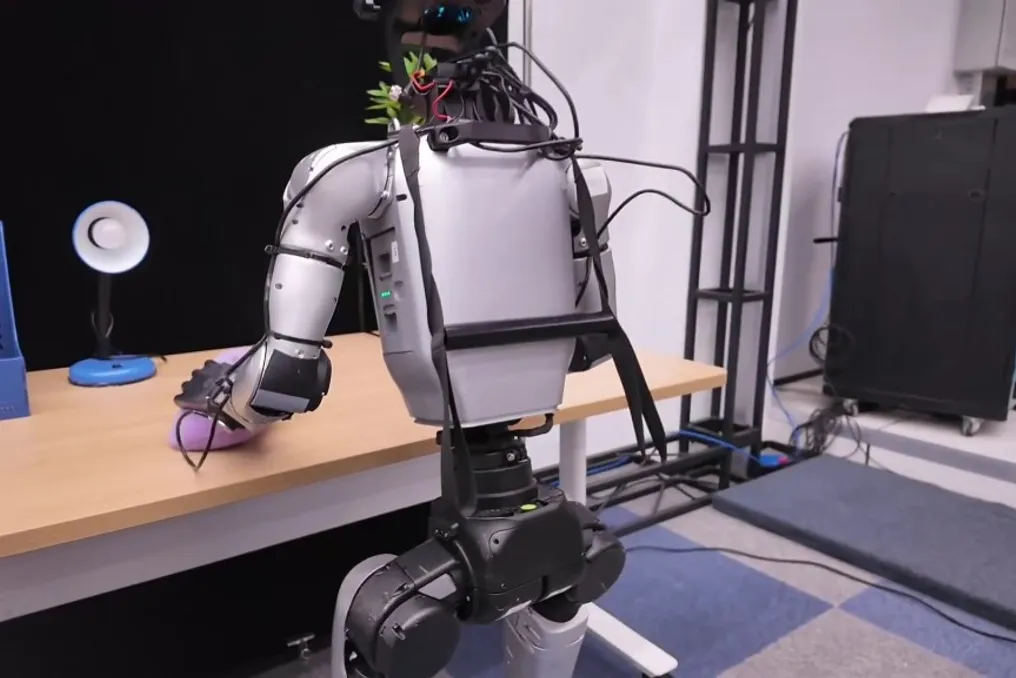
Alibaba, in collaboration with Alibaba Token Hub, has introduced the λ0 model. This foundational model is designed to train humanoid robots in coordinated movements and manipulations by utilizing demonstrations shown by humans.

The system learns from first-person video recordings that are synchronized with body and arm movements. This enables robots to perform more complex tasks, combining walking, posture correction, and two-handed operations.

Researchers created the HumanVerse dataset, which includes 500 hours of recordings of people performing various actions in real-world conditions. This approach reduces the need to collect demonstrations through robot teleoperation.

During testing, the team demonstrated that λ0 achieved 62.5% success rate in tasks related to locomotion and manipulation in the real world. The project also provided researchers with configuration code for data collection equipment and data samples.

Popular