Rosatom developed zero-waste lithium processing technology in Uzbekistan
Read more
UzDaily
uzdaily.uz

Rosatom developed zero-waste lithium processing technology in Uzbekistan

Scientists from the Russian State Corporation Rosatom have created a technology to process mica containing lithium, mined at the Nurlikon deposit in Uzbekistan, that produces no waste.

According to Rosatom's press service, this method allows for the extraction of 94.44% of the lithium into finished products, as well as the reuse of industrial waste in the production cycle.

The development belongs to specialists from JSC 'Giredmet', which is part of Rosatom's scientific division. The technology is designed for processing ore containing about 0.5% lithium oxide.

According to the developers, traditional enrichment methods cannot effectively separate the mineral from the surrounding rock due to the similarity of their properties. Furthermore, the high content of carbonates in the raw material creates additional complexities in the processing process.

One of the key aspects of the new technology is the use of phosphogypsum—an industrial byproduct of the Almalyk Chemical Plant—as raw material at an intermediate stage of processing. It is expected that this will allow for the annual use of about 225,000 tons of phosphogypsum.

The planned processing capacity is 750,000 tons of ore per year. JSC 'Giredmet' reports that this will ensure the production of over 8,500 tons of high-purity lithium carbonate grade KhCh.

The technology is designed to eliminate the formation of both liquid and solid waste. Washing tailings are planned to be used as raw material for the cement industry.

Valery Golovko, head of the technical department of JSC 'Giredmet', noted: 'We deliberately chose a zero-waste model. For low-grade mica ores, this is not just an environmental requirement but an economic necessity. Phosphogypsum, which is currently an industrial waste, is turned into a reagent, and washing tailings become raw material for the cement industry. As a result, we obtain high-purity lithium carbonate.'

Golovko also reported that pilot-industrial tests are planned for next year to prepare the technology for full-scale implementation.
Similar stories

Uzbekistan plans to process 3.6 million tons of waste through energy projects
Read more
uzdaily.uz

Uzbekistan plans to process 3.6 million tons of waste through energy projects

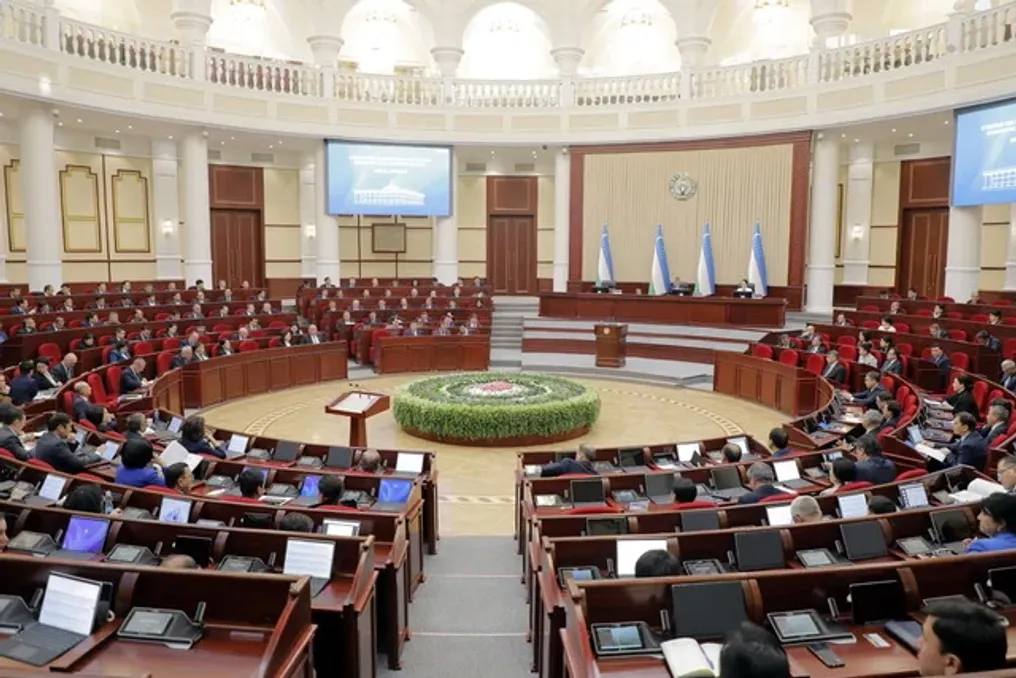
The legislative chamber of the Oliy Majlis of Uzbekistan reviewed the response from Sharifbek Hasanov, Director of the Waste Management Agency and Circular Economy Development, to a parliamentary inquiry regarding measures to improve waste management, develop the circular economy, and enhance the efficiency of related service payments.

According to the information provided, between 2019 and 2025, 54 municipal solid waste landfills were restored in Uzbekistan, returning 262.8 hectares of land to nature. Currently, sanitary services cover 8042 out of 8992 mahallas, or local communities in the country.

To strengthen the technical capacity of sanitation companies, the number of specialized vehicles has been increased; a total of 4606 such vehicles are currently operating across the country. Additionally, 4376 waste collection points have been equipped, and 39401 containers have been installed. These measures have enabled the servicing of an additional 600,000 residents.

Another area of focus is the production of electricity from waste. Six large projects with a total value of 933 million US dollars are being implemented in the country, of which $461.3 million has already been invested. It is planned that after commissioning, scheduled for the first half of 2027, these facilities will process 3.6 million tons of waste annually through thermal treatment and generate 1.6 billion kWh of electricity.

These projects are also expected to save 400 million cubic meters of natural gas annually, reduce greenhouse gas emissions by 800,000 tons, and create 1,000 permanent jobs. To improve waste management, geographical data has been collected for 9061 local self-government bodies, 75569 streets, 227 landfills, and 3548 waste collection points. 3918 specialized waste collection vehicles are connected to a GPS monitoring system, and surveillance cameras have been installed at 1483 sites.

The response to the parliamentary inquiry also noted that since November 2025, subscribers with unpaid waste collection bills receive SMS notifications from the number 2100, managed by the Regional Electric Network of JSC. Nevertheless, legislators pointed out persistent problems, emphasizing the need to prevent the charging of debts for sanitary services that were not actually provided, correct technical errors in SMS notifications, and strengthen supervision in this area.

Deputies also called on the agency to intensify efforts to improve the quality of sanitary services, expand waste sorting and recycling, and develop the circular economy. Priorities include the production of energy resources, raw materials, and materials from secondary resources. After reviewing the matter, the legislators stressed the importance of continuing parliamentary oversight to ensure compliance with environmental requirements, protect public health, and improve sanitary conditions throughout the country. The response from the Director of the Waste Management Agency and Circular Economy Development was taken into account.

Rosatom sees potential for up to 40% localization in the nuclear power plant project in Uzbekistan
Read more
uzdaily.uz

Rosatom sees potential for up to 40% localization in the nuclear power plant project in Uzbekistan

Rosatom has identified the possibility of localizing up to 40% of competencies within the construction project for the nuclear power plant in the Jizzakh region of Uzbekistan. According to the head of the state corporation, such localization will benefit both the economy of the project itself and the long-term development of the workforce.

Alexey Likhachev, CEO of Rosatom, told journalists in Tashkent on October 23 that the company strongly supports this idea of localization. He noted that the more work performed by local contractors, the more effective the economic model becomes.

Likhachev characterized the project as technically exceptional. Two two-gigawatt VVER-1000 power units and two small modular reactors based on the RITM-200 reactor, each with a capacity of 55 MW, are being built at one site.

In the opinion of the head of Rosatom, the simultaneous construction of two gigawatt units and two low-power reactors on a single site is unprecedented globally and holds significant economic value. He emphasized that there are no comparable projects combining such large capacity with flexible small reactors on a single site, and such schemes are not planned in other countries.

Likhachev also described the uniqueness of the project's financial model, which involves international financial institutions in addition to the customer and technology supplier. Furthermore, he noted the strong emphasis by Uzbek authorities on the social component of the project.

The head of Rosatom suggested that Uzbekistan might want to build not only four reactors, stating that 'there will be further progress' and expressing readiness to actively participate in the development.

Likhachev acknowledged the customer's right to independently choose partners but assured that Rosatom is not afraid of competition and will continue to offer its products. He added that serial production increases quality and competitiveness while simultaneously reducing electricity generation costs.

Speaking at the 'Central Asia – Atom 2050' event at the Tashkent branch of the MEPhI National Research Nuclear University, dedicated to dialogue with youth, Likhachev promised that the most advanced technologies of the corporation would be used at the station. He stressed that specialists remain the key driving force in the development of the nuclear industry, and that professionals must not only gain education and skills but also share a common vision and understand the future of nuclear technologies. Likhachev compared working at nuclear facilities to public service aimed at ensuring energy security and technological sovereignty.

The day before, the head of Rosatom visited the construction site and noted that it was already possible to see the area transforming from open land into an active construction site. The main work is currently focused on building the first low-power unit. Full-scale construction of the gigawatt units is planned to begin in 2027. After reaching design capacity, the station should generate 17.2 billion kWh of electricity annually.

On the same day, the President of Uzbekistan, Shavkat Mirziyoyev, met with Likhachev. They discussed the progress of the NPP implementation, personnel training issues, and plans to create a settlement for nuclear industry workers near the facility.

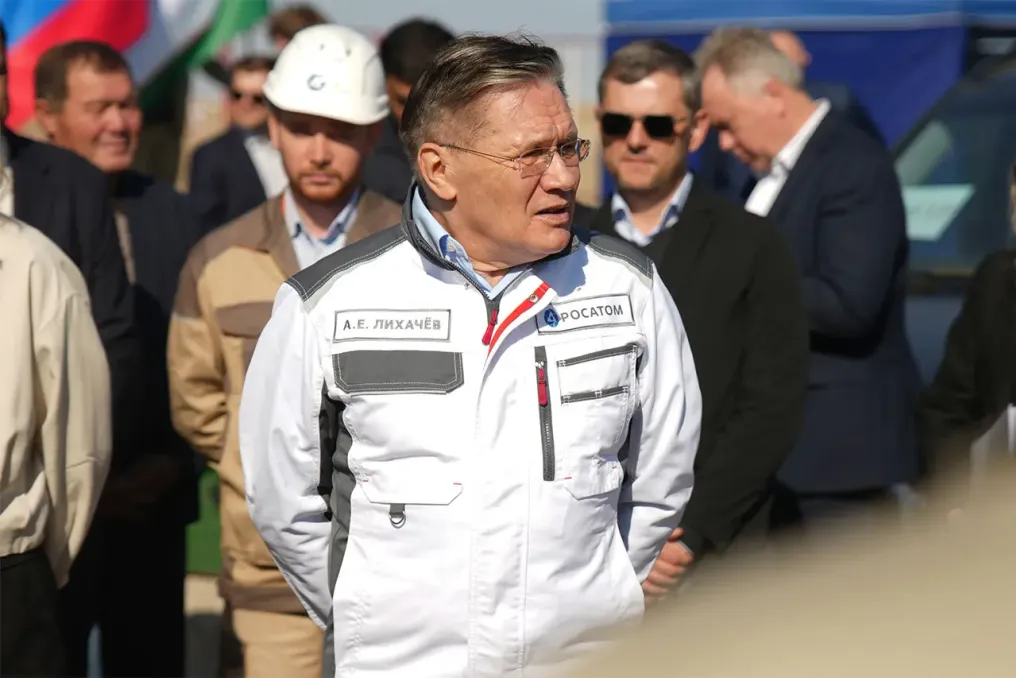
Rosatom Head Visits Nuclear Power Plant Construction Site in Uzbekistan
Read more
uzdaily.uz

Rosatom Head Visits Nuclear Power Plant Construction Site in Uzbekistan

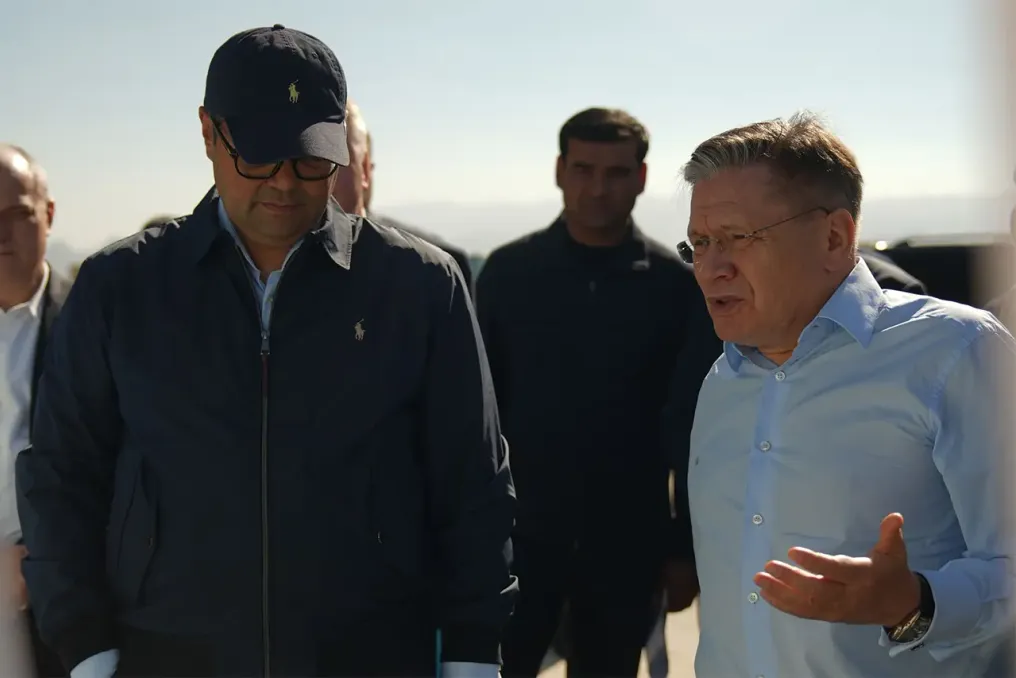
Alexey Likhachev, CEO of Rosatom, visited the construction site of a complex nuclear power plant in the Jizzakh region of Uzbekistan. The Russian state corporation reported that work is underway on the first small-scale power unit.

The pouring of concrete for the foundation slab began on June 4, 2026. The site features 25 units of equipment, and work continues on the base of the reactor building. Completion of the foundation for the first power unit is scheduled for the end of this year, requiring 10,000 cubic meters of concrete.

Likhachev characterized the start of work as a crucial stage of a project significant for the energy sector and economy of Uzbekistan, as well as for cooperation between Russia and Uzbekistan. He noted that the project includes not only the construction of the NPP but also the creation of an atomized city and a modern scientific and industrial cluster.

Construction is also underway for a future settlement for nuclear industry workers in this region. This city is designed to accommodate over 30,000 specialists and their families. The industrial cluster is planned to be located approximately 25 kilometers from the NPP territory.

The complex station will consist of two large-capacity power units, each with a capacity of 1000 MW, and two small-capacity units of 55 MW each. After reaching its design capacity, the station should generate 17.2 billion kWh of electricity annually.

The implementation of this project is carried out within the framework of agreements between Russia and Uzbekistan. In May 2024, both countries signed documents expanding intergovernmental cooperation to include the construction of a small-scale NPP. In September 2025, Rosatom and Uztom, Uzbekistan's atomic energy agency under the Cabinet of Ministers, signed documents on further expansion of cooperation. An additional agreement concerning the construction of the complex NPP was signed in March 2026.

The ceremony marking the start of construction of the first power unit took place on June 4, 2026, in the Ferishinsky district of the Jizzakh region. The event was held via video link between the construction site in Uzbekistan and St. Petersburg. The construction was sanctioned by President of Russia Vladimir Putin and President of Uzbekistan Shavkat Mirziyoyev.

This project will combine power units of different capacities on one site, which will be Rosatom's first export project of this type.

Popular