
Impact of US Midterm Elections on Trump's Political Authority and Market Consequences
Read more
Business Standard
business-standard.com

Impact of US Midterm Elections on Trump's Political Authority and Market Consequences

As markets await the results of the US midterm elections, analysts note that a Democratic Party victory in the House of Representatives and Senate could significantly weaken President Donald Trump's political power, potentially turning him into a puppet president for the last two years of his term.

According to analysts, this could provoke a prolonged political confrontation in Washington, leading to consequences for global markets and potentially creating opportunities for Indian stock markets.

A Democratic triumph might force Trump to rely more frequently on his veto power and executive actions to advance his agenda, thereby increasing the risk of political and constitutional clashes.

V K Vijayakumar, Chief Investment Strategist at Geojit Investments, stated: 'This could even trigger a constitutional crisis with adverse consequences for the US market. India might benefit from this turmoil.'

Historically, in the last 80 years, the party holding the White House has only gained seats in Congress in two midterm elections. Trump experienced a significant reversal in 2018 when Republicans lost 41 seats in the House, and Democrats took control, after which investigations and impeachment began in 2019.

Other major setbacks include the loss of 54 House seats by Democrat Bill Clinton in 1994 and the loss of 63 seats by Democrat Barack Obama in 2010.

Balance of Power

According to Emkay Global, the US midterm elections could lead to Democrats taking control of the House of Representatives and Senate from Republicans, ending the Republican triumvirate and potentially turning President Donald Trump into a puppet leader for the remainder of his term.

However, the brokerage firm warns that the typical puppet presidency dynamic may not work for Trump, given his tendency to challenge political norms and extensive use of executive measures.

Madhavi Arora and Harshal Patel from Emkay Global noted in a memo dated October 30: 'The usual puppet presidency dynamic may not apply, given Trump's inclination to violate long-established norms and his extensive use of executive actions, which could only accelerate in the event of a Democratic victory.'

Impact on Stock Market

For stock markets, political uncertainty arises at a time when US stocks are showing significant momentum, yet financial conditions have tightened, and energy prices remain high. These factors, according to the brokerage house, could limit capital appreciation.

However, historical trends offer some reassurance. According to Emkay Global, the S&P 500 index has historically risen by an average of about 6 percent over 60 trading days following previous midterm elections, reaching 12 percent over 120 days and 17 percent over 180 days.

The brokerage firm also believes that a period of heightened political instability in the US could increase the relative attractiveness of other emerging markets, including India. Nevertheless, the extent of the benefit will depend on how the political confrontation affects the dollar, US Treasury yields, global risk appetite, and foreign investment inflows.

Impact on Commodities

For commodities, the impact of the elections will depend more on policy outcomes than on the political result itself. Analysts at Motilal Oswal Financial Services believe that a Republican victory could signal broader fiscal expansion, persistent uncertainty regarding tariffs, and higher inflation risks, which could potentially support US Treasury yields and the dollar, while creating short-term headwinds for gold and silver.

On the other hand, Democratic control could limit further fiscal expansion and ultimately temper expectations for economic growth, bond yields, and the dollar. Simultaneously, increased political confrontation in Washington could boost demand for safe-haven assets, potentially supporting precious metals.

Navneet Damani and Manav Modi from Motilal Oswal Financial Services wrote in a memo dated October 30: 'For crude oil, the elections matter primarily through US foreign policy, Iran, and sanctions, while copper and other base metals will remain between the US growth forecast and tariff direction.'

Geopolitical events could further complicate the outlook. Damani and Modi added that any resumption of escalation in the Middle East conflict could restore a geopolitical risk premium for crude oil, increase inflation expectations, and raise Treasury yields.

This could create a complex environment for financial markets, where geopolitical uncertainty supports demand for gold, while higher bond yields simultaneously act as a counterweight to precious metals.

Similar stories

Equitas appoints Balaji Nutalapadi as interim CEO following departure of P. N. Vasudevan
Read more
business-standard.com

Equitas appoints Balaji Nutalapadi as interim CEO following departure of P. N. Vasudevan

The Board of Directors of Equitas Small Finance Bank Ltd has approved the appointment of Balaji Nutalapadi as the bank's interim Chief Executive Officer, subject to approval from the Reserve Bank of India (RBI).

This decision was made based on the recommendation of the Nomination and Remuneration Committee. The appointment follows the departure of P. N. Vasudevan from his roles as Managing Director and Chief Executive Officer of the bank.

Vasudevan's departure was attributed to investor concerns regarding a potential conflict of interest arising from his daughter's connection with a Non-Banking Financial Company (NBFC).

As an executive, Nutalapadi has made significant contributions to the development of the bank's digital capabilities, technology modernization, and enhancement of operational efficiency.

Prior to joining Equitas Small Finance Bank, he worked for 28 years at Citi, holding positions such as Managing Director and Head of Citi Solutions centers in India, as well as Head of Operations and Technology in India.

He worked in various regions across Asia, Europe, West Asia, and Africa (EMEA), taking on roles related to asset sales, wealth management, reengineering, consumer operations, technology, and leading global centers of excellence. Furthermore, he oversaw the expansion of Citi's global hubs in India.

Nutalapadi's assumption of office will take place on the date of RBI approval or any other date set by the central bank. Equitas stated that it will ensure a smooth transition to maintain stability among stakeholders and investors.

The Board of Directors expressed gratitude to Vasudevan for his contribution and leadership during his tenure. The bank will determine Vasudevan's release date after receiving RBI approval for the interim CEO appointment and following consultations with him.

Additionally, the bank has initiated the search process for a permanent successor and will submit its recommendation to the RBI in accordance with applicable regulatory requirements. In its statement, Equitas emphasized its commitment to strategic priorities, business goals, and the mission of providing inclusive, responsible, and customer-centric banking services, as well as its intention to strengthen client relationships and create sustainable value for all stakeholders.

Peppermint Robotics raises 100 crore rupees in pre-Series B round
Read more
yourstory.com

Peppermint Robotics raises 100 crore rupees in pre-Series B round

Peppermint Robotics, a company that manufactures autonomous cleaning robots, has successfully raised 100 crore rupees (equivalent to approximately 10.5 million US dollars) in a pre-Series B round. pi Ventures, Crane Venture Partners, and Asiana Fund participated in this round.

The funds were raised amid the company's rapid growth. The startup, based in Pune and Austin, reported that its revenue doubled over the last year, and overall growth between fiscal years 2024 and 2026 reached almost six times. Previously, in April 2025, Peppermint had raised 34 crore rupees ($4 million) in a Series A round.

Peppermint has representatives in nine countries, with the US being its largest market. The company was founded in 2019 as part of the Society for Innovation and Entrepreneurship at IIT Bombay. The autonomous cleaning robots created by the company are used in various commercial and industrial environments, including hospitals, airports, shopping malls, warehouses, hotels, factories, and universities.

The company's machines are designed for floor cleaning and material transport in enterprises, engineered to integrate into existing workflows rather than disrupt them. Peppermint's main clients are facility management companies that oversee cleaning processes, including the selection of equipment, chemicals, and cleaning methods.

Peppermint stated that one of the most challenging applications for its robots is a global pharmaceutical company. There, cleanroom robots underwent qualification testing in an EU GMP class cleanroom, which is one of the most strictly regulated environments where a cleaning robot can operate.

Cleanroom robots are specialized manipulators designed to operate in controlled, contamination-free conditions. The company independently develops the hardware, software, and perception systems, while the robots are assembled in Pune. They function on the patented Peppermint OS, utilizing computer vision and LiDAR for spatial mapping, route planning, and collision avoidance. Operators can monitor the robots' performance in real-time via a cloud control panel. For high-security facilities, the company offers fully autonomous 'invisible' robots that comply with strict information security requirements.

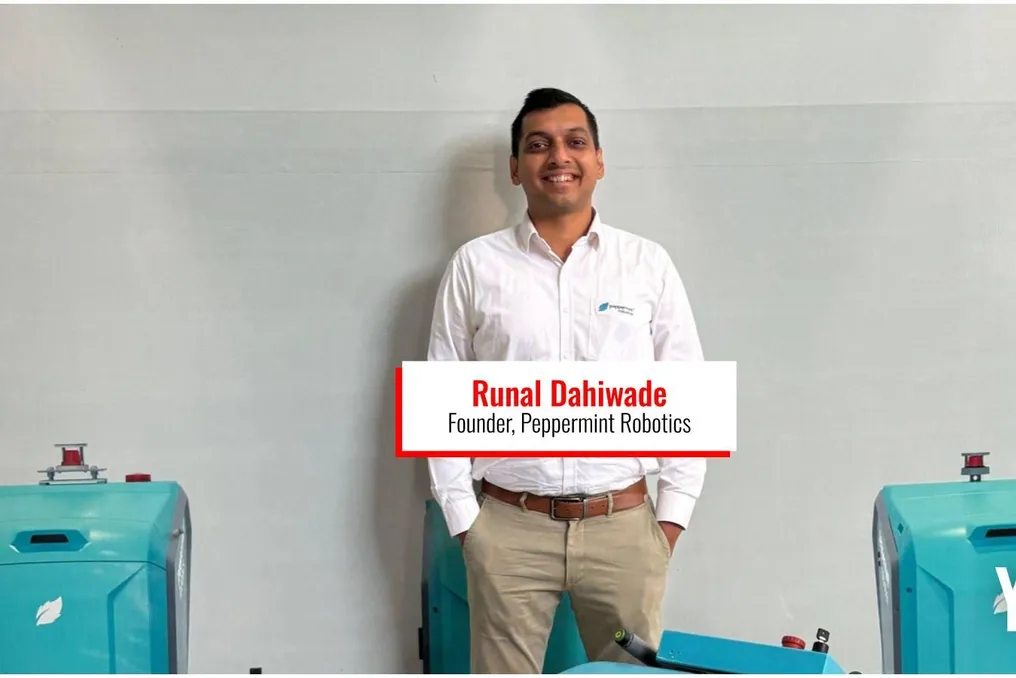
Runal Dahivade, founder and CEO of Peppermint Robotics, noted that cleaning teams ensure the functioning of hospitals, factories, and airports. He emphasized that their robots work alongside these teams, taking on the most monotonous and physically demanding tasks, such as mopping floors and transporting materials. According to Dahivade, clients evaluate the company based on one criterion—the cleanliness of the floor per shift. Therefore, the company builds durable robots designed for multi-year operation and supports each machine throughout its entire lifecycle. The capital raised will allow them to produce more robots and get closer to customers worldwide.

The new investments will be directed towards developing next-generation robotics and expanding production capacity. Furthermore, a final assembly line is planned for North America in the coming months. Peppermint also intends to strengthen its business development in the United States and Asia, increase its presence in Europe, and hire senior executives and engineers. In terms of products, the company plans to expand its range of floor cleaning and material handling robots, as well as develop its cleanroom robot line.

Investors expressed optimism about Peppermint's potential. Shubham Sandip, a partner at pi Ventures, highlighted the company's 'clear return on investment' in demanding sectors such as healthcare and hospitality. Anandamoy Roychoudhury from Crane Venture Partners stated that Peppermint has developed an industrial cleanroom robot for critical enterprises. Neha Aggarwal from Asiana Fund called the company an example of India's advanced manufacturing business capable of competing in global markets.

Popular