Canva undergoes massive restructuring, laying off over 1200 employees in response to the AI era
Read more
YourStory [india, en]
yourstory.com

Canva undergoes massive restructuring, laying off over 1200 employees in response to the AI era

Canva is undertaking a large-scale workforce restructuring affecting 1,271 employees, which accounts for 22% of its total staff, as it reorganizes its business to align with rapid technological changes. These changes include staff reductions, role modifications, and relocation requests, although the company has not yet disclosed the exact number of laid-off employees.

CEO Melanie Perkins stated that this restructuring followed the company's first growth slowdown in the last decade and reflects the need to rethink working methods and team organization. In a memo to employees published on November 4th, Perkins called this the most challenging moment in Canva's 13-year history. She noted that 'new technologies are transforming what people can create, how they do it, and what they expect from the products they use.'

The memorandum did not directly blame artificial intelligence for the staffing changes. It also cited slowing growth and a fragmented organizational structure that arose during the company's expansion. Perkins wrote: 'After studying a wide range of alternatives, I came to the difficult conclusion that small changes would not be enough. To prepare for the next decade, we need to restructure Canva by returning to our roots—small, empowered teams that have the freedom to make decisions, take responsibility, and focus on what is most important to our community.'

Canva will merge its product, growth, and platform teams into a single product organization, reduce narrow specialization, and eliminate management layers. Sydney will become the main base for more product teams. Starting in January, most hybrid employees will be required to work in the office two to three days a week, depending on their location.

Founded in Australia in 2013 by Perkins, Cliff Obrecht, and Cameron Adams, Canva has evolved into a global design platform. The company claims that its platform is used by over 250 million people monthly. Canva is now striving to move beyond template-based design. This year, Canva AI 2.0 was introduced, allowing users to create and edit multi-layered designs through dialogues with an AI assistant. In October, the company also announced new AI-powered tools and a design-focused model.

In August, Canva lowered its revenue growth forecast for 2026 from 30% to 20% because the cost of implementing AI features proved higher than expected. Competitors are also expanding their offerings. On November 3rd, Figma announced an AI feature that uses prototype interactions as context when generating code. In March, Atlassian announced layoffs of about 1,600 jobs, or 10% of its staff, partly to fund larger investments in AI. This week, the Squarespace platform announced a voluntary staff reduction of 19%, citing the need to streamline operations.

Regulation is developing parallel to technology. As of August 2nd, transparency requirements under the EU AI Act apply to certain AI systems. These include informing users about interaction with AI and ensuring machine-readable labels for AI-generated results. Canva assured that departing employees will receive at least six months' salary, 12 months of health insurance in countries where it is provided, career support, and access to $10,000 grants for those wishing to start their own business.

Similar stories

Canva announces layoffs: employees offered support, including MacBook and LinkedIn Premium
Read more
www.aajtak.in

Canva announces layoffs: employees offered support, including MacBook and LinkedIn Premium

The international design platform Canva has announced layoffs. This decision will affect about 22 percent of the company's total staff, amounting to 1,271 employees. Canva CEO Melanie Perkins called this moment the most difficult in the history of the thirteen-year-old company.

However, despite the layoffs, not all affected employees will lose their jobs; some may see changes in their responsibilities or be offered relocation to other cities. Melanie Perkins stated in a message sent to employees on November 4th that the company is making changes to its working methods, team structure, and necessary skills for the future.

According to the CEO, Canva's business growth has slowed for the first time in a decade, making this year the toughest for the company. Perkins emphasized the need for large-scale transformations in the operational structure to prepare for the next decade, as minor adjustments would not suffice.

The company aims to work with smaller, more autonomous teams to accelerate decision-making and clearly define employee responsibilities. Although the CEO's message did not directly mention the impact of artificial intelligence on layoffs, the decision comes against the backdrop of increasing use of AI tools in the design and software industry, which is changing the competitive landscape and business practices.

Canva plans to consolidate its product, growth, and platform teams under a single product organization. The goal of this step is to increase cohesion between different groups and reduce workflow delays. Furthermore, the company intends to reduce management levels and consolidate certain functions so they carry broader responsibilities.

The company wants teams to be able to run projects from start to finish independently, avoiding constant reliance on different departments for decision-making.

Canva plans to concentrate some of its product and other teams in Sydney. Employees may be asked to relocate there, and the company will assist them with the move. Starting in January, most hybrid employees will be required to come into the office two to three days a week. The company notes that while working in different countries has its advantages, collaborative teamwork is essential for solving complex problems.

For those leaving the company, Canva has announced a support package. Departing employees will receive at least six months' pay, in addition to all legally mandated payments. Additionally, they will be offered career counseling, interview preparation, and access to LinkedIn Premium for one year.

It was also announced that employees whose positions are being eliminated can keep their corporate MacBook laptops. Moreover, some employees will be offered the opportunity to apply for a $10,000 grant to launch a new business or public project. This decision by Canva demonstrates the company's commitment to a complete reorganization, even though it means 1,271 employees must now seek a new career path.

Layoff Methods: From Voluntary Departure to Performance Review
Read more
www.aajtak.in

Layoff Methods: From Voluntary Departure to Performance Review

Uncertainty in the workplace remains unnoticed by an employee until the company notifies them via message or email. Receiving a termination letter immediately upon waking up raises serious career concerns. However, companies are developing increasingly new methods of downsizing.

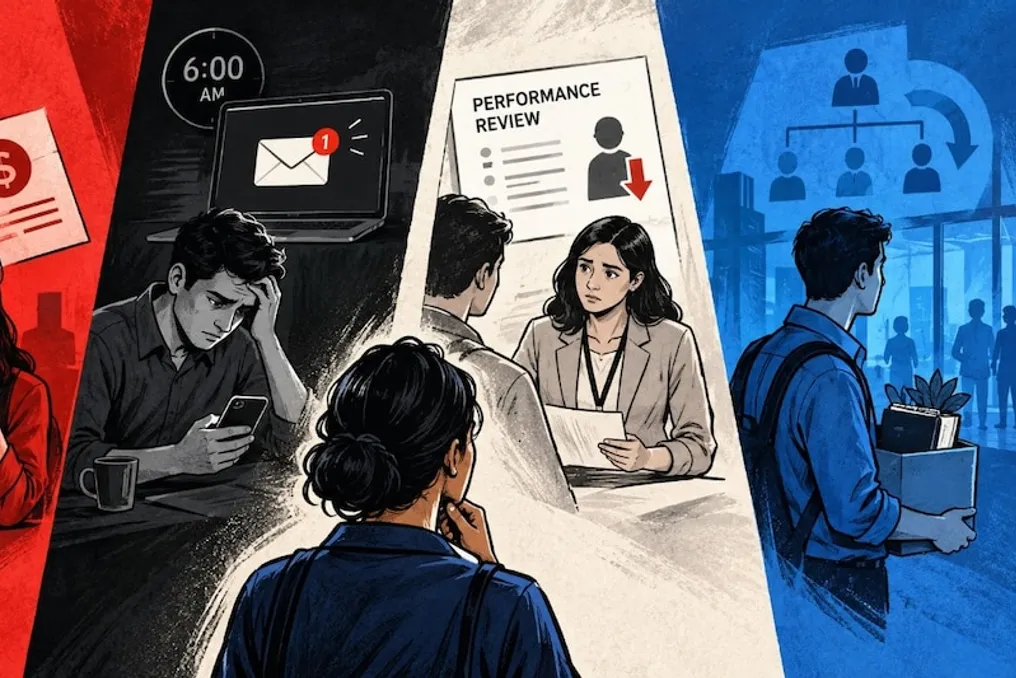
These methods can take the form of an early morning termination notice, a decision made during an appraisal, or an HR offer of a financial package in exchange for leaving the job. In some cases, the employee has the right to choose to leave, while in others, the company makes the decision independently.

Microsoft offered around 60,000 eligible employees in India, the US, the UK, and Canada the option of a voluntary buyout. Through this program, employees can leave the company while receiving financial support. This step was taken during a period when Microsoft is actively investing in artificial intelligence infrastructure and adapting its workforce to business needs.

A question people often ask is whether all 60,000 employees will be laid off. The answer is no. A voluntary departure differs from a forced reduction. Nevertheless, this offer reignites familiar workplace anxiety: what happens when a company decides it needs a different workforce composition?

Downsizing can take various forms—from early morning termination letters and buyouts to performance-related reductions and major organizational changes. Each reduction has its own solutions, uncertainties, and consequences for the people involved. It is necessary to understand four aspects of layoffs that every employee should know.

A reduction does not mean the company suddenly fires employees. Sometimes it offers them the chance to leave by providing a financial package. Other steps are taken under the guise of a performance review or organizational transformation. Recent events in the tech sector show that layoff methods are diverse, and each situation presents unique challenges for employees.

Different forms of downsizing include Microsoft's voluntary departure offers, termination letters received by Oracle employees early in the morning, potential layoffs following performance reviews at Qualcomm, and changes within Adidas' technology division. Therefore, it is crucial for employees to understand the differences between all these situations and how they might affect their careers.

Microsoft offered a voluntary exit proposal to its eligible employees in 2026. Under this program, employees meeting criteria in certain internal levels 70 or below, in selected departments of the company, were offered the opportunity to leave in exchange for financial assistance. This offer applies to certain organizations in India, the US, the UK, and Canada, but not all Microsoft employees are candidates. This is significantly different from standard company layoffs. With a buyout, the employee gets the option to leave under contract terms, whereas in a forced layoff, the company itself decides on the end of employment.

Before accepting such an offer, an employee should carefully consider several points. These include the size of the package, the likelihood of finding new employment, health insurance, future financial needs, and the time required to find a new position. Receiving a financial package does not guarantee that the decision to leave will be easy.

Furthermore, some employees are suddenly informed of a company reduction. In Oracle's case in September 2026, some employees were sent an email early in the morning notifying them of the termination of their positions due to company changes. The company also provided information about the last working day in the letter. The company did not disclose the total number of affected employees to the public during this period.

In such a situation, an employee may face many questions after being let go. They need to find out the severance pay amount, when the debt payment will be made, when access to company systems will be closed, and how to start looking for a new job.

The main difference between a buyout and such a termination notice is that with a buyout, the employee may have a choice, whereas with receiving a termination letter, the decision to end employment has already been made by the company.

There is also a form of reduction that takes into account employee performance evaluations. Reports have emerged regarding global job cuts at Qualcomm following the annual employee review in 2026. According to reports, CEO Cristiano Amon spoke about the need to strengthen a culture of performance and attention to areas that consistently fail to meet expectations. The company has not disclosed the number of positions that will be affected by the proposed reduction.

However, it is important to understand that a performance-based reduction and general organizational changes are not the same thing. In organizational changes, an employee's position may be eliminated even if their performance was high. Whereas in performance-based decisions, the employee...

Qualcomm plans job cuts following annual employee performance review
Read more
www.aajtak.in

Qualcomm plans job cuts following annual employee performance review

Reasons for layoffs in companies are not always solely linked to financial difficulties or business downturns. Currently, the evaluation of employees' work, productivity, and results also plays a significant role in decisions regarding staff reductions. Qualcomm has developed a plan to reduce its global workforce after conducting an annual personnel assessment. This move once again raises the question of whether corporations use employee performance metrics as a basis for dismissals.

Following the annual review of its employees, Qualcomm announced its intention to cut jobs worldwide. In a message addressed to employees, CEO Cristiano Amon stated that the goal of this initiative is to foster a strong culture of performance and improve areas where the company is not meeting expected results. Employees can expect notification of layoffs in November. The company has not yet disclosed the exact number of employees whose positions will be affected. Decisions on layoffs will take into account both business needs and organizational priorities, as well as the skills and specialization of the personnel.

Typically, companies reduce staff in response to the need to lower costs, changes in business, or the disappearance of a need for a particular department. This can be called traditional downsizing. In such cases, an employee's dismissal may occur due to a change in their role or department, rather than due to their personal performance. In contrast, when downsizing is based on performance, the employee's work evaluation, effectiveness, ability to meet goals, and overall level of productivity can be used as a criterion. The company has the right to decide who to retain and who to offer alternative employment.

However, both types of reductions can happen simultaneously. For example, if a company is reducing staff to cut costs, it may also conduct performance and qualification assessments of these employees in parallel.

There is a significant difference between these approaches: in traditional downsizing, the position or department itself may disappear. Conversely, in performance-based downsizing, the position may remain, but the company may decide to replace the employee currently holding that position. For instance, if a department continues to function, but management believes that the performance of some employees does not meet established expectations, it may consider replacing those individuals with other workers.

It is important to note that a reference to performance by the company does not mean that the laid-off employee had poor results. Organizational needs and other business reasons may also underlie the reduction.

Processes such as employee performance reviews, efficiency improvement plans, and personnel ratings have been used by companies for a long time. They help assess employee work and identify areas needing improvement. Since companies are now mentioning performance and effectiveness when explaining layoff reasons, it becomes critically important to understand whether an employee is leaving due to the elimination of their role or if their termination is based on an evaluation of their work. However, the processes and reasons for layoffs differ in each company.

If the retention of a job is tied to the results of a performance evaluation, it increases the significance of annual appraisals and set goals for employees. In this case, employees naturally raise questions about the standards by which their work is evaluated. It is also important that companies provide employees with clear feedback on their results and apply uniform standards across all teams. Managers' opinions, changing work needs, and company priorities can also influence performance evaluations.

Overall, economic downturn or cost reduction cannot be the sole reason for layoffs. In some cases, the evaluation of employee skills and performance also becomes part of the decision-making process. Therefore, it is crucial for employees to understand what the company expects from them and on what basis their work is being assessed.

Popular