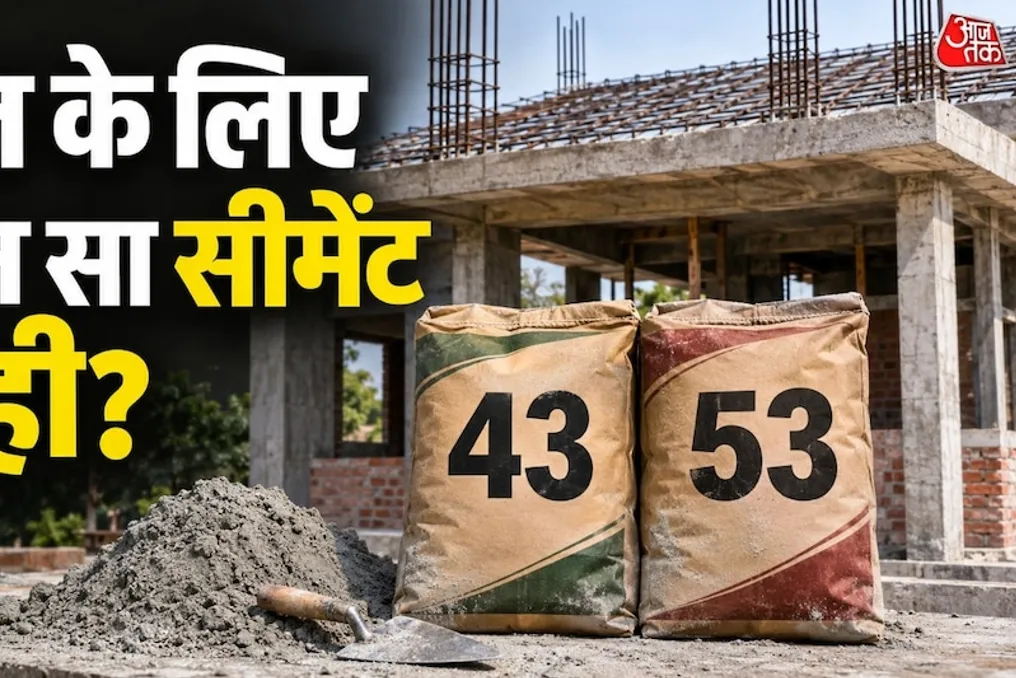
When purchasing cement for building a house, there are many bags available on the market, some marked with grade 43, and others with grade 53. Since the price of these can vary, the question often arises about the differences between these two types of cement. There is doubt whether cement grade 53 is stronger and if it should always be chosen, or if cement grade 43 is also suitable for building a house. In fact, the numbers 43 and 53 on the bag indicate its strength or power, but this does not mean that cement grade 53 is better suited for all types of work; both types are used in different construction tasks.
Let's look in simple terms at what the difference is between them and which cement should be chosen when constructing a house.
Cement grade 43 is usually used in the construction of residential buildings and general construction works. Its feature is that it gains strength gradually, meaning more time is required to achieve full strength. This cement can be used for wall masonry, plastering, floors, and general concreting. It is considered a good option for many internal construction tasks in a house. The advantage of cement grade 43 is that tasks such as plastering and masonry are easy to perform with it. However, the choice of application depends on the requirements of the specific job and consultation with an engineer.
Cement grade 53 is known for gaining strength faster compared to cement grade 43. It is specifically designed for construction work where high strength is required in a short period. It is usually used for structures such as beams, columns, roof pouring, and reinforced concrete (RCC) structures. It is also used in large projects and where concrete must reach a certain strength within a set timeframe. However, this does not guarantee that any structure built with cement grade 53 will automatically be stronger; the strength of the structure depends not only on the cement but also on the correct amount of sand, gravel, water, and the method of execution.
The main difference between cement grades 43 and 53 lies in their strength. Cement grade 43 achieves a strength of at least 43 MPa after 28 days, while cement grade 53 achieves a strength of at least 53 MPa. Simply put, according to established standards, cement grade 53 has greater strength than cement grade 43. The setting time also differs: cement grade 53 gains strength faster in the initial stages, whereas cement grade 43 increases its strength slowly. Cement grade 43 is used for general construction work, wall masonry, and plastering. At the same time, cement grade 53 is suitable for beams, columns, roof pouring, and RCC work. Nevertheless, the choice must be based on the construction needs and the advice of an engineer. As for price, it can vary depending on the brand and the market.
If you are building your house, it is crucial to understand what purpose the cement will serve before purchasing it. For plastering and masonry, cement grade 43 can be a good choice, and the appropriate cement should be selected according to the nature of the work. For roof pouring, cement grade 53 can be used, but the choice must be guided by the advice of a structural engineer. In the case of beams and columns, the cement choice must be determined by the house design, concrete needs, and engineering recommendations. For making a floor, cement grade 43 or another suitable cement can be used, depending on the nature of the work. Therefore, one should not buy cement grade 53 just because its number is higher, assuming it is universally better. The right cement is the one chosen according to the construction requirements.
When buying cement, it is not enough to only look at its grade; other factors must also be considered. First, check the packaging date on the cement bag to avoid buying overly old material. Second, ensure that the cement bag is not torn and has not been exposed to moisture. Third, avoid cement with lumps that may have formed due to humidity. Fourth, choose a reliable brand and check for the ISI mark and relevant standards. Fifth, store the cement properly: place it on wooden pallets off the ground, protecting it from moisture.
It is important to understand that the strength of a house depends not only on the cement grade. Proper design, high-quality sand and gravel, the exact amount of water, and quality concrete curing after pouring (concrete care) are necessary to ensure strength.