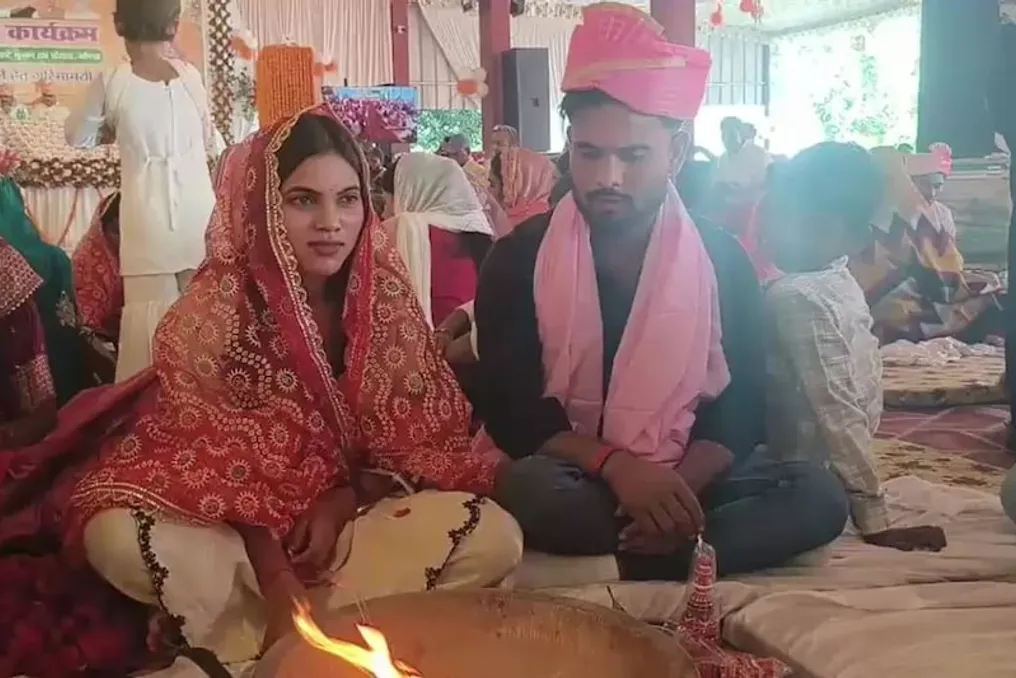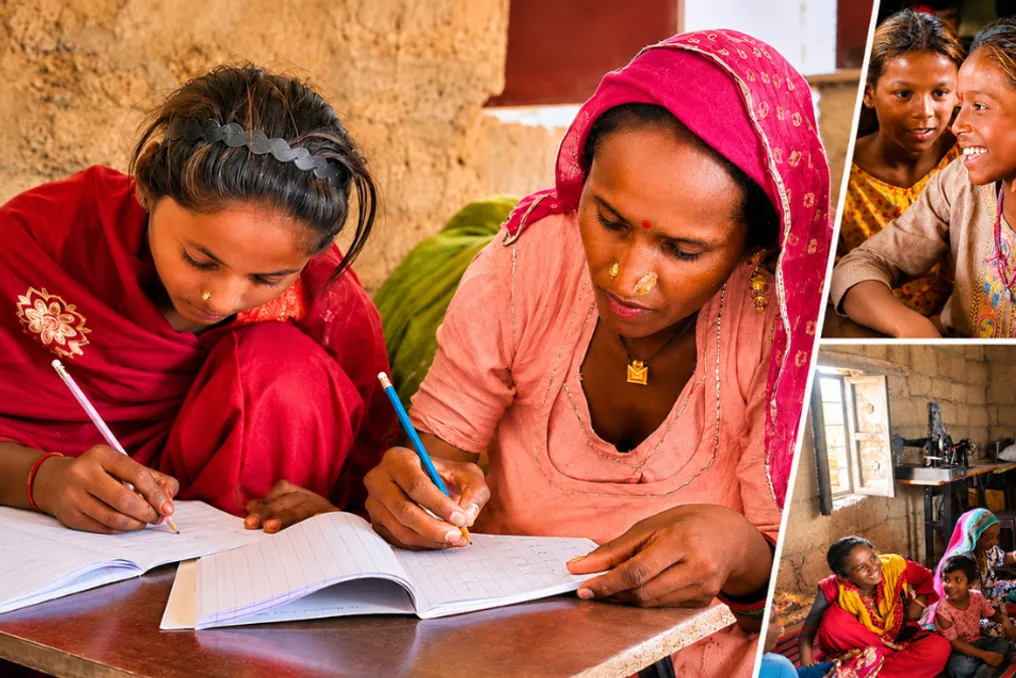
Monika Jod, who realized at the age of fourteen that the life planned for her did not entirely belong to her, turned to Trust Sambali after being denied the opportunity to study. At home, she heard that a man was the light of the family: 'Ladka Ghar ka chirag.' The women around her also did not support her pursuit of education, as marriage, like many other decisions concerning girls, seemed to be the domain of the family.
However, Monika did not accept that her choice ended there. Throughout her life, she left home four times, trying to distance herself from the idea that a woman's place is predetermined by marriage, family expectations, and domestic duties. Years later, at the age of 35, she works with women who are going through a similar path.
Some of them come to Trust Sambali after becoming involved in marriage arrangements, exiting which can have consequences for another woman. Govind Singh Rathor, founder of Trust Sambali, based in Jodhpur, explains that 'their marriages are not considered separate relationships. They are tied to a tradition known as atta-satta.'
In some parts of Rajasthan, a woman's marriage is a family deal. Rathor explains: 'A daughter is brought into one family, and a daughter from that family marries her brother or another man from her family. These two marriages are discussed together. What happens in one can affect the other.'
Your Marriage Belongs to More Than Just You
This is the part of atta-satta that is often overlooked when this tradition is simply described as an exchange of marital relationships. Its most significant feature is not only that two marriages are arranged simultaneously, but also that one woman's choice can be used as leverage against another.
Rathor has spent years working with women who find themselves in such situations. He notes that this practice remains particularly prevalent in the western districts of Rajasthan, including the desert districts of Barmer, Bikaner, and Jodhpur. The consequences, he says, can be devastating. He states: 'Women at such young ages, like 19, marry men aged 50 or 60, and their lives often descend into cycles of violence, abuse, and neglect.'
He recalls his own experience: 'I married at 15 when my wife was only 14. Later, we entered into a social marriage when I was 19 and she was 18.' His personal experience, he says, is part of a broader reality. He remembers a German visitor remarking, 'There are no teenage girls in Rajasthan!', which showed how many girls are forced to grow up prematurely, burdened by responsibilities and deprived of the freedom to experience adolescence.
When Marriages Become Interconnected
Families may believe that exchanging daughters reduces the financial burden associated with marriage, including dowry or *dahej*. However, reciprocity has a flip side. Imagine a woman leaving her husband. In a normal marriage, the dispute would concern her, her husband, and their respective families. But within the framework of atta-satta, her decision can be presented as a breach of agreement between households.
Her family might be told that if she does not return, the other family will send its daughter back. Rathor asserts: 'If one woman is subjected to violence, another woman can automatically become vulnerable to violence too.'
The Cost of Refusal
The tradition continues not because every family necessarily views women as commodities, says Rathor, but because this arrangement is woven into economic and social structures that families find difficult to challenge. Rathor emphasizes: 'People look at everything materially. But a girl is not a material object.'
For families with limited resources, the promise of reducing wedding expenses can make atta-satta seem rational. But what starts as an economic agreement can create a form of social debt in which women are expected to uphold an agreement they never made themselves. He notes: 'Women naturally seek some relief, some way out of difficult circumstances. But the same system can turn against them.'
Rathor recalls a case that came to Trust Sambali concerning a young woman whose family had entered into an atta-satta agreement. Certain conditions were attached to her brother's marriage, and she agreed to this arrangement. However, shortly after her brother's wedding, she left home with a man she loved. Her decision did not end the problem. According to Rathor, members of her community tracked her down, and her parents were pressured to settle the dispute through the local panchayat. The family had to pay a significant sum as part of the settlement.
Rathor also reports that local mediators or agents involved in facilitating such agreements can demand sums of 10–15 lakh rupees, after which the woman may still be forced back into a marriage she does not want.
Tradition Under Scrutiny
This practice attracted the attention of legislators in Rajasthan this year when the Rajasthan High Court, while hearing a matrimonial dispute, criticized atta-satta, calling the arrangement a form of 'mutual hostage-taking' between families. This observation embodied the problem faced by women working on such cases.
The organization The Better India contacted Kumkum Thanvi, a counselor-psychologist and psycho-oncologist working under the Nirbhay Trust Sambali Initiative. This initiative, launched in 2014, is an emergency aid system that connects survivors with internal psychologists, medical teams, and legal advisors to guide them in learning their rights and navigating legal processes.
Thanvi says: 'It usually takes three or four sessions to help families understand that if one marriage faces difficulties due to incompatibility, conflict, or violence, it does not mean that another marriage must also be dissolved. This is one of the main issues associated with the atta-satta marriage practice. Legally, we follow the same procedures and provide the same legal advice as in any other marriage-related case.'
But what happens when a woman approaches the Trust asking to leave an abusive marriage? 'First, I try to understand the woman's situation, explain her rights, assess her immediate safety needs, and help her explore available options without pressuring her toward any specific decision. This may include contacting the police if she is threatened, physically abused, harassed, confined, or coerced; seeking protection under the Domestic Violence Act of 2005 in cases of domestic violence; or approaching the District Legal Services Authority (DLSA) for free legal aid, including guidance on separation or divorce.'
However, knowing one's rights does not automatically make leaving possible. Thanvi names financial dependence, concerns about child custody and education, family pressure, and the prospect of lengthy legal battles as some of the biggest barriers women face.
'Simply telling a woman to leave her marriage is not enough,' she says. 'She also needs to know where she will go, how she will support herself and her children, and who will support her afterward.'
This is where custom meets individual freedom. Rathor also believes that this is why the problem cannot be solved solely through individual intervention. 'Therefore, it makes no sense to entirely blame the police or the families,' he says. 'The real solution must start with a change in mindset.'
You Cannot Give Away Daughters in the Name of Tradition
Rathor sees education and economic independence at the heart of these changes. One argument used to justify atta-satta is that exchanging daughters can alleviate the financial burden of marriage and dowry. But Rathor argues that this reasoning hides what is actually being exchanged. A woman is not an economic counterweight to another marriage.
The situation becomes more serious when children are involved in such arrangements. 'Girls as young as nine or ten years old are tied to atta-satta agreements,' he says. Rathor also points to the gender imbalance in Rajasthan as one of the factors contributing to the continuation of reciprocal marriages. With fewer available girls in community families, they increasingly resort to arrangements like atta-satta to secure marriages for their sons.
But ending this practice requires more than just telling families not to exchange daughters. It requires providing alternatives for girls and women. 'People must understand that a daughter is not something that can be traded.'
The Way Out Starts Before the Crisis
This is where the work of Trust Sambali goes beyond rescuing women from individual marriages. The name Sambali refers to the 'upliftment of underprivileged women.' Its approach focuses on helping women and girls achieve sufficient independence so that they no longer need the organization for survival.
Education is one part of this work. Vocational training is another. For women experiencing domestic violence, the organization runs a shelter service where they can find a safe place to live while receiving counseling, support, and advice. It also assists women who wish to seek justice through the courts.
A woman with access to these things has more choices. Rathor asserts: 'The ultimate goal should be to make women independent. They must reach a point where they no longer need Sambali.'
Yet, almost 19 years after Trust Sambali began working with women and girls in Rajasthan in 2007, the need for its intervention remains evident in the cases it continues to handle. Between April 2025 and March 2026, the Trust received 956 calls on its hotline, processed 188 cases through psychological counseling and legal guidance, and provided temporary shelter to 14 high-risk survivors.
Among them was Nisha (name changed), a 19-year-old whom her brothers tried to force into an atta-satta marriage in April 2025 to secure a bride in return. When Nisha resisted, she faced severe physical and emotional violence, leaving her and her mother without support. She eventually approached the National Commission for Women, which helped ensure her rescue and placement in Trust Sambali. Under the care of project psychologist Dr. Dipti, she found a safe place to recover and talk about the future she wanted. 'I want to study, not get married,' she said.
During an intensive family mediation session, Nisha faced further pressure from relatives to return home. But she held firm and chose independence. Today, she remains under the protection of the Trust and receives the education she was almost forced to give up.
Monika Chose Differently
Monika knows what this independence means because she had to build it herself. At 14, she came to Trust Sambali after being denied the opportunity to study. The women in her own family also did not support her. But her father, along with Trust Sambali founder Govind Singh Rathor, encouraged her to pursue education and build her own life. Monika left home four times in her life. 'I tried to escape the idea that her future was already decided,' Monika tells The Better India. 'I wanted to break away from the mindset that women are nothing.'
Years later, her efforts earned her the Gargi Puraskar, an award recognizing girls who demonstrate outstanding academic achievements. Gargi Puraskar (Gargi Award) is a scheme by the Government of Rajasthan that rewards deserving students who achieve exceptional results in the 10th and 12th grade exams. When she told Rathor about the award, he advised her to attend the ceremony. Monika hesitated. Rathor told her: 'Go and take your mother with you.' Her mother went. For Monika, this moment marked a change in their relationship. Years of conditioning
{