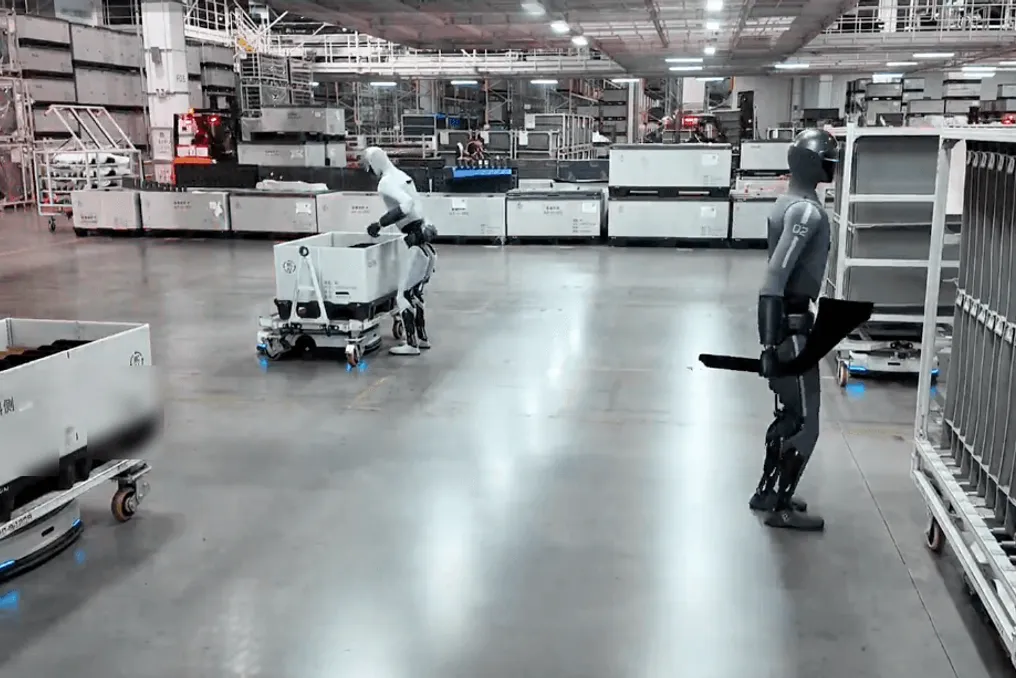
Xiaomi humanoid robot completes first eight-hour shift at auto plant and begins apartment trials
Read more
Pandaily
pandaily.com

Xiaomi humanoid robot completes first eight-hour shift at auto plant and begins apartment trials

Xiaomi has announced that its humanoid robot has completed its first eight-hour working cycle at an automotive plant. During this shift, the robot ensured full daily production demand on the central console side cover sorting station.

This significant milestone was presented by the company during the World Internet Conference Summit in Uzhgen in 2026. There, the robotics team received the 'Leading Technology' award for the base model technology designed for large-scale robotic manipulation.

According to Xiaomi, the robot independently resolved detected anomalies during the shift and interacted with production line systems, which the company views as a preliminary check of capabilities at the line level. This launch is part of an internship at the factory that began in March. At that time, the robot worked autonomously for three hours at the self-tapping screw loading station, achieving a two-sided installation success rate of 90.2% while maintaining a 76-second line cycle.

By July, the success rate increased to 98%, and the robot took over work at two additional stations: side cover sorting and container stacking. The overall success rate across these three stations ranges from 94% to 98%.

In a domestic setting, Xiaomi has begun trial operations in the Xiaomi Youth Apartment—the company's residential complex for employees. Engineers developed an agent system built upon the pre-trained Xiaomi-Robotics-1 model. This system covers data collection, model output, and task execution, and was refined after several rounds of additional training.

During the test run, the system functioned continuously for over 30 minutes across three rooms, completing more than 50 tasks. These included tool preparation, tidying up the sofa and tables, cleaning up trash, placing items back in place, inspecting the premises, re-checking the entire area, and exiting.

A video published by Xiaomi demonstrates this launch as a single 32-minute segment. Xiaomi-Robotics-1 was introduced on July 16th and made public in August. The company reports that the model was pre-trained on over 100,000 hours of manipulation trajectories in real-world conditions, covering more than 1700 scenes and 260 types of tasks. It was then further trained on over 10,000 hours of cross-embodiment data, allowing it to adapt to mobile manipulators and two-armed robots.

The company also noted that in July, the model ranked first in the overall RoboCasa 365 and RoboDojo rankings. A separate vision, language, and action model, Xiaomi-Robotics-0, uses a hybrid architecture that, according to Xiaomi, provides an output latency of 80 milliseconds on a consumer graphics card.

Xiaomi presents both applications—industrial and domestic—as a unified model stack. The company did not disclose how many robots are participating in the apartment trials, which specific apartment is being used for testing, or how long the trial period will last.


Similar stories

Six humanoid AgiBot G2 robots operated in a Shanghai store for 24 hours, completing 1730 tasks
Read more
pandaily.com

Six humanoid AgiBot G2 robots operated in a Shanghai store for 24 hours, completing 1730 tasks

Six humanoid robots of the AgiBot G2 model completed a 24-hour shift in a convenience store located in the Xuhui district of Shanghai. This live-streamed event ran from 10:00 on November 2nd to 10:00 on November 3rd, and according to AgiBot, online viewership exceeded two million people.

Each robot performed a strictly defined function: one greeted customers at the entrance, two handled stocking, inventory replenishment, and shelf patrolling, one prepared coffee, one managed the checkout and hot food service, and the sixth was responsible for table cleaning. According to AgiBot's final count, the six robots completed 1730 tasks, which included 683 customer receptions, 369 deliveries and goods pickups, 147 coffees prepared, 126 breakfast orders, 277 inventory replenishment and shelf checking operations, and 128 instances of table cleaning.

Four out of the six robots passed the event certification, which assessed task completion speed, reaction time, ability to handle exceptions, and customer feedback. Invited testers attempted to create difficulties for the robots by mixing regular and diet cola and requesting only the latter, creating disorder on a full pack of chewing gum shelf, as well as standing in aisles or dropping boxes in the robots' paths.

Reports indicated that the robots confirmed beverages by combining voice requests with visual verification; they restocked shelves by visually counting items instead of relying on price tag placement; and they stopped to navigate around obstacles. Minor manipulations, such as hanging candy bags on hooks or picking up a soft cake without damaging it, remained among the most challenging tasks, and the robots occasionally made errors.

All six robots were coordinated using Genie Master, an embodied agent framework from AgiBot, which links task decisions, movement execution, and feedback through its Embodied Execution Protocol. The system analyzes successful and unsuccessful runs daily, stores useful experience in long-term memory, and filters corrected attempts for use in training data, while the robots practiced during periods of lowest activity. AgiBot emphasized that the test was conducted without human involvement in the loop, meaning no human demonstrations or on-site manual adjustments.

Ren Guanghui, Vice President of AgiBot's Embodied Research Center, told the media that the company would track metrics such as task success rate, first-attempt success, response time, total cycle time, qualified deliveries per unit of time, frequency of human intervention, recovery time, and system availability. However, the figures published upon completion only concerned the number of tasks completed, and AgiBot has not yet released data on success rates or the number of interventions.

This test launch marked the conclusion of AgiBot's AI WAVE series of releases, which began on October 22nd and integrated the company's datasets, simulation platform, models, and robotic hardware onto one live platform.

TeleAI from China Telecom establishes Gamma Robotics to create self-evolving humanoid robots
Read more
pandaily.com

TeleAI from China Telecom establishes Gamma Robotics to create self-evolving humanoid robots

China Telecom's AI research institute, TeleAI, has created its first commercial company—an embodied AI startup named Gamma Robotics. This company is registered in the Xuhui district of Shanghai and is based in a major large model innovation center.

Gamma Robotics' main focus will be on developing self-evolving humanoid robots and creating whole-body models. The company plans to open a humanoid robot laboratory in collaboration with TeleAI.

The founder and CEO is Bai Chenjia, who previously headed TeleAI's Institute of General Embodied Intelligence and was involved in forming the embodied AI research team. Li Xuelun, CTO and Chief Scientist at China Telecom, as well as head of TeleAI, will serve as a scientific advisor.

Technical Objectives of Gamma Robotics

Gamma Robotics pursues two key technical goals. Self-evolution implies that robots continuously accumulate experience during real-world interaction and update their capabilities, allowing the models to improve during operation. The whole-body model aims for a highly articulated system formed by the human body and dexterous hands, with the goal of simultaneously solving balancing, complex contact, and fine manipulation tasks.

The company states its intention to model locomotion and dexterous manipulation within a unified structure so that movement, balance maintenance, grasping, and object handling are integrated into complex task execution skills.

According to the announcement, the team relies on TeleAI's work, which already provides connectivity between the embodied brain for planning, the cerebellum for motion control and synthetic data generation. China Telecom's cloud and computing resource network is expected to provide resources for training, inference, and deployment.

A distinctive feature is the operator's network infrastructure. Gamma Robotics will collaborate with TeleAI on coordinating AI Flow—TeleAI's intelligent communication network—at the device, edge, and cloud levels, connecting robots to edge nodes and cloud systems. The goal is for experience gained by one robot in the physical world to become a shared capability for other nodes, allowing robots to learn from each other and perform tasks collectively.

Initial demonstration projects will focus on servicing and operating China Telecom's data centers, as well as home and commercial sector services. Both parties plan to test the limits of the robots' capabilities, system stability, and effectiveness in real-world scenarios with ecosystem partners, after which they will refine products and delivery based on the feedback received.

For China Telecom, this spin-off connects its computing network and AI research with a dedicated business for creating humanoid robots.

Access to pandaily.com website is restricted using Cloudflare
Read more
pandaily.com

Access to pandaily.com website is restricted using Cloudflare

The owner of the pandaily.com website has temporarily blocked user access to the resource. This restriction is implemented using the Cloudflare service.

For more detailed information about this situation, users can refer to the official Cloudflare documentation on HTTP status codes, specifically at the link https://developers.cloudflare.com/support/troubleshooting/http-status-codes/cloudflare-1xxx-errors/error-1015/.

Popular