Moonshot AI unveils K3.1 agent solution for game development in Unity, Unreal, and Blender
Read more
Pandaily
pandaily.com

Moonshot AI unveils K3.1 agent solution for game development in Unity, Unreal, and Blender

Moonshot AI has released a comprehensive solution for creating games and creative works, based on the Kimi K3.1 model series, Kimi Code and Kimi Work products, as well as plugins for professional tools including Unity, Unreal Engine, and Blender.

According to the company's statement, this package is designed to help studios accelerate game concept testing, advance engineering and artistic production, and integrate player feedback gathered during launch and operation back into the next development phase.

In the description, the Kimi model is capable of analyzing design documents, screenshots, source code, and 3D assets, after which it plans the necessary work. The Kimi Code product handles implementing changes within an existing codebase, while Kimi Work takes on multi-stage production tasks spanning multiple files.

Thanks to plugins and tool calls, Kimi can directly interact with existing projects, returning editable files to the user along with a report of completed actions. In Unity and Unreal Engine environments, upon receiving necessary access rights and project files, the system first maps the code structure, scene hierarchy, and module dependencies, then makes changes via editor plugins, and finally verifies the result through playback steps, logs, and execution data. For engineers, reports on code differences and verification records are maintained.

For operations in Unity, the Kimi models utilize the Tuanjie Codely Agent, a gaming agent from Unity China integrated into the Tuanjie Engine. Kimi interprets the developer's intentions, writes code, and analyzes testing results and screen recordings, while the Codely agent performs operations within the engine using editor scripts and runtime. During one demonstration, Kimi showed that it could operate for 20 hours without human intervention, recreating an existing game and generating a native project ready for further development.

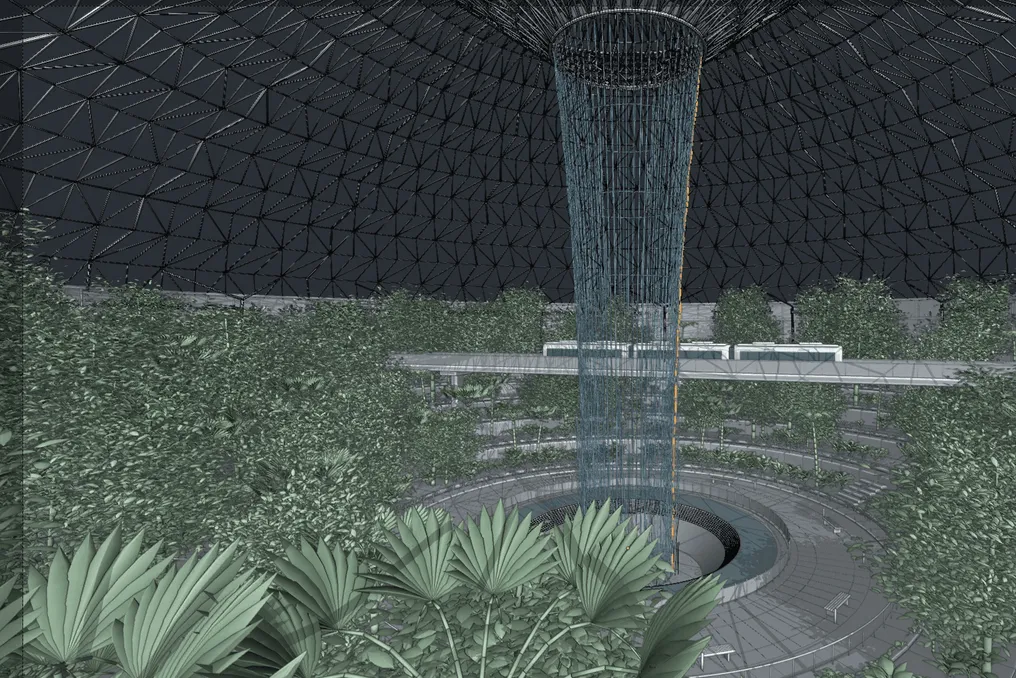
The launch page features several demo builds created using Kimi K3.1 Pro. An internal jungle valley was constructed in Blender, and a 17.5-second flythrough was rendered at 1920x1080 resolution and 60 frames per second, alongside a cathedral interior in the browser containing approximately 3.3 million triangles and 8368 animated components. In Unreal Engine 5.8, a celestial palace scene was created featuring a colonnade of 36 arches with a 1750-meter radius and a procedurally modeled dragon totaling 36 million triangles, rendered using Nanite and Lumen. Kimi also claims that designers without programming experience can create playable prototypes in Godot within one or two days.

In addition to production tasks, this solution includes batch creation of advertising creatives, integration of in-game assistants via the Kimi API, sorting community feedback with source attribution, preparing localization drafts with back-translation checks, and initial selection of user-generated content. Kimi advises teams to start with one clearly defined task and evaluate pilot projects based on criteria such as time saved, quality of the result, and volume of required human refinement.


Similar stories

Doubao Work provides access to Kimi, GLM, and DeepSeek models for corporate clients
Read more
pandaily.com

Doubao Work provides access to Kimi, GLM, and DeepSeek models for corporate clients

Doubao Work, ByteDance's artificial intelligence agent application, announced on October 29th that it is expanding its functionality by providing access to third-party models for business clients. The first group of integrated models includes Moonshot AI's Kimi K3.1 Pro, Zhipu's GLM-5.3, and DeepSeek-V4.1-Flash. These models are now displayed in the application's model list alongside Doubao's proprietary models from ByteDance.

This update applies to team and enterprise subscription plans and is activated by default. Companies are not required to purchase separate access rights from each model developer or submit individual applications. Resource consumption is deducted from the AI credits that the organization already holds in Doubao Work.

Model Access Management

Administrators gain the ability to control which users can use a specific model. They can grant access to individual members, departments, groups, or the entire company. Furthermore, administrators can enable all models from one provider simultaneously or configure the use of a single specific model.

This move changes the positioning of Doubao Work. Previously, the application primarily served as a demonstration of ByteDance's Doubao models within an agent capable of interacting with files, browsers, and desktop applications. By allowing enterprises to direct tasks to competing Chinese models, the core product becomes the agent itself, rather than the underlying model. This also allows teams to choose a model based on the task type, such as using a coding-oriented model for engineering work and another model for handling long documents.

This development aligns with a broader trend among Chinese desktop agent products. This week, Xiaomi added DeepSeek, GLM, Kimi, and Qwen models to its MiMo Desktop, and several other agent tools have made similar moves. For enterprise-level buyers, a unified billing system and standardized permissions for multiple model developers significantly simplify the procurement process, which previously required comparing solutions from different manufacturers.

Doubao Work is continuously expanding its feature set. In recent weeks, capabilities such as saving recorded computer actions as reusable skills, importing chat history, skills, and memory from other AI tools with a single click, and an infinite creative canvas have been added. The application also supports parallel agents and local graphical interface control on Mac.

ByteDance has not specified what other third-party models will follow this initial batch, describing the current composition as the first group of models joining the platform.

Hoorakhsh Studios begins production of the animated series 'Shahnameh'
Read more
www.tehrantimes.com

Hoorakhsh Studios begins production of the animated series 'Shahnameh'

Production has begun at Hoorakhsh Studios for the animated series 'Shahnameh,' which is overseen and created by Ashkan Raggozar. The series utilizes 2D animation and artificial intelligence methods in its creation.

Following the release of the feature animated film 'The Last Fiction' and the writing of seven graphic novels based on 'Shahnameh' plots, Ashkan Raggozar has returned to Ferdowsi's epic, as reported by the ILNA agency.

It is planned that the series will adapt all stories from Ferdowsi's 'Shahnameh' from beginning to end, with its release and broadcast occurring simultaneously over approximately ten years.

The animated series 'Shahnameh' will be produced in both Persian and English, taking into account the interests of international streaming platforms. Each season will consist of 8–12 episodes, with each episode estimated to last 15–20 minutes.

The first season, titled 'The First King,' tells the story of the reign of Kayumars, a legendary figure in Iranian mythological history mentioned in both the Avesta and 'Shahnameh.' 'Shahnameh' is the studio Hoorakhsh Studio's first major independent animated series. The studio's portfolio includes two feature animated films, over 11 short animations, more than 10 music videos, the publication of 11 graphic novels, and the development of five video games.

'Shahnameh' (Book of Kings) is an extensive epic poem written by the Persian poet Ferdowsi approximately between 977 and 1010 AD. It is the national epic of the Great Iranian Empire. Comprising about 50,000 couplets, 'Shahnameh' ranks among the longest epic works in the world and is the longest epic created by a single author. It primarily describes Iran's mythical, but partially historical, past, starting from the creation of the world up to the Muslim conquest in the seventh century.

This national epic is observed in Iran, Afghanistan, Azerbaijan, Tajikistan, as well as in regions influenced by Persian culture such as Armenia, Dagestan, Georgia, Turkey, Turkmenistan, and Uzbekistan. Ferdowsi spent 33 years completing 'Shahnameh' in its entirety. The work holds immense significance for Persian culture and language, considered a literary masterpiece and a defining work of Iran's ethno-national cultural identity. Ferdowsi (940–1025) is revered as one of the most influential figures in Persian literature and one of the greatest figures in literary history.

Infinigence AI developed a three-component character agent, halving the time to generate the first token using split output
Read more
pandaily.com

Infinigence AI developed a three-component character agent, halving the time to generate the first token using split output

Infinigence AI, in collaboration with Three-Body Universe, the developer of Liu Cixin's franchise 'The Three-Body Problem,' unveiled a character agent at the 'Three-Body Day' event in Beijing on October 25, 2026. The Chinese name of this agent corresponds to the concept of Sophon from the novels and it serves as an administrator of a mini-universe from the books.

The presentation was conducted by Infinigence CEO Xia Lixue and Three-Body Universe CEO Zhao Jilong, according to reports from QbitAI and Zhidx. According to the QbitAI article, the information was provided by Infinigence itself.

An interesting aspect is the process of creating and maintaining such an agent. It operates on Infinigence's AgentWorks platform. Source material is uploaded into grouped knowledge bases, which are automatically parsed, chunked, and converted into embeddings. The character's personality is defined through multi-level structured prompts, rather than a single long instruction.

A memory module called Infini Memory allows the agent to retain facts between sessions, preventing contradictory or fragmented memories. Responses pass through a cycle involving several agents: first, a response is generated, then it is evaluated, and only failed parts undergo refinement. Personality generation and knowledge retrieval are performed in parallel to save time, while a separate reviewer agent checks each response for deviations from the character and inconsistencies with the novel's setting.

For testing, Infinigence created a tracing-based evaluation system that automatically verifies results against the source text, while the Three-Body Universe content team manually reviews the obtained data.

Infinigence Infrastructure Achievements in Serving

In the field of serving, Infinigence's infrastructure plays a key role. Typically, the output of large models is divided into a prefill stage, which reads the prompt, and a decode stage, which forms the response. Infinigence's proprietary heterogeneous inter-cluster architecture, named PDD, goes further by breaking this two-stage chain into a three-stage disaggregated structure, which they label P-RLD-MD, distributed across separate clusters.

Since agent traffic often reuses the same query prefixes, the decode side applies RadixCache prefix caching. This ensures that the overall context, such as personality, is not transmitted or recalculated with every call. The company claims that this reduces the volume of KV data transferred between clusters tenfold, allowing the use of standard Ethernet, reducing time to the first token by 51.5%, and decreasing cost per token by 37.5%.

For a chat character with a long fixed personality and a large number of regular users, savings on common prefixes constitute the main part of the costs.

Popular