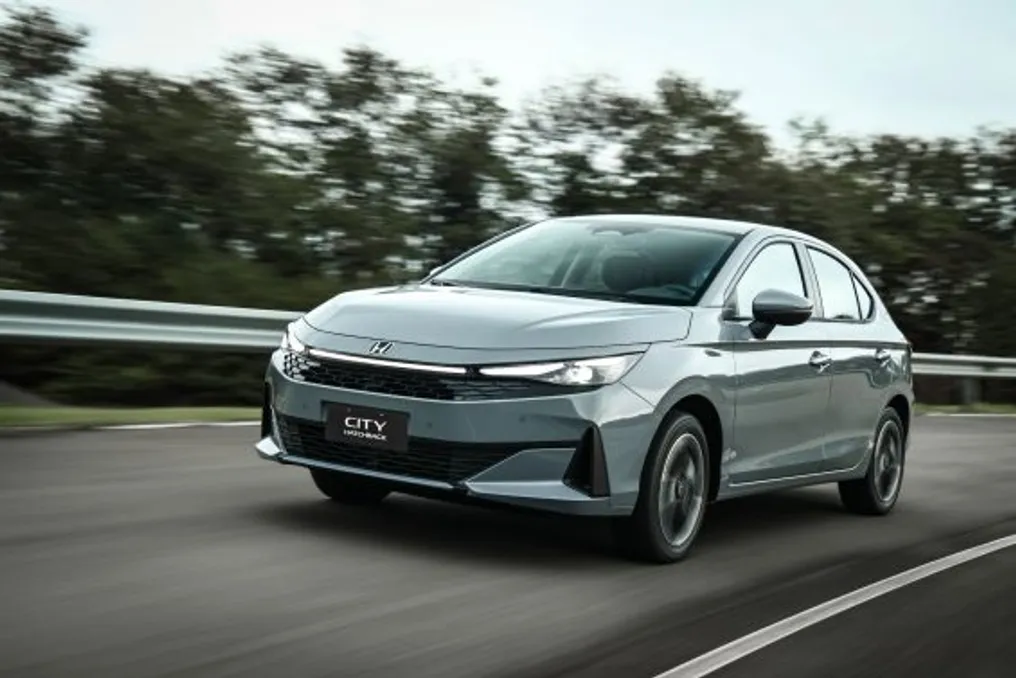
Honda has introduced the 2027 line of the City, available in hatchback and sedan versions, with price ranges varying from R$ 117,700 to R$ 156,400. These values position the Japanese compact vehicles in a highly competitive market segment.
This price level offers a wide range of options, including entry-level SUVs, compact SUVs, light pickups, electric compacts, compact sedans, and even mid-size SUVs on promotion. Given this fierce competition, the City must rely on solid arguments to stand out.
The brand's main differentiator lies in its reputation. Honda possesses a strong commercial appeal sustained by reliability, proven mechanics, good market liquidity, and low depreciation—a term the marketing calls 'residual cost.' This combination has established Honda as a desired product, an image built over more than 35 years since imports were allowed.
The manufacturer has achieved a quality level superior to that of other generalist automakers, positioning itself one step below German premium brands. However, the landscape has changed with the rise of Chinese brands, which are no longer seen merely as cheap vehicles of questionable quality, but have reached a sophistication standard comparable to European premium cars.
Despite fluctuations in the automotive panorama, including the increased participation of Chinese brands, Honda has maintained its stability in the Brazilian retail market without needing to modify its production plan or pricing policy. In contrast to other brands that have lost ground to the Chinese advance, Honda has registered sales growth.
Between January and September, the brand registered 82,634 units licensed, surpassing the 73,570 units sold in the same period of 2025, representing a slight increase of over 12%, significantly above the total market's 8%. Although its market share decreased from 4.07% to 3.83% in the same interval, almost all traditional brands saw their shares reduced due to the consolidation of new competitors such as BYD, GWM, GAC, Geely, and Omoda & Jaecoo.
Thus, Honda continues its trajectory in the Brazilian retail market, supported by the loyalty of its customer base, which trusts the added value of the H emblem.
Technical specifications and performance
The 2027 City shares the same characteristics as current generations, being offered with a single mechanical unit. It uses the 1.5 VVTI engine, which delivers 126 hp and 15.8 kgfm of torque. This engine is coupled with a CVT transmission, the same setup used in the sedan, hatchback, and WR-V and HR-V SUVs (in entry-level versions). This engine is suitable for consumers who are still hesitant about three-cylinder turbo engines or electrified units.
The City's performance is consistent, though not surprising. The power and torque provide good agility both in the city and on the highway. As it is a naturally aspirated engine, the peak torque occurs at higher RPMs, above 4,000 rpm. However, the gearbox quickly adjusts the ratios, immediately increasing the revs, resulting in agile acceleration and safe overtaking, despite lacking the thrust of a turbo engine.
The overall behavior of the City is characterized by being balanced and smooth, typical of any Honda vehicle, without jerks. The suspension has excellent calibration, remaining firm during curves while absorbing road imperfections.
Inmetro data indicates satisfactory fuel consumption: the City Sedan consumes 9.1 km/l in the city and 10.8 km/l on the highway using ethanol. With gasoline, the figures are 12.9 km/l in the city and 15.3 km/l on the highway.
Interior finish and technology
The equipment package varies from the LX to Touring versions, in addition to the RS, exclusive to the hatchback. All versions include digital climate control, electric steering, and a multimedia system with wireless connectivity for Android Auto and Apple CarPlay.
The Honda Sensing driver assistance system becomes standard starting from the EX version. In the top-of-the-line Touring and RS versions, the Low Speed Follow function is added, along with Adaptive Cruise Control (ACC), which maintains throttle control even at speeds below 32 km/h.
The interior finish of the City draws attention due to the quality of the materials. The more expensive versions feature leather-upholstered seats and panels, which increases the feeling of sophistication. However, the model could improve by having electric-adjustable seats, a feature that could be an additional attraction to encourage the consumer to invest over R$ 150 thousand in a compact, considering the various alternatives available.
In summary, the Honda City is an attractive automobile, offering a reliable engine without relying on turbines or complex electronic modules, efficient consumption, and a package of features expected of a modern and well-equipped car.
The City's weak point may be its exterior design. The Brazilian consumer, like much of the global public, shows a preference for SUVs, even if they are essentially the same structure with a modified body. The Honda customer itself reflects this trend: the WR-V, which shares the platform, engine, transmission, and equipment, starts at R$ 150 thousand but sold 27,145 units from January to September, surpassing the sales of the sedan (11,568) and the hatchback (10,005). For someone looking for a car at R$ 117,700, the City is a difficult option to beat.