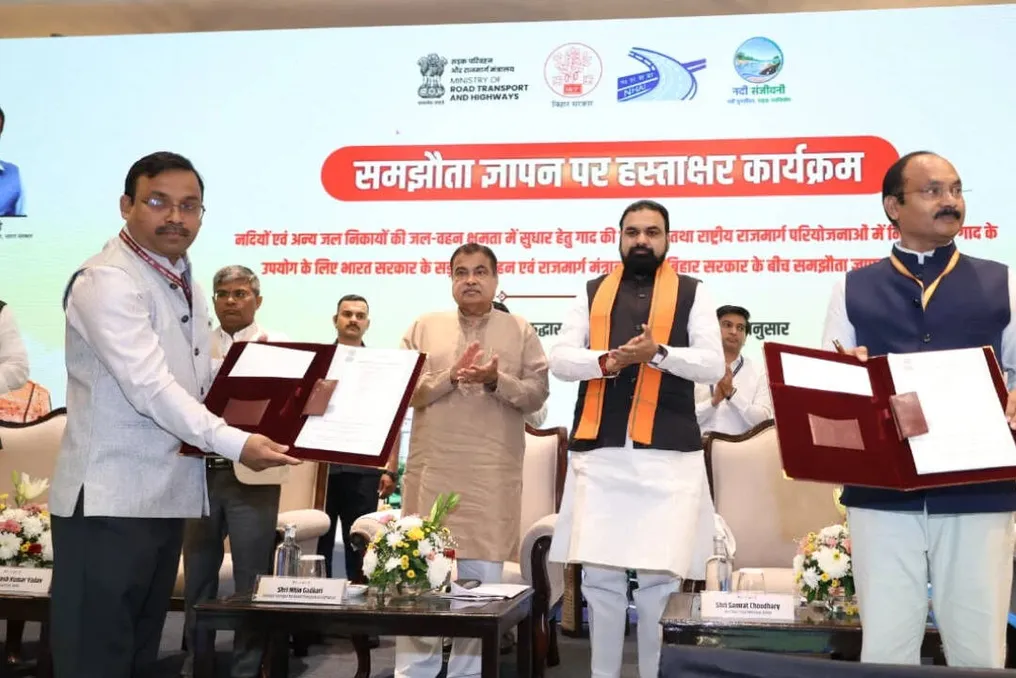
The Ministry of Transport and NHAI plan to clean rivers and water bodies across the state of Bihar at their own expense to address the issue of annual floods, as well as utilize the extracted silt and sand for road construction needs.
This initiative, implemented under the 'Nadi Sanjivani' (river rejuvenation) program, was signed between the Ministry of Transport and the Government of Bihar on Tuesday. This measure has a dual purpose: road departments will carry out dredging operations and receive construction material free of charge, which simultaneously improves water flow in the rivers and reduces the risk of flooding.
According to the agreement, 243 million cubic meters of silt will be used in 16 current national highway projects, and another 835 million cubic meters are planned for 27 future projects.
Annual floods in Bihar are caused by the deposition of silt in riverbeds, where turbid water from the Himalayas in Nepal flows during rains. Union Minister of Transport Nitin Gadkari stated after signing the agreement that if the plan is successfully implemented, this problem will be largely resolved. He noted: 'The silt, which until yesterday was the cause of floods, will now become the basis for development.'
Gadkari also emphasized that this approach can serve as a model for other states, allowing construction materials to be obtained through the dredging of rivers and water bodies. Currently, highway builders are forced to purchase soil and other materials from afar, leading to delays and increased construction costs.
Bihar Governor Samrat Choudhary highlighted the state's vulnerability to recurring floods, which damage farmers, agricultural land, livelihoods, and infrastructure. He explained that the destruction in Bihar is caused not by its own water, but by water from neighboring countries and other states. Choudhary added that seven major rivers from Nepal flow through Bihar, and rains in Nepal lead to destruction in Bihar. Despite receiving more than 32% less rainfall this year, the water level in three main rivers reached its maximum (HFL).
Choudhary reported that the maximum water level in the Ganges in the last 200 years has been reached, which is a clear sign of silt deposition in the rivers, prompting the state government to promptly accept Gadkari's proposal for river cleaning.