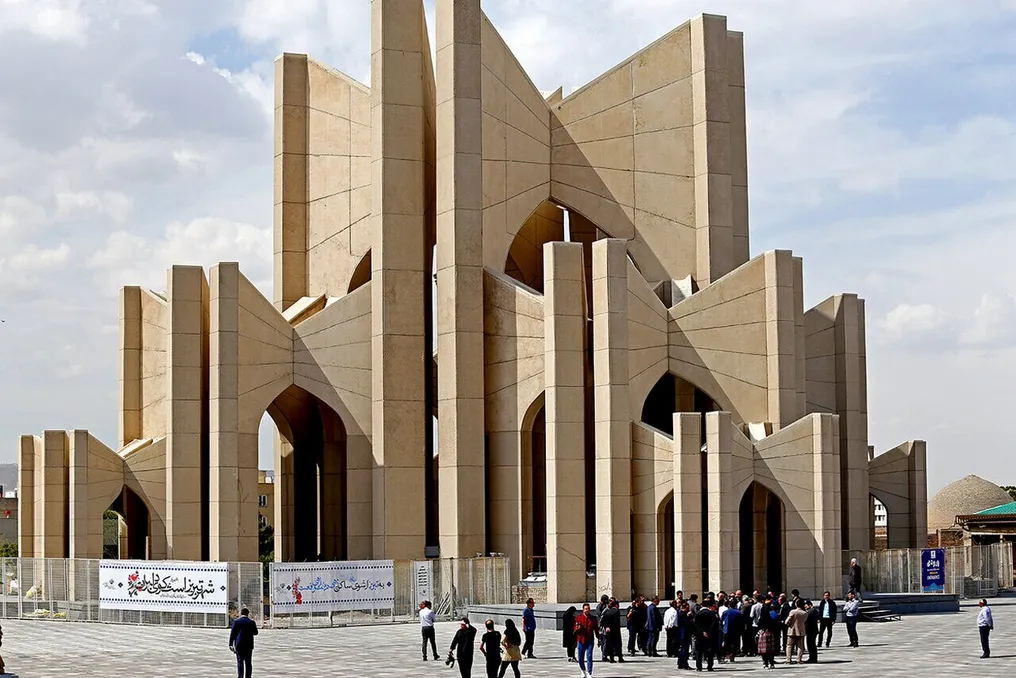
Located in the historical district of Sorhab in Tabriz, the Makbarat-o-Shoara complex, or Poets' Cemetery, is one of the city's most unique cultural attractions. This memorial complex commemorates generations of Persian poets, mystics, scholars, and prominent figures whose lives and works contributed to Iran's literary and intellectual heritage.
The cemetery is situated along Seghatoleslam Avenue in the Sheshgelan district, east of the tombs of Seyed Hamzeh and Gey Magham. In addition to its architectural value, it allows visitors to learn about Tabriz's deep literary roots and its long-standing role as a center of Persian culture. The monument also serves as a reminder of Tabriz's historical significance—a city that has served as a political, cultural, and commercial center throughout various periods of Iranian history.
A Cemetery Rooted in History
The exact date of the founding of Makbarat-o-Shoara is unknown. The earliest mention of it is found in Hamdullah Mostofi's work, 'Nojat ol-Ghulub,' a geographical and historical publication. He mentions this cemetery in the Sorhab district, one of Tabriz's oldest urban areas, alongside Charandab.
The burial ground, which previously had several names, including Khazirat-o-Shoara, Khazirat-ol-Ghozat, and Sorhab Cemetery, was used for centuries. However, its historical structure suffered greatly due to military invasions, natural disasters, and floods. Among the events that contributed to the deterioration of the cemetery's condition was the Ottoman attack on Tabriz near the end of the 10th century AH. Subsequent earthquakes, particularly those recorded in 1193 and 1194 AH, caused additional damage to the site.
Despite the destruction, the cultural significance of the cemetery has been preserved. Efforts to preserve and revive the complex intensified in the 1970s. In 1971, following a newspaper competition for an architectural design, the project presented by architect Golamareza Farzanmehr was selected. Following this, the construction of a new symbolic monument began, transforming the historic cemetery into a prominent cultural landmark.
A Resting Place for Literary Figures
Makbarat-o-Shoara is closely associated with some of the most famous names in Persian literature. Asadi Tusi, who lived from 999 to 1072, is considered the first poet buried in this complex. Other notable figures connected to the cemetery include Haghani, Katran Tabrizi, Anvari Abivardi, Zahiruddin Faryabi, Homam Tabrizi, Falaki Shirvani, and Shams ad-Din Sajasi.
Although many original tombstones and burial structures have disappeared, their connection to this place has secured its place in Tabriz's cultural memory. The burial of Mohammad Hossein Shahriar, one of Iran's most influential contemporary poets, further strengthened the mausoleum's literary importance. Shahriar, known for his Persian and Azerbaijani-Turkic poetry, became the last poet interred at the complex. His presence helped revive public interest in the cemetery and establish it as an important site for literature enthusiasts.
A Cultural Stopover in Tabriz
For travelers exploring Tabriz, Makbarat-o-Shoara offers a compelling complement to the city's historic Grand Bazaar, a UNESCO World Heritage masterpiece, and the famous Blue Mosque. The mausoleum's attractive modern architecture, its historical ties, and its literary atmosphere make it a captivating destination for visitors interested in Iran's cultural heritage.
Visiting the complex offers more than just a view of a monument; it provides insight into the literary traditions that have shaped Tabriz and its identity over centuries, making Makbarat-o-Shoara an indispensable stop for those seeking to understand the cultural character of northwestern Iran.