The organization Jamiatul Ulama KwaZulu-Natal issued an apology after publishing on social media that labeled Halloween as 'worship of the devil' and included claims that other religions worship 'Shaitan'. This publication drew sharp criticism from religious figures who warned of the risk of increased intolerance.
The post stated that Christians, Jews, and Hindus worship 'Shaitan' (Satan). This provoked outrage among religious leaders, some of whom accused the organization of promoting religious intolerance and undermining social cohesion. The message also advised Muslims to refrain from participating in Halloween celebrations.
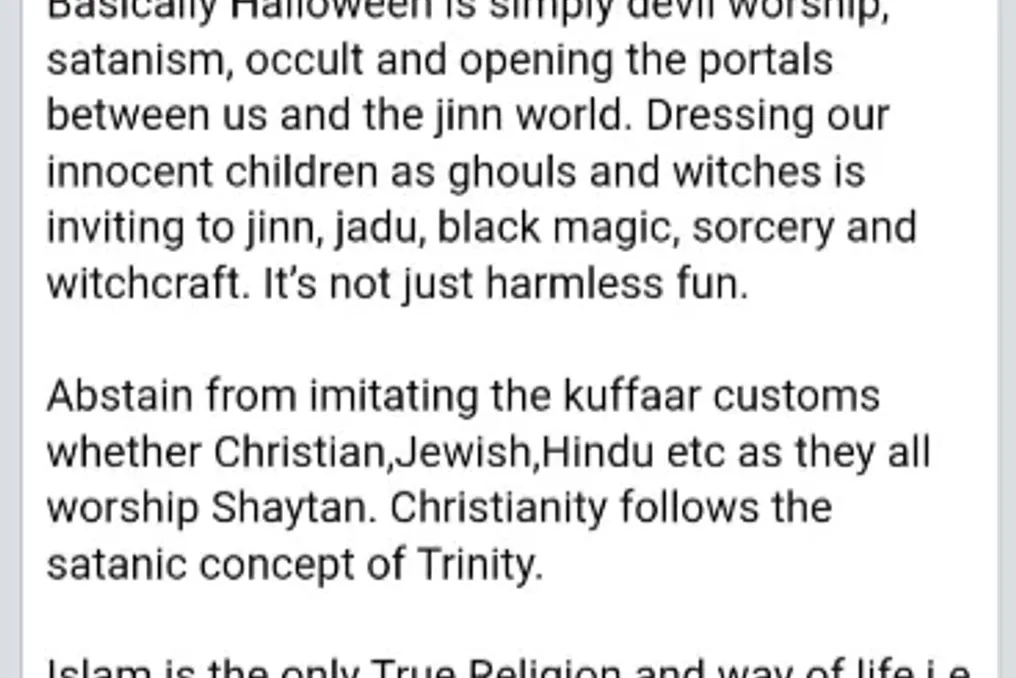
In response to the negative reaction, the organization's executive committee released a clarification and an unconditional apology. In the now-deleted post, Jamiatul Ulama KZN claimed: 'Essentially, Halloween is just the worship of the devil, Satanism, occultism, and opening portals between us and the world of jinn. Dressing our innocent children in the guise of ghouls and witches is an invitation to jinn, magic, black magic, witchcraft, and sorcery. It is not just harmless fun.'
The same post stated: 'Refrain from imitating Kuftaar customs, whether it be Christianity, Judaism, Hinduism, etc., because all of them worship Shaitan. Islam is the only true religion and way of life, meaning following Allah Taala, the Prophet PBUH, and the Quran and Sunnah. Any other path leads us to destruction.'
Furthermore, the post described the concept of the Trinity in Christianity as satanic, emphasizing that Islam is the only true religion. The executive committee of Jamiatul Ulama KZN distanced itself from the 'additional wording' in the post, asserting that it was added by an employee without permission.
The statement read: 'The publications department prepared a poster about Halloween intended to guide Muslims against participating in Halloween celebrations. However, additional wording was added by an employee when uploading the poster. This wording, which was subsequently changed and ultimately deleted, was not authorized by the organization and does not reflect the official position of Jamiatul Ulama KZN.'
The organization maintained its stance that Muslims should not participate in Halloween but acknowledged that the message should have been conveyed without insulting other faiths. 'Our belief that Islam is the true religion revealed by Almighty Allah Taala remains unequivocal. Similarly, our guidance that Muslims should refrain from participating in Halloween celebrations remains unchanged. However, such guidance must always be conveyed responsibly and without causing offense or humiliation to others.'
Jamiatul Ulama KZN admitted the pain and offense caused by the post and offered its unconditional apologies for the inappropriate remarks directed at other religious communities. The executive committee also accepted responsibility for the incident and promised to strengthen internal oversight and public communication procedures.
Professor Bridge Maharaj, Deputy President of the South African Hindu Maha Sabha (SAHMS), condemned the post, calling it irresponsible, deeply offensive, and incompatible with the constitutional values of South Africa. Maharaj stated that the claim that Christians, Jews, Hindus, and followers of other faiths worship Shaitan is an insult to millions of South Africans and threatens to incite religious discord.
He noted that the assertion that 'everyone worships Shaitan' and that 'any other path leads to destruction' is deeply offensive to millions of South Africans. Moreover, it fundamentally contradicts the values of mutual respect, tolerance, and coexistence upon which the constitutional democracy of South Africa is built. He emphasized that South Africa is a proud multicultural, multi-religious, and diverse nation.
Maharaj considers it imprudent and irresponsible for any religious organization, especially one as influential and widely represented as Jamiatul Ulama KZN, to disseminate messages that humiliate, demonize, or malign the sincerely held beliefs of other faiths. He added that such statements go beyond theological disagreement, crossing the line into religious intolerance, as they characterize entire religious communities as followers of Satan, thereby fueling division and damaging decades of painstaking interfaith dialogue in South Africa.
While communities should build bridges of mutual respect and cooperation, such rhetoric creates divisions between people of different faiths and backgrounds. In Maharaj's view, the vast majority of South Africans, including many Muslims, Christians, Hindus, Jews, and traditional African religions, understand that peaceful coexistence is built on respect, not humiliation.
He concluded that while religious organizations have the right to express their beliefs and guide their members, this should not come at the expense of other faiths. Maharaj called on the organization to apologize to the affected religious communities and reaffirm its commitment to interfaith respect. He warned that if the matter is not addressed adequately, SAHMS may refer it to the Commission for the Promotion and Protection of the Rights of Cultural, Religious and Linguistic Communities (CRL Rights Commission), the South African Human Rights Commission, and the Equality Court.
Meanwhile, Reverend Kirill Shunmugam Pillai of the KZN Pastors Association stated that the church rejects Halloween celebrations but also strongly disagrees with Jamiatul Ulama KZN's characterization of the doctrine of the Trinity. Pillai noted that the church rejects Halloween festivities because the biblical view is that Halloween encourages communion with the dead, represents a time of fortune-telling, promotes new behaviors and sensual pleasures, and normalizes association with evil.
However, he rejected the organization's claim about the satanic nature of the Trinity. 'We reject their statement on the Trinity with the contempt it deserves. The true biblical meaning of the Trinity is that there is only one God who eternally exists as three distinct Persons: Father, Son (Jesus Christ), and Holy Spirit, as revealed from Genesis to Revelation,' he stated.
Dr. Raymond Perrier, Director of the Dennis Hurley Centre, presented a different historical perspective on Halloween, noting that the celebration has Christian origins and is linked to important Christian days of remembrance. 'Halloween is an ancient Christian tradition spanning hundreds of years, connected to All Saints' Day and All Souls' Day. There is nothing satanic in its origin,' said Perrier. He added that the Dennis Hurley Centre observes this event and promotes interfaith cooperation, referencing the history of Durban where people of different religious views worked together. 'We have a history of all confessions working side by side in Durban, focusing on what unites us, not what divides us.'