
Major Uzbek Factories Connect to Digital Greenhouse Gas Emissions Register with World Bank Support
Read more
Podrobno.uz [uz]
podrobno.uz

Major Uzbek Factories Connect to Digital Greenhouse Gas Emissions Register with World Bank Support

A presentation and discussion of the 'Roadmap' for the phased implementation of the Monitoring, Reporting, and Verification (MRV) system for greenhouse gas emissions at significant industrial and energy enterprises in Uzbekistan took place in Tashkent on November 3.

According to the Ministry of Economy and Finance press service, this meeting was held as part of a World Bank mission visit. The mission was led by Senior Specialist Wei-Zhen Liu, who represented the 'Knowledge Platform for Carbon Pricing in Europe and Central Asia' technical assistance program.

The event was organized by the Ministry of Economy and Finance together with the Green Economy Projects Center and World Bank experts. Representatives from the Ministry of Energy, the National Committee on Ecology and Climate Change, the Hydrometeorological Service Agency, as well as heads of several key companies from the energy, metallurgical, chemical industries, and construction material production sector, including 'Uzbekneftegaz', 'Thermal Power Plants', AGMK, NGMK, and 'Uzkhimprom', participated in the discussion.

Goals of Implementing the MRV System

The main objective of the meeting was to demonstrate practical ways to implement the 'Law on Limiting Greenhouse Gas Emissions' (ZRU-1073). Participants detailed priority areas for launching the MRV system at the level of specific facilities. These areas include forming the necessary regulatory and methodological framework, developing specific industry monitoring methodologies, creating a national database of emission factors for various types of fuel and production activities, and establishing data exchange between agencies and providing methodological support to factories.

Specialists paid close attention to creating electronic reporting forms and a digital register of greenhouse gas emissions, as well as their subsequent integration with the RISQ National Transparency System online platform. Furthermore, the development of IT infrastructure and strengthening institutional capacity were discussed within the framework of the World Bank's Partnership for Market Reforms (PMI).

The implementation of this initiative will ensure transparency and reliability in emissions accounting at large industrial sites. This will allow for the formation of a high-quality database for conducting national inventories and preparing the country for the introduction of a carbon tax and the launch of an Emissions Trading System (ETS).

Moreover, having accurate emission data at the enterprise level will help local exporters comply with the requirements of the European Union's Carbon Border Adjustment Mechanism (CBAM), thereby supporting their competitiveness in global markets.

Similar stories

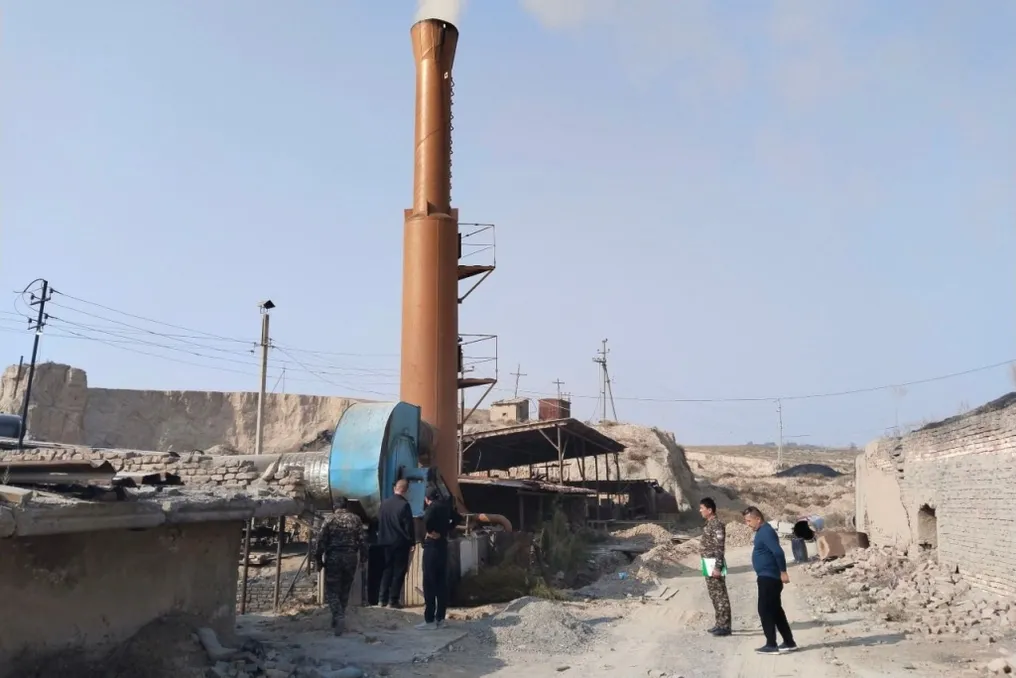
Brick factory in Namangan region suspended operations due to exceeding harmful emission standards
Read more
podrobno.uz

Brick factory in Namangan region suspended operations due to exceeding harmful emission standards

A decision was made in the Namangan region to temporarily halt the activities of a brick factory after environmental specialists recorded significant emissions of dust and gases into the atmosphere.

This situation became known on October 29 from the National Committee on Ecology and Climate Change. It was established that the production facility had violated environmental standards. The enterprise's management was handed orders requiring the elimination of the detected shortcomings, and the factory itself temporarily ceased operations.

Environmental inspections were also conducted in the Andijan region, where local residents filed complaints regarding smoke and dust emanating from brick and lime production facilities. Residents noted that such emissions created breathing difficulties.

Specialists inspected the dust and gas purification units installed at these production sites and collected samples for subsequent laboratory analysis. Appropriate measures will be taken based on the results of these studies in accordance with current legislation.

In the Andijan region, two makeshift kilns used for burning lime were also dismantled, and legal measures were applied against individuals who committed violations.

Inspections aimed at monitoring compliance with environmental requirements continue in various regions of Uzbekistan. Previously, the National Committee on Ecology warned that atmospheric inversion might persist in Tashkent, which hinders the dispersion of pollutants near the ground, and this condition could last for another ten days.

Ecologists explain the reasons for deteriorating air quality in Central Asia
Read more
podrobno.uz

Ecologists explain the reasons for deteriorating air quality in Central Asia

The issue of a sharp decline in atmospheric air quality has once again attracted public attention. Ecologists note that this problem affects not only the capital of Uzbekistan but also has a regional character. A detailed analysis of the causes was presented at the Committee on Ecology and Climate Change, based on data obtained from national and international observations.

According to monitoring data, on October 26, the Air Quality Index (AQI) exceeded the critical threshold of 100 units in six out of the eight largest cities in Central Asia. Specifically, in Bishkek, the indicator reached 160, placing the city fourth in the global anti-ranking for pollution. In Tashkent, the AQI was 157, and in Shymkent, it was 149, while in Dushanbe and Karaganda, it reached 134.

In neighboring Kazakhstan, the number of cities experiencing adverse meteorological conditions increased from four to ten in a short period. In Tashkent, the average daily index over a five-day period rose by 76%: from 93 points on October 21 to 164 points on October 26. The peak pollution was observed at night: over the last month, the average reading at 23:00 was 119, whereas during the day at 17:00, it remained at 82. The synchronous atmospheric haze in remote cities indicates that the main cause lies in the scale of regional atmospheric processes.

Causes: Anticyclone and Temperature Inversion

During the third decade of October, a sluggish anticyclone formed over Central Asia. The combination of calm winds, lack of precipitation, and strong temperature inversion prevented natural air movement. Physically, this manifests as warm air covering cooled ground, acting like an airtight lid, which stops vertical mixing of the atmosphere.

Under such conditions, the concentration of PM2.5 microparticles rapidly increases even with unchanged emission volumes, as exhaust fumes, heating smoke, industrial emissions, and lifted dust remain trapped in the lower layers of the atmosphere.

Natural Dust vs. Anthropogenic Factor

Central Asia is located within a vast arid zone that includes territories such as the Karakum and Kyzylkum deserts and the dried bed of the Aral Sea (Aralkum). Dusty plumes easily cross national borders, making it impossible to solve the problem of transboundary dust transport within a single city. Laboratory analysis of air samples taken in the Almazarsky, Yunusabadsky, and Mirzo-Ulubeksky districts of Tashkent revealed the composition of PM2.5 pollution particles:

39.7% was attributed to natural mineral dust from the deserts, and 42.6% to combustion processes related to transport, industry, and the energy system. During periods of intense dust storms, the share of the natural factor in the capital's air could reach 64%, and in some samples, 78%.

Annual Trend and Monitoring Network

The Ecology Committee emphasizes the need to separate short-term pollution spikes from the overall annual trend. For the period from January to October 19, 2026, the content of PM2.5 particles in Tashkent decreased by 28%, and PM10 by 32% compared to the same period last year. Furthermore, the average air quality index for October improved from 124 to 104.

To ensure timely control, the monitoring system in Uzbekistan has been expanded: 28 automatic monitoring stations have been connected to the national platform, whose data is available to scientists and the public in real time.

What needs to be done?

Specialists point out that climate change, drought, and reduced soil moisture contribute to an increase in the frequency of dust storms and atmospheric stagnation. In this regard, key measures have been identified: strengthening regional cooperation and prompt data exchange between the hydrometeorological services of Central Asian countries for joint dust transport forecasting; advance prediction of inversion phenomena and timely public notification; systematic reduction of emissions from factories, boilers, and transport, as well as increasing energy efficiency.

Strict control over dust suppression at construction sites and large-scale greening of uncultivated land, as well as competent urban planning that preserves air corridors, are also necessary. The main conclusion of the scientists is that weather conditions can significantly worsen the ecological situation, but protecting public health depends on reducing anthropogenic load and interregional coordination.

Director of the National Climate Change Center explains the reasons for prolonged smog in Tashkent
Read more
podrobno.uz

Director of the National Climate Change Center explains the reasons for prolonged smog in Tashkent

Air pollution observed in Uzbekistan, particularly in Tashkent, is linked to several factors, including unfavorable meteorological conditions and natural phenomena. These factors encompass a deficit of precipitation, windy weather, and disruptions to natural air exchange processes. This was reported by Farrukh Sattarov, Doctor of Philosophy in Technical Sciences and Director of the National Climate Change Center.

As of October 26 of this year, only 3.9 millimeters of precipitation were recorded in the capital, while the monthly norm is 23.7 millimeters. Consequently, the actual amount of precipitation was almost six times lower than the established norm. The lack of moisture slows down the process of natural washing away of dust particles, contributing to their concentration in the atmosphere.

Scientific observations indicate that over the last decade, the number of adverse meteorological conditions caused by strong winds and insufficient rainfall during the cold half of the year has increased by 57% compared to previous periods. This circumstance also hinders the self-purification of the air basin.

Specialists from the National Committee on Ecology and Climate Change compared data obtained from ground monitoring stations with satellite imagery for the period from October 1 to 26. For this purpose, the international atmospheric composition modeling system SILAM was used. The analysis established a direct correlation between the influx of dust masses and the increase in the Air Quality Index (AQI): on days of precipitation on October 4–5, the index was within the range of 66–71, but in subsequent dry days, the indicators worsened.

According to data from the European platform EUMETSAT and the Meteosat meteorological satellite, accumulations of large dust masses were recorded over Tashkent, Tashkent region, and partially over Syrdarya and Jizzakh regions on October 25 and 26. Experts predict that the impact of the dust front and adverse conditions related to pollution may continue until the beginning of next week.

Popular