The automotive world registered two notable events: the sale of a Honda NSX belonging to Ayrton Senna for an expressive value and Kimi Antonelli winning the Formula 1 world championship.
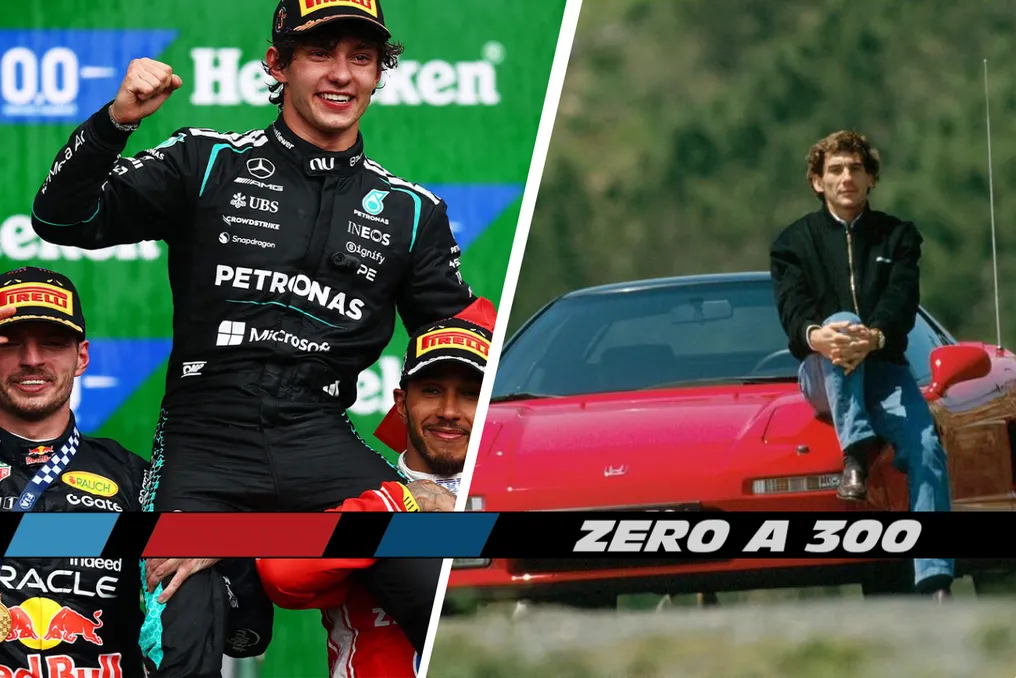
Regarding Senna's vehicle, one of the Honda NSX models was auctioned by RM Auction’s during The London Auction, its main event of October. The car, which was red and was in Senna's possession at Quinta do Lago, in Portugal, was sold for £871,000, which is equivalent to approximately R$ 6.3 million. This amount exceeded the initial estimate from the auction house, which placed the price between £500,000 and £800,000.
The history of the NSX, with chassis number T000233, is well documented: it was gifted by Honda to the Brazilian driver in 1991 and registered on March 22, 1991, with license plate SX-25-59. After Senna's death on May 1, 1994, the car passed to the dealership Nipomotor, located in the district of Faro, in Portugal, responsible for its importation. Subsequently, in 2009, it was bought by a car dealer in the Algarve, and in 2013, British collector Robert McGagan acquired the NSX for personal use.
The car was kept by a Japanese collector in the province of Nagoya. Although Senna owned two other black Honda NSX models, his image is more linked to the red model. The new buyer, whose identity was not disclosed, received all documentation, including a copy of the fax attesting to Honda's gift to Ayrton Senna.
In another sphere, Kimi Antonelli achieved the Formula 1 world title, becoming the youngest champion in history. The Italian secured the 2026 title last Sunday (the 1st), by finishing third in the Mexican GP with Mercedes. At only 20 years and 68 days old, Antonelli broke the record set by Sebastian Vettel, who won his first title at 23 years and 134 days in 2010.
Antonelli also ended a 73-year drought for Italy, which had not had a champion since Alberto Ascari in 1953. He arrived in Mexico needing only ninth place to secure the championship, regardless of the opponents' results. Starting in fourth place, he drove a cautious race, managing tires and avoiding issues in a race marked by accidents, Safety Car interventions, and a red flag resulting from the strong collision of Valtteri Bottas, who suffered a suspension failure in his Cadillac.
At the restart, Antonelli overtook Charles Leclerc and consolidated third place, which he maintained until the end of the race. The winner in Mexico was Max Verstappen, who started fifth and finished just 0.799 seconds ahead of Lewis Hamilton, who came second with Ferrari. Leclerc finished fourth, followed by Lando Norris, while George Russell, Antonelli's teammate at Mercedes, finished sixth.
This title was won in Antonelli's second season in Formula 1. He was selected by Mercedes to replace Hamilton in 2025 and, after an initial year of learning, became the third Italian champion in history, joining Giuseppe Farina and Alberto Ascari. With a lead of 119 points, he secured the championship early, even before the São Paulo GP, scheduled for the following weekend, November 6 to 8. Mercedes also leads the Constructors' World Championship, but has not yet secured the title.
Other news covered Anfavea's intention, the association of vehicle manufacturers in Brazil, to increase taxation on imported cars and restrict the entry of Chinese vehicles. Igor Calvet, president of the entity, presented proposals to Vice-President Geraldo Alckmin, aiming to curb the increase in imports, which grew by 106.4% between January and September 2026 compared to the same period last year.
The proposals include the creation of temporary trade safeguards, applied as a surcharge on vehicles imported by companies that do not produce in Brazil; the institution of an Automotive CIDE, a contribution charged on the value of imported vehicles, in addition to the 35% Import Tax, which may cover auto parts; and the negotiation of an annual limit on Chinese imports equivalent to 2.5% to 3% of the Brazilian market, or about 75,000 to 90,000 units annually.
It is relevant to note that the surcharge proposed by Anfavea would not affect imports made by the manufacturers themselves already operating in Brazil, nor the CKD and SKD kits used in local assembly. According to Calvet, these measures aim to protect the competitiveness of the industry installed in Brazil against the growth of Chinese brands and national production costs. Alckmin will forward the suggestions for technical and legal analysis by the government, with expectations of new developments in November, after Fenatran.
Additionally, the Dakar Rally will return to Africa, but with a change in route. The organization announced that the 2027 edition will take place between Portugal and Morocco, abandoning Saudi Arabia due to security issues in the Middle East. The 49th edition is scheduled to take place from January 9 to 23, 2027, starting in Loulé-Faro, in the Algarve region of Portugal, and finishing in Marrakech, Morocco. The total route will be 7,824 km, with 4,341 km timed, distributed over a prologue and 12 stages.
The Moroccan route will comprise 11 stages, passing through Bouarfa, Zagora, Agadir, Smara, and Dakhla before finishing in Marrakech. The organization foresees special stages of 350 to 500 km, covering mountains, rocky terrain, and vast desert areas in the south of the country, with a rest day planned in Agadir. The Dakar, which originated in 1978 between Paris and the capital of Senegal, had its trajectory interrupted in Africa in 2007, moving to South America in 2008 and then to Saudi Arabia in 2020. However, the move to 2027 is considered temporary, as the organization confirmed its return to Saudi Arabia in 2028 for the 50th edition. The 2027 calendar awaits formal approval from the FIA World Motor Sport Council. The Dakar Classic, intended for historic vehicles, will also follow the route to Portugal and Morocco.
Finally, the Renault Duster Oroch, pioneer of monocoque pickup trucks, ended its production in Brazil after 11 years and the sale of about 139,000 units. Renault launched this segment with the Duster bed version at the end of 2015, before the Fiat Toro. In 2022, the pickup underwent its last major update, changing its name from Duster. Although the Toro was a reference, the Duster was seen more as a utility vehicle, while the Toro presented a more modern and bold style.
The successor to the Oroch is the Renault Niagara, which was recently launched and began to be marketed in Argentina this Monday (the 2nd). Based on the platform and contemporary design inherited from the Boreal SUV, the Niagara has greater potential to compete with the Fiat Toro. Unlike the Oroch, which was manufactured in São José dos Pinhais (PR), the Renault Niagara will be produced in Córdoba, Argentina.