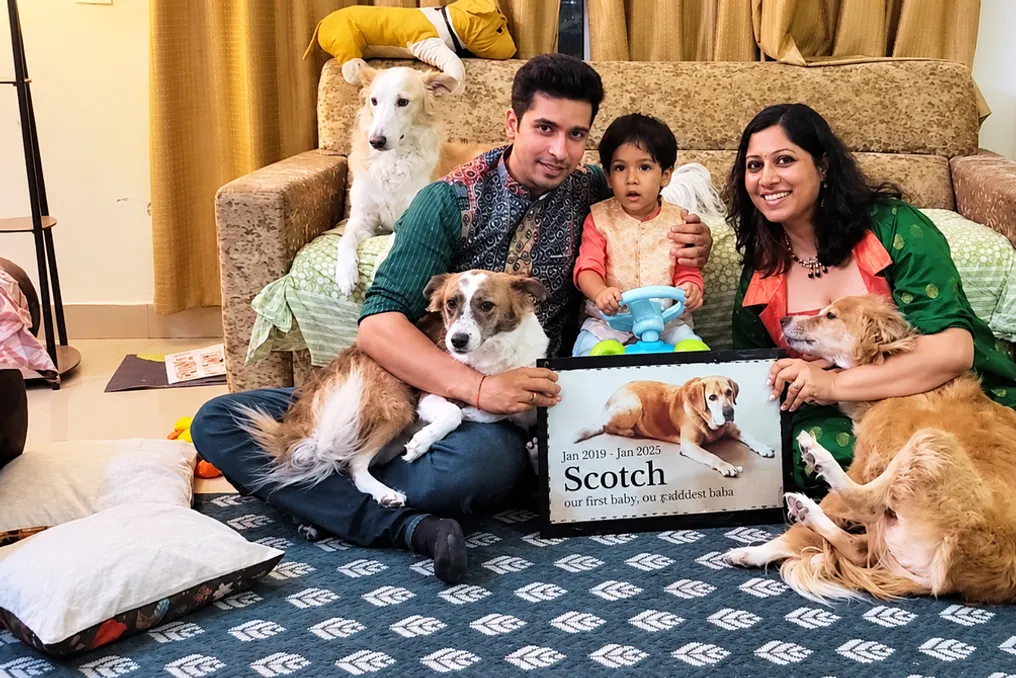
In one family home in Faridabad, the preparation for celebrating Diwali takes a somewhat different course. Three-year-old Rishaan Garg Batra is preparing to celebrate the festival with his parents, Neha Garg and Sidhant Batra, as well as the family's four dogs. Plans include lighting diyas, taking a family photo, meeting friends and relatives, playing games, and, of course, enjoying delicious food.
However, one element is absent from these celebrations—fireworks. There is also no rush to buy new outfits or festive decorations at the last minute.
For Neha, who is a podcaster, writer, and brand strategist, and Sidhant, an entrepreneur in IT and sports, Diwali has always been associated with the simple joys of spending time together. This couple never particularly enjoyed noisy festivities or the idea of acquiring something new on the occasion. Over the years, they have formed their own traditions around this festival of lights and are now instilling the same understanding in Rishaan.
For Rishaan, Diwali looks like a small number of lights, familiar faces, meals shared with loved ones, and created shared memories.
Two childhood experiences that changed their approach to Diwali
Neha and Sidhant had long felt discomfort about fireworks, albeit for different reasons. A turning point for Sidhant came when his sister told him about the child labor involved in pyrotechnics production. As a result, the two brothers decided to stop setting off fireworks around the fifth or sixth grade. Consequently, the whole family transitioned to a quieter format of celebrating Diwali.
Neha, on the other hand, grew up in a large, multi-generational family where fireworks played a significant role in the celebrations. Huge supplies were bought annually and distributed among different family groups, and every child received their share. Nevertheless, she never particularly liked them.
She recalls: 'I just didn't like the loudness and the cloud of smoke that remains after we set them off.' Furthermore, she was concerned about her mother, who suffered from severe allergies due to the smoke. While the other family members went upstairs to set off firecrackers, her mother often remained in the kitchen, coughing and struggling with the fumes. Neha says: 'Seeing her, I felt great stress and always wondered: why are we doing this if it causes her so much discomfort?' Instead of joining the others, she stayed with her mother and helped prepare a lavish festive dinner.
As they grew older, both began to realize the broader consequences of this practice—from air pollution and noise to animal suffering. Since they love dogs, the latter was especially difficult for them to ignore. When they became a couple, giving up fireworks became a simple decision they agreed upon.
90% of the child's wardrobe comes from second-hand stores
Another thing Neha and Sidhant never associated with holidays is shopping. Despite growing up in very different family environments, both had similar views on buying new clothes for special occasions. For Neha, weddings were times when new clothes were usually purchased. Since several weddings took place in her extended family, there were always outfits that could be reused for celebrations.
Sidhant also did not understand the idea that every holiday should be accompanied by a new wardrobe. In fact, he found it difficult to reconcile school essays describing the purchase of new clothes as an integral part of festive celebrations. Today, the couple maintains the same approach at home. Neha notes: 'We wear clothes we already have, repurpose outfits, and avoid purchases simply because a holiday is coming soon.' Instead, if they decide to spend money, it is usually on food or experiences they can share with family and friends.
Neha emphasizes: 'Food is a huge part of how we celebrate and how we view holidays and how we view unity. And if our money goes towards anything material at all, it goes towards food.' The same approach applies to Rishaan's wardrobe. Since his birth, the couple has consciously encouraged friends and relatives to give him used clothes instead of buying new ones. Today, almost 90 percent of his wardrobe consists of items from second-hand stores, including casual wear, formal wear, and traditional costumes such as kurtas. For Neha and Sidhant, this is something they practice only during Diwali; it is a lifestyle they want their son to consider completely normal.
Raising with four furry brothers
At home, some of Rishaan's earliest lessons in empathy are related to his relationship with the family's four dogs. The little boy knows that fireworks can scare his furry brothers, and that smoke and noise affect the animals around them. He has also begun to understand why his parents refuse to set off fireworks.
Sidhant recounts that Rishaan sometimes takes on the role of explaining this to others. 'If he sees people setting off fireworks, he approaches them and says, you know, it's bad. You shouldn't do it; it causes pollution,' he says.
The couple tries to explain the reason behind their decisions rather than just asking Rishaan to follow certain rules. They discuss with him what happens when people set off fireworks, why unnecessary purchases increase waste, and what they choose when they decide to celebrate differently. It is important to them that he understands the logic behind these decisions. Neha asserts: 'Children are not stupid. They are very smart. They understand if you logically explain to them why you are doing it one way and not another.'
A family photo that includes everyone
Although Neha and Sidhant prefer modest Diwali celebrations, one family tradition has become more significant as their family grows. One of their favorite rituals is the annual family photograph. It features the couple, Rishaan, their four dogs, as well as photos of three deceased dogs.
This tradition started quite spontaneously when there was only Neha, Sidhant, and their first two dogs, Koch and Maya. As the family grew, the photos grew too. When one of their dogs passed away, they decided to include its picture in the frame. The tradition has continued ever since.
Today, this photograph serves as a way to unite the entire family, including the furry members who are no longer with them. Another ritual they created is the joint lighting of diyas. On Diwali evening, the family gathers around the lights, prays in turns, and then prays together. Neha shares: 'We simply pray to the light, because it is a festival of light. So on that evening, we light diyas and pray as a family and pray as individuals to any power that may exist.'
They spend the rest of the day visiting friends and relatives, eating delicious food, and playing games such as Tambola, cards, and Dumb Charades. There is no complicated to-do list or pressure for the day to look a certain way. Just time spent with loved ones.
Small traditions they want to pass on to their son
Neha says that parenthood has made Diwali more meaningful for them. Previously, the couple was content with the festival remaining simple. Now, they strive to create memories and traditions that Rishaan can look forward to every year. Living in Faridabad, they are also aware of the pollution surrounding the festive season. The family hopes to celebrate Diwali in a less polluted and noisier place in the future, away from city festivities, although they have not yet managed to realize this plan.
When asked what she hopes Rishaan will remember about Diwali when he grows up, Neha does not talk about what they have decided to exclude. Instead, she hopes he remembers happiness, food, games, family photos, and time spent with friends and loved ones. For parents who want to make their celebrations more mindful but fear their children might miss out on something, she has a thought based on her own experience. 'Children only miss what they know. If they know your path, they won't miss any other path.'
For Neha and Sidhant, the hope is that Rishaan grows up understanding the reasons for their choices and finds happiness in the traditions they share. For this family, Diwali is lighting a few diyas, gathering everyone for that cherished photo, and ensuring there is always a seat at the table for one more person.
}, {