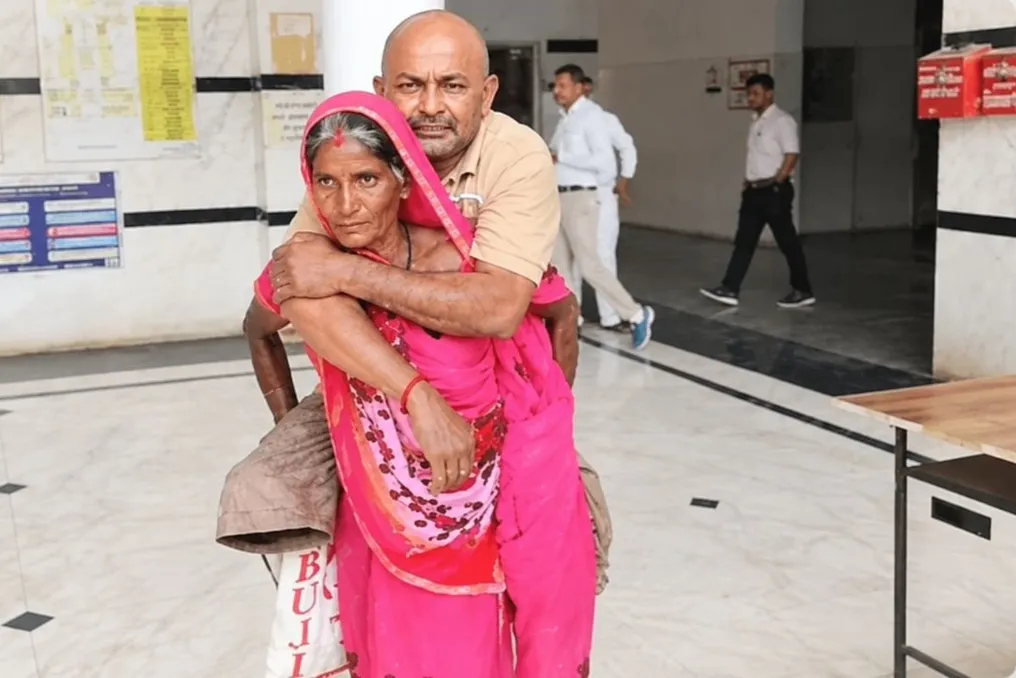
Woman carries paralyzed husband to collectorate demanding pension and tricycle
Read more
YourStory [india, en]
yourstory.com

Woman carries paralyzed husband to collectorate demanding pension and tricycle

A video showing 60-year-old Bindubai carrying her paralyzed husband, Dayashankar, on her back to the Burhanpur collectorate in Madhya Pradesh state went viral on social media on Saturday evening. She went there to request a tricycle and disability allowance for her husband.

The video came to the attention of Chief Minister Mohan Yadav, who ordered immediate assistance for the family. According to NDTV, Dayashankar has since been provided with a tricycle, and the family has received support for their daughters' education.

The young couple lives in Mahadjan Colony and attended a public hearing regarding complaints, where Bindubai met with Collector Vivek Kumar. Dayashankar was paralyzed nine years ago, and one of his legs was amputated during treatment. Since then, he has been unable to walk, and Bindubai carries him when he needs to be moved.

She presented a certificate confirming his paralysis. In the video, she states that officials told her she would receive nothing.

Bindubai's situation is not unique. Unpaid home care disproportionately falls on women. According to the Ministry of Statistics and Programme Implementation's Survey of Time Use for 2024, 34% of women aged six and over participated in unpaid care for household members on the day of the survey, compared to 17.9% of men.

Bindubai's persistence after being told she would receive nothing represents a form of leadership that is rarely highlighted. Her event, SheSparks by YourStory, highlights women leaders and innovators, which will take place on February 19 and 20.

Similar stories

Widow's Allowance Scheme in UP: Who Receives 1000 Rupees Monthly and How to Apply
Read more
www.aajtak.in

Widow's Allowance Scheme in UP: Who Receives 1000 Rupees Monthly and How to Apply

The state of Uttar Pradesh is implementing a welfare program that provides financial support to women whose husbands have passed away and who lack stable sources of income. This program, known as the Widow's Allowance Scheme, is also referred to as the destitute women's allowance scheme.

The main objective of this initiative is to provide financial assistance to needy women to cover their daily necessities.

As of October 2026, according to media reports, the state government is considering increasing the monthly allowance amount for the elderly, destitute women, and people with disabilities from 1000 to 1500 rupees. These reports mention that the total number of beneficiaries across the three categories exceeds 1.21 crore.

However, it should be noted that the increase in the amount is subject to the approval of the cabinet and the issuance of an official order; until an official order is released, the current amount should be considered 1000 rupees.

Applications are submitted online through the state's social security portal. Typically, required documents include income certificates, Aadhaar number, bank details, and a death certificate of the husband for widows.

This allowance represents the most direct manifestation of welfare, as it reaches women who do not possess savings and have no provider in the family.

70-year-old grandmother pulled stretcher on her own in a hospital in Rajkot
Read more
www.aajtak.in

70-year-old grandmother pulled stretcher on her own in a hospital in Rajkot

The hospital lacked staff to transport the patient on a stretcher, which forced an elderly woman, around 70 years old, to take charge of the stretcher and start pulling it herself. Her relatives, who needed to be taken for treatment, were on the stretcher. This video, shot at the Rajkot Civil Hospital in Gujarat, went viral, raising questions from the public.

A natural question arises: why did she have to overcome difficulties on her own at such an age, when she might need assistance, just to get a sick family member to treatment? After this incident became public, the hospital administration announced an investigation and notified the relevant agency.

The Rajkot Civil Hospital is considered one of the major hospitals in the Surat region and attracts patients hoping for treatment, especially families who cannot afford expensive private clinics, as state institutions are a significant support. However, what is shown in the viral video calls this system into question: an elderly woman is depicted pulling a stretcher across the hospital grounds, carrying her relative who needs medical care.

Imagine the situation: the patient's condition worsens, the family is already under stress, and in such circumstances, the responsibility for moving the patient within the hospital is placed on an elderly person. This only exacerbates the problems. The video captures a 70-year-old woman pulling a stretcher. Nevertheless, details about the exact circumstances at that moment, whether staff were present, or why the woman had to pull the stretcher alone, have not yet been disclosed.

After the video spread widely, M.S. Roy, an accountant at the Rajkot Civil Hospital, commented on the situation. He called the incident regrettable and stated that an investigation was underway. According to the administration, the relevant agency received official notification. The need to develop Standard Operating Procedures (SOPs) to prevent similar incidents in the future was also voiced. The administration emphasized that compliance with rules regarding providing personnel for transporting patients on stretchers would be strictly monitored so that patients and their relatives do not face similar difficulties, thereby acknowledging the seriousness of the situation.

This entire situation raises several questions concerning the hospital system itself: were there truly no staff available to move the stretcher at that time? Did the relevant agency fulfill its duties properly? Or was there some unforeseen circumstance whose information has not yet become public? The answers to these questions are currently unknown, although the administration has announced the start of an inquiry. One thing is clear: having stretchers in a hospital and the ability to receive help when needed are two different things; convenience only makes sense when it benefits the patient.

Popular