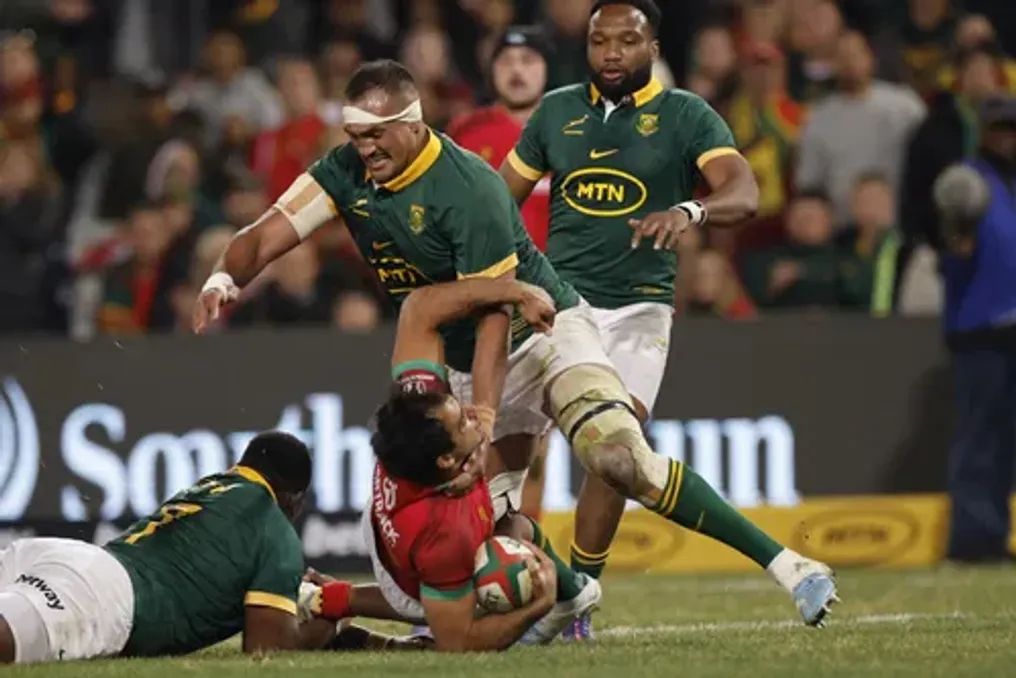
Coach Rassie Erasmus defended the inclusion of Salmaan Moerat in the Springbok squad before the match against Italy
Read more
IOL
iol.co.za

Coach Rassie Erasmus defended the inclusion of Salmaan Moerat in the Springbok squad before the match against Italy

Ahead of the upcoming South African National Championship match against Italy in Turin, head coach Rassie Erasmus strongly defended the inclusion of Paarl player Salmaan Moerat following social media controversy regarding his place in the team.

Moerat, who will take position number 4 instead of injured Eben Etzebeth, is preparing for his first appearance for the Springboks this season against Italy on Saturday. Previously, he had been sidelined for a long time due to neck and toe injuries.

Despite Moerat often struggling to regain match fitness due to setbacks in previous seasons, Erasmus has consistently supported him, even against strong criticism from the coach's detractors. The phrase 'Rassie knows best' often proves true given Erasmus' impressive career as a Springboks coach and his achievements since returning to leadership in 2018, making it foolish to question his decisions.

However, comments about Moerat on social media are full of skepticism. This raises the question: why does Rassie support Moerat?

In response to the criticism Moerat sometimes receives from fans, Erasmus explained that the Springbok coaching staff evaluates functional performance, not external hype. He stated: 'I never truly listened to people who talk nonsense about Salmaan because he is not the player you see on the field doing flashy things, and we do not expect him to do that.'

He continued: 'We expect him to do what he always does for us. We need a hard worker like Jean Klerk or RG Snyman. RG is also a bit more flashy, but that is what we need in the team, and Salmaan brings that to the team.' Erasmus added that no one probably understands how hard he works in scrums, how much he drives through tackles, how he clears players from rucks, how physically strong he is, and how well he stops mauls. He concluded: 'But we are not upset that people don't see it. As long as Salmaan and his teammates know that we see and value it, he is the guy we are happy to have in our team.'

Nevertheless, there is statistics that supports Erasmus' words. While casual observers focus on dynamic ball carrying in open space, performance metrics highlight Moerat's exceptional effectiveness and physical capability around the field.

According to last season's United Rugby Championship campaign statistics, Moerat demonstrated an outstanding successful tackle rate of 90%, becoming one of only two South African locks to achieve this. Furthermore, he ranked second behind Etzebeth (1.8) in the metric of 1.4 meters post-contact per carry.

Erasmus also noted his importance in mauls, as new rules make it difficult for the defending team to counter this tactic. Moerat is a key specialist in stopping mauls, combining his intelligence and strength, which creates difficulties for opponents. These data, combined with an exceptionally low overall error count of only 0.8 per match, underscore why he provides the necessary solid foundation that allows more free and flashy forwards to succeed.

After moving to the French Top 14 heavyweights La Rochelle, Moerat quickly adapted after the toe injury that ended the previous campaign, demonstrating a series of dominant physical performances in one of the most demanding domestic rugby leagues.

Beyond his work in tight contact, Moerat's quiet authority and natural leadership have earned immense trust within the Springbok squad and among the coaching staff. With experience as a South African captain, including leading the team to victories during his tenure, his composure under pressure provides the Springboks with another strong leadership option on the field.

When the Springboks face Italy in Turin, Moerat will have the perfect opportunity to once again show why he remains highly valued by the world champions, regardless of the noise on social media.
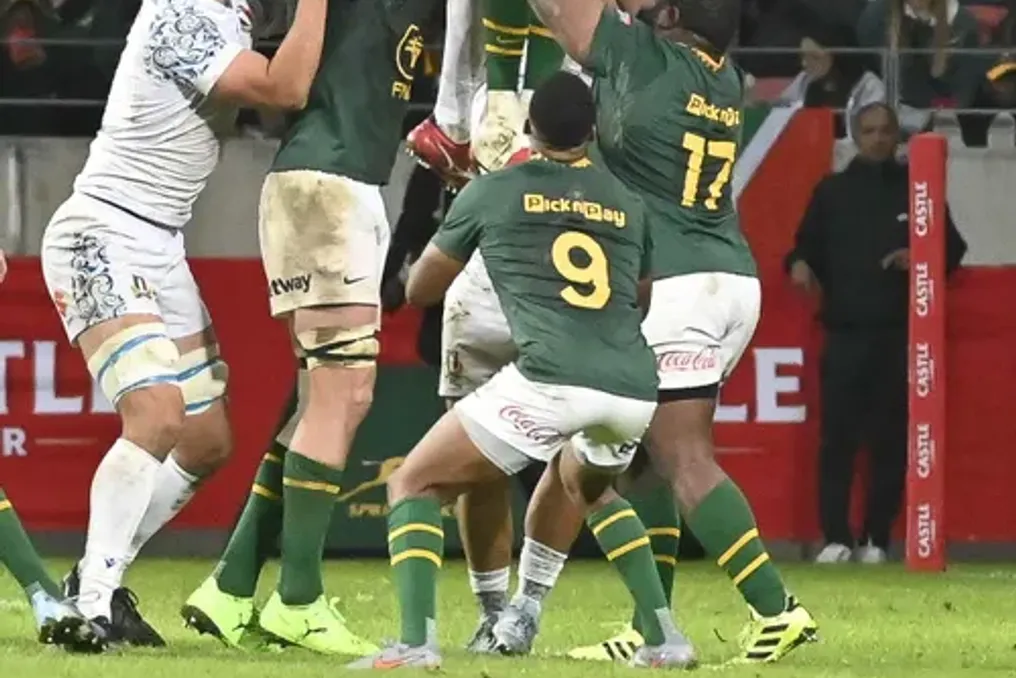

Similar stories

Rassie Erasmus defends Salmaan Moerat and criticizes opponents ahead of Italy match
Read more
iol.co.za

Rassie Erasmus defends Salmaan Moerat and criticizes opponents ahead of Italy match

Although Salmaan Moerat does not always attract attention with flashy moments or headlines, the Springboks' head coach, Rassie Erasmus, highly values his contribution to the World Cup squad. He issued a strong defense of the player, explaining why his work in scrums, mauls, and ball retention makes him an important part of the world-champion team, despite periodic criticism.

Moerat will play for the world-champion team for the first time this season as he was included in the 23-man squad for the Nations Cup match against Italy, which will take place in Turin on Saturday. This former Stormers player quickly adapted at La Rochelle in France, showing several good performances for the new club. He has now returned to the Bok squad, replacing Eben Etzebeth at number 4 after missing Nations Cup and 'The Greatest Rivalry' matches against the All Blacks due to neck and leg injuries.

Erasmus emphasizes Moerat's unsung work

Erasmus stated that they know what kind of physical player they have in the tight five and expect him to do his job, as always, when playing against the Azzurri on Saturday. 'I never listened to people who say nonsense about Salmaan because he is not the player you see on the field doing flashy things, and we don't expect that from him. We expect him to do what he always does for us,' Erasmus said about the star from Paarl.

He continued that they need a 'hard worker' like Jean Klerk or RG Snyman. While RG is more spectacular, that is what the team needs, and Salmaan brings that to the collective. 'Nobody probably understands how hard he fights in scrums, how hard he participates in mauls, how hard he cleans out the ball at the ruck, how physically strong he is, and how well he stops mauls. That is probably something that cannot be explained to people,' the coach noted.

Nevertheless, Erasmus added that they are not upset that people do not see this. As long as Salmaan and his teammates know that the management sees and values their efforts, he remains a player they are happy to have in the squad. 'So, when it comes to things that people don't understand or don't fully see, I understand why they have their opinion. But, obviously, we have our opinion about Salmaan.'

Erasmus acknowledged that the Springboks pay attention to public opinion in South Africa and regularly monitor discussions and criticism on social media. He also mentioned that Moerat has captained South Africa several times and performed well in those matches. This tight five led the team in three Championship matches and won two of them.

'Obviously, we listen to what people in South Africa are saying. I am not going to pretend that we are like other countries and say that social media doesn't affect us. I follow it. I like South Africans who have opinions on things, and I certainly saw it when Willie (Le Roux) was heavily criticized, when Faf (de Klerk) was out of action, and I also saw moments when someone succeeded against all odds.'

The match against Italy gives Moerat another opportunity to demonstrate why he remains highly valued in the Springboks squad, regardless of critics' opinions. With the firm support of the Bok management, he intends to let his game speak for itself in Turin.

Rassi analyzes the composition of the South African squad ahead of defending the World Cup title
Read more
iol.co.za

Rassi analyzes the composition of the South African squad ahead of defending the World Cup title

Rassi Erasmus faces the challenge of deciding which players from the Springboks and young forwards of the South African national team should be retired, and whom to support to form a team capable of winning a third consecutive World Cup.

World Cups are often remembered by teams that crossed the line when their emotional coaches could not let go of aging stars. However, Erasmus will not allow such a scenario, as the 'Boks' are preparing to defend their title in Australia next year.

His November squad demonstrates an understanding of this task. The inclusion of several promising young players is aimed not at a complete overhaul of the South African national team, but at ensuring the readiness of the next generation for when the current elite leaves the field.

Young talents such as Yakin Ahmed, Luan Gillime, Marcus Müller, and Riley Norton were included, while Sebastian de Clercq and Emmanuel Tsituka took their places due to good form in the United Rugby Championship.

As the South African national team's opening match against Italy in Adelaide on October 3, 2027, approaches, Erasmus has little time to determine which young players can transition from promising candidates to genuine contenders for the Tests.

The November tour is seen as the ideal opportunity for this determination. At the beginning of the year, Erasmus set two key goals for 2026: achieving victory in the 'Great Rugby Rivalry' and building squad depth during international matches in July and November.

He followed this plan in July, making significant changes to the lineup for matches against Scotland and Wales after fielding his strongest team against England. Now, ahead of another intense series of games, the focus is on finding players who can withstand the pressure of international rugby without lowering the standard of the South African team's victories.

Erasmus acknowledges the value of investing in youth. The South African junior team won the U-20 Rugby World Cup in both 2025 and 2026, providing a promising stream of talent for the senior team.

Fourteen players from these recent junior successes have already gained experience in the United Rugby Championship, and three—Wusi Moyo, Jaco Williams, and Norton—have advanced to play for the senior South African team.

This is an encouraging result, but the real test is how many of them can establish themselves as permanent international players and, ultimately, World Cup contenders.

Rugby in South Africa has previously shown similar progress. The 2002 Junior World Cup champions under Jake White included John Smith, Shalk Burger, Jean de Villiers, Frikkie du Preez, and Ricky Januarie. They became central figures in the triumph of the South African team at the 2007 World Cup, where Smith led the team to glory.

The takeaway is not that every junior champion will become a star in the senior squad, but that a strong development system can lay the foundation for future international success.

School rugby is also becoming increasingly professional, helping young athletes arrive in senior squads better prepared for the demands of elite competition. Erasmus has an additional advantage in close cooperation with South Africa's U-20 coach, Kevin Fourie, which gives him insight into the progress and potential of young players long before they reach the senior squad.

His current task is to turn this potential into reliable squad depth for the Tests. This does not mean throwing a handful of young players into deep water and hoping they learn to swim. Erasmus usually prefers to introduce newcomers gradually, surrounding them with experienced veterans who can help them settle in.

The November opponents must provide a tough test. Italy is capable of causing problems for the South African team, regardless of its world ranking. Old rivals France and Ireland will be very difficult opponents.

Erasmus acknowledged that the National Championship format adds extra motivation, as every earned point could be decisive in the race for the top of the table.

South Africa is currently leading the Southern Hemisphere rankings in points difference, with 15 points, the same as New Zealand. The South African team will play Italy on November 7, France on November 13, and Ireland on November 21, before the Final weekend in London from November 27 to 29.

The immediate goal is to win, but the long-term mission is no less important. Erasmus must determine which veterans are still playing a vital role, which young players are ready right now, and where succession planning remains incomplete.

Popular