In early July, one resident of Wenzhou, Mr. Zhang, received a typhoon forecast. He removed solar panels covering 1000 square meters from his roof in Zhejiang province, located in eastern China. However, two days later, Typhoon Bawi struck the province, tearing solar panels from numerous roofs. Broken panels and bent frames scattered across the streets. Meanwhile, heavy rains fell in southwestern China, flooding solar modules and transformers at a power station in Guigang, Guangxi province.
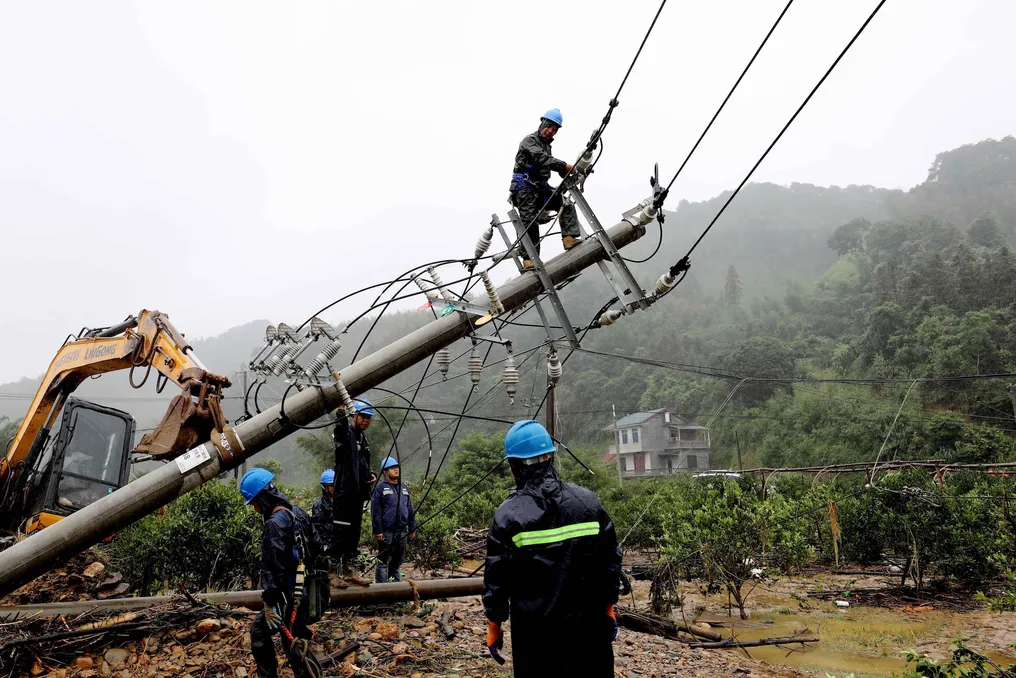
A few days earlier, further inland in Hubei, tornadoes and thunderstorms damaged power lines. Wind and solar power plants were affected, including their generation equipment, transmission lines, and drainage systems.
Such weather-related damages can occur anywhere in the world: heatwaves and droughts reduce hydropower generation; lower and warmer rivers force nuclear power plants to shut down due to inability to maintain cooling; and stations using seawater for cooling face intake blockage from jellyfish blooms.
Clean power plants are intended to reduce global warming, but they must also be resilient to extreme weather events brought by climate change. However, these events are just the tip of the iceberg. Experts warn that the long-term consequences of changing patterns of solar activity, wind, and precipitation are unpredictable, and clean energy equipment must be designed and sited with these issues in mind.
According to the latest 'Blue Books on Climate Change,' published in July, China is experiencing an increase and intensification of heatwaves and heavy rains, as well as more unpredictable typhoons. These annual publications, prepared by professors and experts, contain detailed information on specific topics such as oil distribution, climate change, or environmental protection.
Studies show that prolonged high temperatures reduce solar energy generation efficiency by approximately 0.5% for every degree above the baseline of 25°C. Solar panels also lose efficiency when covered with snow, and wildfires and hail can damage them. Extreme precipitation can decrease solar energy output, although it increases hydropower generation, but it poses a threat to power grids and other infrastructure.
Strong winds and typhoons present a more obvious threat. In September 2024, Typhoon Yagi hit Hainan in southern China, overturning turbines at a wind farm and causing tens of millions of dollars in damage. A global review showed that strong winds were responsible for over half of all wind turbine collapses between 2000 and 2016.
Chinese standards require that the supporting structures of solar panels withstand wind speeds of 'once in 50 years' for the given area. Overall, the industry ensures that its structures can withstand winds of 216 km/h generated by a Category 17 supertyphoon. Nevertheless, strong wind remains a serious threat to solar energy. In April 2025, rooftop installations in northern and central China were damaged or blown off. More serious than the economic damage are human casualties: in June of the same year, solar panels and other items on the roof of an elementary school in Dezhou, Shandong province, were blown off, resulting in one student's death and two injuries.
According to the climate insurance company KWh Analytics, hailstorms pose the greatest financial threat to solar energy, not wind. A study published in August found that the main threats to solar energy systems in China are strong winds and hailstorms, which can cause damage worth tens of millions of yuan.
However, the simultaneous occurrence of two or more disasters is worse than any single event. When southwestern China faced a heatwave and drought in the summer of 2022, peak energy consumption increased by 25%, while hydropower generation halved. Many businesses were forced to close to ensure power supply to homes.
The combination of two or three anomalous weather events—heat without wind, cold without sun, cold and snow—affects electricity generation, transmission, demand, and infrastructure in complex ways. In April 2025, vast areas of China were affected by strong winds, sandstorms, cold waves, heavy rains, and blizzards. Snow and sandstorms devastated the north, while the south experienced heavy rains and severe thunderstorms. According to a study published in June, numerous solar panels and 1100 power lines were damaged, leaving 1.35 million households without electricity. Strong winds increased wind energy generation by over 40%, while sand, rain, and snow reduced solar energy generation by approximately 20%.
Wei Ke, a researcher from the Institute of Atmospheric Physics, Chinese Academy of Sciences, stated: 'More frequent extreme weather events caused by climate change pose an overarching threat to renewable energy facilities and the power supply system. The grid requires stability in generation, demand, and transmission. We must consider now how it will cope with unstable climates.'
Long-term climate changes will have a broader impact than just extreme weather events. Changes in wind speed, solar radiation, and temperature will affect the generation of wind and solar energy, as well as the optimal locations for their use. Wang Yu, a researcher at the Institute of Energy, Environment, and Economy, Tsinghua University, told Dialogue Earth: 'Planning and cost estimation for connecting renewable energy sources to the grid are mainly based on historical climate data. Future changes may lead to a divergence of these estimates from actual costs. If we add more frequent extreme weather events to this, problems with safe and stable grid operation may arise.'
According to the China Meteorological Administration, the number of rainy days in China has decreased between 1961 and 2025, although the total amount of precipitation has increased. There are also regional differences. For example, in the southwest, where much hydropower occurs, there are fewer rainy days.
Prolonged periods of low sunlight certainly affect solar energy generation, and climate change is making them longer. In China, such 'solar droughts' usually occur in the Sichuan basin and the eastern part of the Yunnan-Guizhou plateau. However, a 2025 study shows that their number increased between 1981 and 2020, especially in the middle and lower reaches of the Yangtze and in the northern plains of China.
Similarly, wind drought hinders wind energy generation. Globally, wind speed at an altitude of about 10 meters above the ground has steadily decreased between 1970 and 2010—a phenomenon known as the global land lull. This effect is most noticeable in the mid-latitudes of the Northern Hemisphere, which includes China and other parts of East Asia. Some studies have found an increase in wind speed after 2010, but research by the National Climate Center in 2026 still showed a decrease in wind speed in China by 0.06 m/s per decade between 2005 and 2024.
A 2025 study indicated that changes in wind speed and solar radiation could slightly reduce the potential for low-cost renewable energy in China. Zhu Xiangrong, the lead author of this study and a Master's student at Tsinghua University, explained: 'Areas where resources are currently abundant, such as Xinjiang, Qinghai, and Inner Mongolia, all in the north, will see a noticeable decline, while provinces in the south will generally increase. However, the north still retains far more renewable resources.'
In addition to the diverse and generally negative impact on the generation side, Wang Yu noted that climate change can exacerbate the mismatch between generation and demand. For instance, during a heatwave, the demand for air conditioning electricity rises sharply, while solar and wind energy generation may decrease. Droughts and hot weather often occur simultaneously, meaning increased electricity demand precisely when hydropower generation is low and water for cooling coal or nuclear power plants is scarce.
These changes will increase pressure on both the supply and demand sides, subjecting the power supply system to increased stress. As mentioned, the power supply system and clean power plants are based on historical data on demand and climate. But climate change causes more frequent extreme weather events and makes renewable energy output less predictable. All of this requires new requirements for materials, technologies, site selection, and early warning systems used in clean energy projects.
Sites chosen for offshore wind energy projects may face increased extreme wind speeds. This necessitates more robust turbines designed to feather blades to protect the more expensive tower and nacelle. Research has shown that the greatest threats from strong winds and hail to solar energy generation in China are in the east, but strong winds will spread to central China by 2060.
In the future, disaster risks must be considered when selecting sites for solar projects. Installations in areas prone to strong winds may be tilted differently or use stronger support structures to minimize damage. Experts note that as the power supply system becomes more dependent on renewable sources, the risk of persistent extreme weather events must be considered at the planning stage, affecting questions of construction location and equipment durability.
Wei Ke proposes a three-pronged defense: upgrading equipment and intelligent control will make the power supply system more reliable; flexible grids and various forms of energy storage can smooth out fluctuations in supply and demand; and regional cooperation can redistribute electricity loads across different locations or times. China, of course, is preparing for the consequences of climate change. Its national adaptation strategy until 2035, published in 2022, included increasing the climate resilience of the energy industry. Solar power plant design standards, published in 2024, now require protective measures where extreme weather conditions occur, where sandstorms are common, and in coastal shallows and high air pollution zones. There are also rules regarding the materials used in solar modules and support structures, requiring consideration of climatic conditions, temperature, wind, snow, and corrosion. Rules on climatic conditions and extreme weather events cover both onshore and offshore wind projects. In typhoon-prone areas, standards for offshore wind projects account for rare occurrences such as extreme winds, rough seas, and storm surges. Wang Yu emphasized that the 20-year service life of solar and wind energy equipment is sufficient to survive ongoing climate change. Decisions made today will determine the level of risk for decades to come. When planning large energy projects, changes in the availability of wind and sunlight caused by climate change must be taken into account.