The author recounts his long-held desire to participate in Autoclásica, an event held in San Isidro, Argentina, a wish he had been postponing for at least four years due to organizational difficulties, city changes, and lack of financial and personal planning.
In addition to Autoclásica, there was another long-desired destination: the Fangio Museum, located in Balcarce. Both locations are considered must-see spots for automotive enthusiasts in Argentina, although they are not adjacent, which required more detailed planning.
In 2025, MAO managed to make the trip to Autoclásica. That year, Pedro from ACE organized an expedition sponsored by Ford, which transported five Brazilian Ford Model A cars to the Argentine exhibition, supported by a Bronco and an F-150.
This expedition led to something even more remarkable. In the same year, another Pedro, known as Mazza, undertook a motoring journey across Argentina, visiting workshops and racetracks. During a stop in Balcarce, at the headquarters of Crespi Competición, founded by Tulio Crespi in the 1960s, Mazza spoke with Tulio and discovered the possibility of driving some of the company's cars on the local racetrack.
Balcarce also offered the opportunity to visit the Juan Manuel Fangio Museum, administered by the foundation named after the five-time champion. The proposal went beyond a simple visit, including the chance to drive historical cars maintained by the Foundation.
Organizing this experience required more than just attending; it necessitated establishing contacts, structuring logistics, and gaining access. Thus, the two Pedros joined forces to organize the 2026 expedition, integrating ACE and Driven by Mazza. The package included the international travel, participation in Autoclásica, and exclusive experiences in Balcarce, with accommodation at the Casco de Fangio, a hotel belonging to the Fangio foundation.
FlatOut acted as a media partner, and the trip would serve as an opportunity for the format to get close to and evaluate what could be offered to members of the FlatOut Clubsport.
For the author, the main motivation was to realize the visit to Autoclásica and the Fangio Museum on the same trip, with the possibility of driving race cars in Balcarce being an unexpected element in the initial itinerary.
The expedition departed from São Paulo on October 3rd, traveling through Southern Brazil, crossing Uruguay to Colonia del Sacramento, and subsequently crossing the Río de la Plata to Buenos Aires. From there, they headed to Balcarce, where Crespi, the racetrack, and the Fangio Foundation awaited them, before returning to the Argentine capital for the four days of Autoclásica.
The participants would use three distinct vehicles: a 1982 Chevrolet Chevette, a 1992 Volkswagen Gol CL with a 1.8 engine and GL characteristics, and a 1972 Triumph GT6. A Volkswagen Golf Variant would serve as support vehicle. These cars belonged to the participants themselves, clients of the expedition, and FlatOut subscribers, representing different automotive schools.
Kiko, Fernando, and Marco opted for the road trip. Fernando and Leonardo would fly to Buenos Aires, joining the group only for the activities in Balcarce. Additionally, the Pedros had the task of transporting two Brazilian sports cars from the Dream Car Museum collection in São Roque—a 1979 Concorde and an automatic Hofstetter Turbo—on platforms, managing their own logistics to cross borders.
The original plan involved a second support car, but the lack of sponsorship prevented this change, forcing the author to travel as a passenger. He also intended to extend his stay in Buenos Aires to reunite with his wife, planning a more reflective trip inspired by authors such as Clarkson, Chesterton, and Setright. However, he ended up without a car, but not without the trip.
The group met on Saturday evening in São José/SC, after the first phase started in São Paulo. On Sunday, they would head to Pelotas/RS, where they would spend the night before crossing the border into Uruguay on Monday.
A Long Sunday
On Sunday morning, while leaving São José for Pelotas, the Triumph experienced ignition failures, a common electrical problem in old English cars. Although Marco, the owner, knew that exciting the alternator would be necessary, the procedure did not solve the problem that day. Suspicion fell on the battery, but since they were in the Florianópolis region, no one worried excessively about finding a battery on Sunday.
After resolving the starting issue, the group proceeded, monitoring the battery charge. The pace was set by the slowest, especially the Chevette, maintaining an average speed between 80 and 100 km/h. During a stop between Santa Catarina and Rio Grande do Sul, it was noted that the battery was not charging, although the alternator prevented a drastic loss of charge. The cause of the Triumph's electrical problem was identified as a loose terminal on the alternator.
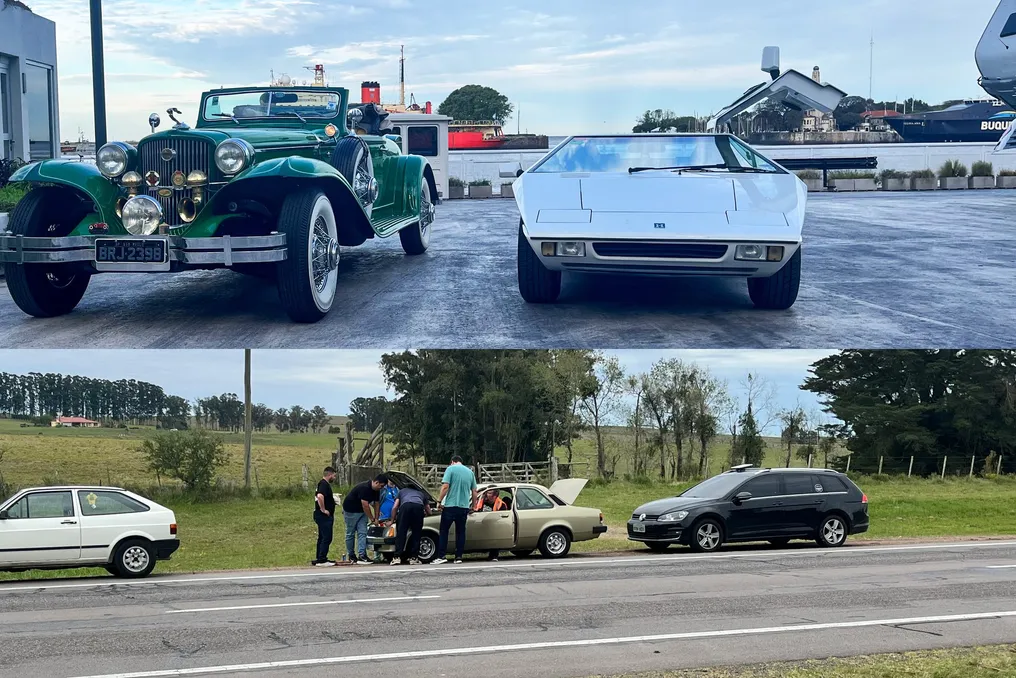
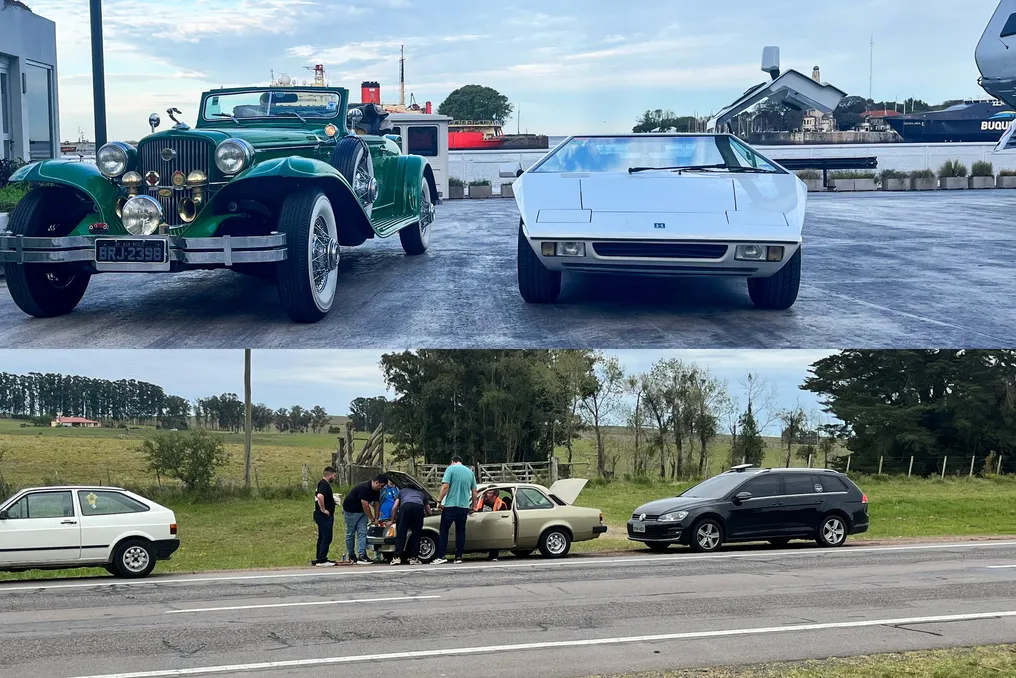
Upon reaching near the Gaucho capital, in the lowlands near Gravataí, Marco and his father detected a noise coming from the rear axle of the Triumph. The suspicion was a wheel bearing defect, which required immediate attention. The challenge was finding a mechanic available in Porto Alegre on a Sunday afternoon.
Using the FlatOut network, the author requested help from FlatOuters in Rio Grande do Sul. Marcos de Sá indicated Jonatas, a mechanic who agreed to receive them at his residence near Cachoeirinha, where he had the necessary tools to try to solve or mitigate the problem.
While heading to the workshop, the Gol had another unforeseen issue: its mechanical fuel pump failed, requiring it to be towed to Jonatas's house. The expedition, which began with four vehicles, began facing challenges with the Triumph suspected of bearings, the Gol unable to proceed alone, and a Chevette with an unstable carburetor, all in the middle of the second day.
Despite the setbacks, the atmosphere remained friendly among the enthusiasts. After disassembling the Triumph's wheel hub assembly, it became evident that the bearing was damaged, likely due to improper previous installation, where excessive tightening of the bolt damaged the component instead of correctly adjusting the clearance.
Without new bearings, continuing the journey would be risky. Marco chose to stay in Porto Alegre with his father, planning to source the bearings and finalize the repair to reach the group in Argentina on Monday. The rest of the group continued, as it was crucial to arrive in Pelotas that night to receive the platforms with the Concorde and the Hofstetter before the Uruguayan border.
The day ended with the group arriving late in Pelotas. The first Sunday of the expedition concluded with a disabled car, two unplanned mechanical interventions, and a significant delay, but the overnight destination was reached.