Approximately three months after the publication of the Dialogue Earth report on the lack of drinking water in two Adivasi villages in the state of Jharkhand, eastern India, local authorities presented plans for creating new water infrastructure and ensuring emergency supplies.
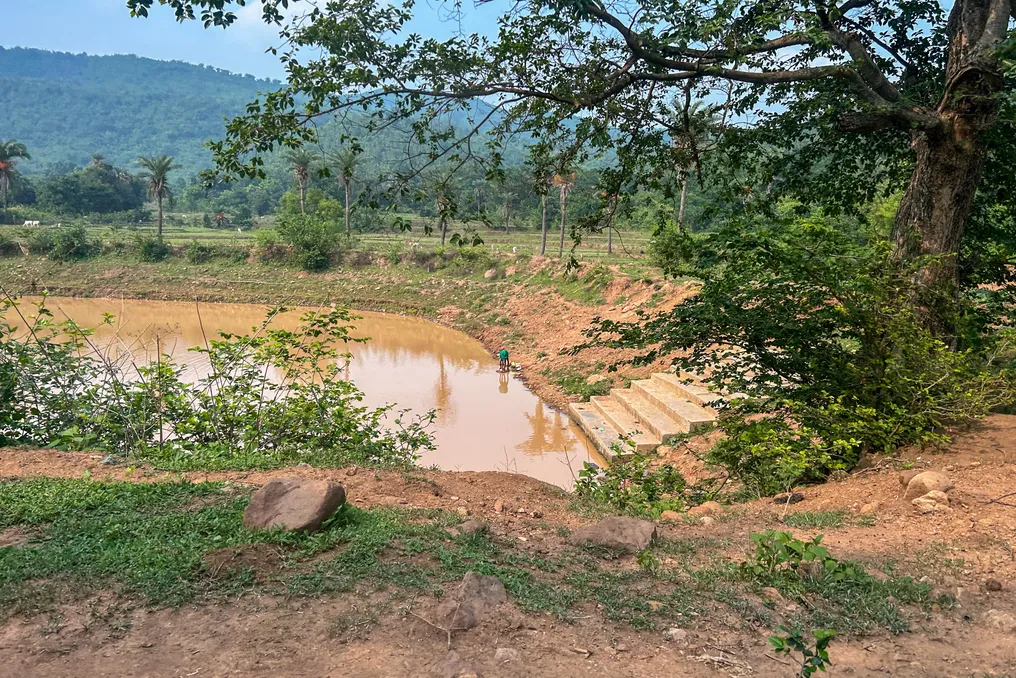
In June, representatives of Dialogue Earth visited Adivasi families and community leaders in the villages of Ukhrapahari and Burhidangal, located in the Dumka district. They found that residents were no longer migrating with the intention of settling elsewhere; previously, they would leave temporarily to earn money for building a house or holding a wedding back home. Their attachment to home remained despite problems, including the lack of safe water. Without functioning water supply, residents had to use natural ponds, which were shared with domestic livestock and wild animals. Women had to make several arduous trips daily to these unclean water bodies.
Residents reported that in January 2025, officials laid a pipeline in Burhidangal as part of the Jal Jeevan Mission, which promised to connect all rural Indian households to piped water by 2024. However, according to the residents, nothing has happened since then. Officials explained that although the project is 65% complete, delays in obtaining administrative clearances from various government departments have pushed the full completion date to 2028.
On October 6, Aniket Sachan, Deputy Commissioner of Dumka district, informed Dialogue Earth that the administration conducted a survey of available water sources in both villages and is developing measures to solve the shortage problem. He specified that each village has '2-3 hand pumps and 1 water tower.' Nevertheless, the groundwater level drops in the summer, causing several sources to dry up, leading to 'difficulties for residents.' Together, the two Adivasi villages have about 527 residents in 107 households.
Sachan stated that if the groundwater level drops after April, the administration plans to drill a deep high-yield well. Such wells are intended to access groundwater at greater depths. Their effectiveness depends on local geological conditions and the presence of groundwater below existing wells.
He added that the administration will monitor the water level until March, and if the sources run dry again, a deep well will be installed in one or both villages. Sachan highlighted two difficulties: firstly, existing drilling technologies in Dumka do not allow drilling deeper than the current water level; secondly, installing a deep well is expensive. Since other villages in the region face similar needs, the administration will 'efficiently utilize' available resources.
Furthermore, Sachan reported that the administration is collaborating with Pradan, an NGO registered in New Delhi, on 'GIS [Geographic Information System] planning and aquifer mapping.' The goal of this collaboration is to attempt to raise the groundwater level in both villages. Sachan noted that a detailed project report is under development, and annual action plans will be ready within a month. The main challenge, the official admitted, is convincing residents to provide land for the work. He emphasized: 'The cost is immediate, but the benefits manifest in the future. But Pradan has a good local presence and helps in achieving consensus.'
The administration also plans to purchase tankers for transporting water with capacities ranging from 3000 to 5000 liters, depending on the available budget. These trucks will be provided to representatives of the 25 Zila Parishad (District Council), and an operational expense of 50,000 Indian rupees per vehicle will be allocated for the summer period. According to the plan, communities can request delivery from their local representatives. Sachan added: 'This is a contingency measure that we hope not to have to use.'
The long-term solution is the Shikaripara-Kathikund Full Block Coverage Multi Village Scheme under the Jal Jeevan Mission, completion of which may take another two years. Sachan noted: 'This is the only scheme that can ensure reliable piped water supply for all households.'
After publishing their story, Dialogue Earth contacted Sourav Kumar, Block Development Officer of Katikind, and Alok Kumar Soren, a Member of the Legislative Assembly for the Shikaripara constituency, which includes these two villages.
On August 7, Kumar stated that the administration is assessing the drinking water situation in the two villages, and concerns will be conveyed to the relevant authorities. On the same day, Soren stated that he would raise the issue before officials of the Drinking Water and Sanitation Department to ascertain the status of the Jal Jeevan Mission works and the reasons for the delay. He also intends to explore possibilities for accelerating the work and consider temporary measures for residents until the permanent system is completed.
Prem Hasda, a 40-year-old resident of Burhidangal, said that officials visited the village in August to investigate issues related to drinking water and access to existing sources. 'They came during the monsoons, so the water level was higher than usual, and the pumps were working. The real problem arises from May to June,' he said.
Hasda also mentioned that residents have not yet been officially informed about the latest developments presented to the Deputy Commissioner of Development in Dialogue Earth. Thus, the proposed plan involving wells and tankers remains a measure formulated by the administration based on acknowledging the problem; its implementation has not yet taken a concrete form.