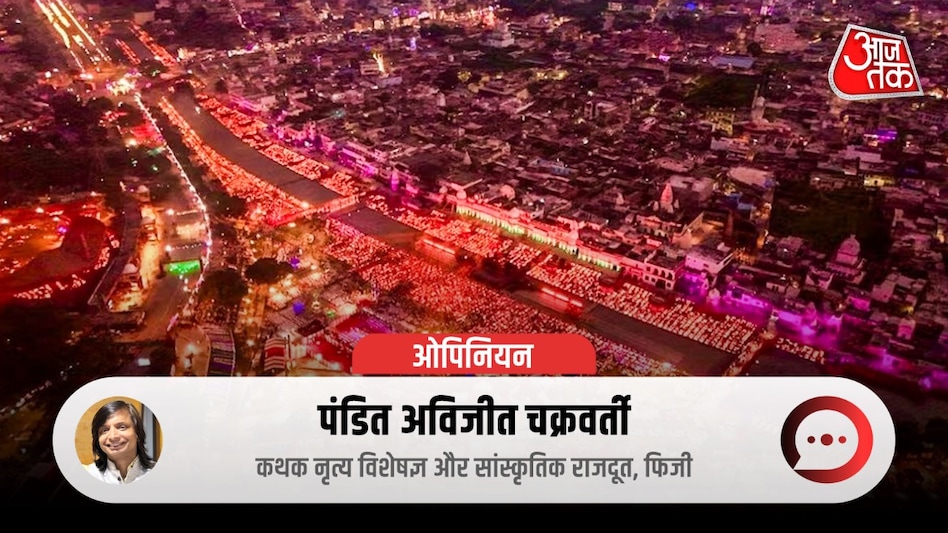
When millions of oil lamps shimmer simultaneously on the banks of the sacred Sarayu River in Ramnagri Ayodhya, this spectacle symbolizes not only the victory of light over darkness but also becomes a transcendental experience illuminating the inner world of all humanity. Dipotsav-2026 represents another golden chapter where the sacred city of Ayodhya has established itself on the world stage as the largest and most radiant center of 'cultural confluence.'
This event transcends religious boundaries, transforming into a grand global platform for artists from all over the world, where art communicates directly with the divine. As artists from different countries, cultures, and languages embody the ideals of Ram-katha through their artistic, musical, dance, and theatrical performances on Ram-Padi, the entire world unites in a single harmony. This is a declaration that Shri Ram belongs not just to a specific territory, but to the whole world.
This Dipotsav, which celebrates a decade this year, is a living reflection of the faith and vision of Chief Minister Yogi Adityanath. The tenth stage in any journey is a moment to pause, look back, and determine the path forward. What began ten years ago with lighting up the embankments of Ayodhya today has transformed into a global cultural festival awaited not only by the residents of the country but also by many corners of the world.
As the sweetness of languages, the colors of costumes, the hum of folk melodies, and the reverence of many nations merge with the flame of candles, the festival begins to expand beyond Ayodhya, becoming a celebration of global cultural consciousness. A particularly noteworthy feature this year is the presentation of Ramlila by five countries, each in its own tradition and style. Artists from South Africa, as well as Sri Lanka, Nepal, Laos, and Thailand, will present the story of Shri Rama on the sacred land of Ayodhya in their own way.
Preparations are also underway for the participation of artists from the Philippines, Thailand, and Russia. This fact itself testifies that Lord Ram is not the heritage of any single geographical point, language, or community. He is a symbol of the human ideal that every culture has recognized, accepted, and celebrated in its own voice.
The journey of Ram-katha resonates in many countries around the world. In the stages of Southeast Asia, the Ramayana has lived for centuries in dance, theatre, and puppet shows. The lands of Thailand, Laos, Nepal, and Sri Lanka are steeped in memories of the Ramayana. Although the names of characters, costumes, and styles of Ramlila arriving from other countries may differ, the core tone of the narrative remains unified—it is the triumph of dignity, self-sacrifice, truth, and duty. These diverse streams converge in Ayodhya. Just as many rivers flow into one sea, all these presentations are directed towards one Ram-tva.
The greatest trait of Indian culture is its inclusive nature. Our tradition has never insisted that truth be presented in only one way. This is why the same Ram-katha was told and heard in hundreds of ways. The international character of Dipotsav is a modern evolution of this generous outlook. When an African artist presents the scene of Ravana's killing in their rhythm, or a Laotian dancer portrays Sita's suffering in their movements, the audience feels that the language of compassion and dharma needs no translation; it reaches heart to heart.
Diversity within the country itself will also enrich this event. Artists from Assam, Bengal, Uttarakhand, Jammu and Kashmir, and Kerala will present productions based on Ramcharitra and Ram-katha. Every corner, every state of India sees Rama in its own understanding. This diversity, stretching from east to west and north to south, is a testament to the unity that has connected the name Rama for centuries.
In this sense, the stage of Ayodhya will become both a small India and a small world. According to the plan of the Department of Culture, six small, four medium, and two large stages will be prepared, where about 2500 Indian and foreign artists will showcase their art. This number is proof of the belief that providing a stage for art is one of the most significant services to society. The flow of music, dance, and theatre running simultaneously on twelve stages for several days will transform Ayodhya into a living capital of art.
After the Pranapratishtha ceremony at the Rama Temple, a new chapter has been added to the identity of Ayodhya. This city has now become not only a place of pilgrimage but also a major center for cultural tourism. Pilgrims come here for Darshan (worship), and cultural tourists come for the experience. They want to hear this story, understand the traditions, and feel something new within themselves. The international character of Dipotsav connects two emotions here—reverence with experience, and experience with understanding.
It is important to understand the spiritual message of this cultural confluence. The special quality of the lamp is that by burning itself, it gives light to others, and even if thousands of lamps are lit by its flame, its light does not diminish. The dialogue of cultures is similar to this. When we respectfully give space to the traditions of others on our stage, our own identity becomes brighter. The greatest message of Ram-katha is that dignity is not just a personal quality, but the foundation of collective life. Ram during exile...
2