Chinese Technologies Modernize Kenya's Packaging Industry
Read more
CGTN
cgtn.com

Chinese Technologies Modernize Kenya's Packaging Industry

While manufacturers and buyers gather at the China International Import Expo (CIIE) in China, Chinese industrial technologies are transforming production in Africa thousands of miles away.

In the city of Kisumu, located by the lake in Kenya, equipment manufactured in China is helping local producers increase efficiency, boost production volumes, and meet the growing demand for packaging materials.

Packaging plays a critical role in protecting products, preserving their quality, and establishing a link between producers and consumers, covering sectors from food and agriculture to pharmaceuticals and retail.

IBS Pack Prints, established in 2023, is utilizing Chinese technology to strengthen local manufacturing and support businesses across western Kenya.

Chinese Equipment Stimulates Local Production

IBS Pack Prints was created to address the shortage of packaging suppliers in western Kenya, a region home to numerous tea factories, bakeries, and agricultural processing plants.

Beatrice Omari, the company's administrative director, noted that investments were aimed at bringing packaging production closer to manufacturers in the Nyanza and Western regions. She stated: 'The director had a vision for polyethylene packaging because we only have one in Eldoret in this region, so we wanted to cover at least this side.'

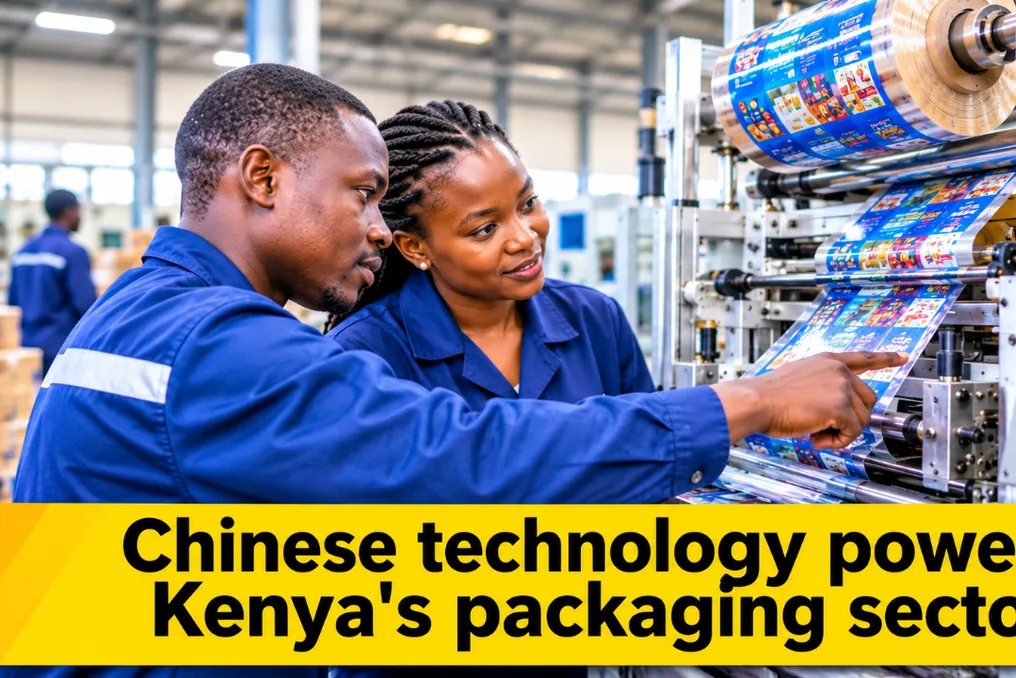
Today, Chinese equipment forms the backbone of the factory's operations, handling the tasks of printing, processing, and cutting packaging materials. Omari emphasized: 'In fact, 99% of the machines are from China. Furthermore, the raw materials are also from China, such as CPP and PET,' adding that other materials are sourced from Saudi Arabia.

The collaboration goes beyond mere equipment supply. Engineers from China visited Kenya to install and commission the machinery, ensuring the operational readiness of the production systems before handing them over to local staff. She explained: 'They sent the machines along with their mechanical engineers who installed each machine and ensured the machines were working before leaving the country.'

These investments have strengthened local manufacturing capabilities and reduced the region's reliance on sourcing packaging from distant suppliers.

Automation Boosts Efficiency and Skills

Inside the factory, machines handle the printing, processing, and cutting of packaging materials, while workers monitor the process and inspect the finished goods. This technology has automated tasks previously done manually, contributing to improved efficiency and production stability.

Eric Onyango, the company's production manager, noted that modern equipment has transformed daily operations. He said: 'Now you just turn on the machine, and the knife cuts. So it makes the job easier compared to how we used to do it manually.'

However, operating complex equipment requires technical knowledge, especially when dealing with various packaging materials and maintaining production systems. Onyango traveled to China in 2025 to acquire additional equipment as part of the company's expansion.

His experience reflects the growing importance of technical cooperation in assisting African producers in adopting modern industrial technologies. Beyond increasing productivity, such investments open up opportunities for workers to develop skills in machine operation, maintenance, and quality control.

Packaging Strengthens Value Chain Production

Although packaging is often the final stage of production, it plays a crucial role in determining how goods reach the consumer. For food processors, it helps maintain quality and protect goods during transport. For manufacturers and retailers, packaging enhances branding and product identification.

Henry Koski, assistant branch manager at Kipchimatt, a retailer in western Kenya, asserts that packaging allows consumers to distinguish products from competing brands. He stated: 'Packaging identifies goods from one producer to another and one company to another.'

He cited tea and sugar products from Kipchimchim Group of Companies as an example of how packaging supports brand recognition. IBS Pack Prints supplies packaging for bread, tea, sugar, water, ice cream, confectionery, and beans, as well as materials used by hospitals and pharmaceutical companies. The company's diverse clientele demonstrates the industry's contribution to agriculture, food processing, healthcare, and retail.

As Kenya expands local production and adds value to agricultural products, reliable packaging will remain indispensable for enterprises aiming to enter broader markets.

Challenges and Growth Opportunities

Despite technological progress, packaging manufacturers face difficulties, including high equipment costs, imported raw materials, and unreliable power supply. At IBS Pack Prints, power outages can disrupt production and necessitate restarting machines. Onyango explained: 'The problems we face mainly occur during voltage spikes. This machine is designed so that when the electricity goes out, everything stops.'

Such failures can slow down production and increase operating costs, highlighting the importance of reliable infrastructure. Nevertheless, the demand for packaging continues to create opportunities for industrial investment. Access to Chinese equipment provides Kenyan enterprises with the ability to modernize production, develop technical skills, and strengthen manufacturing capacity.

In Kisumu, IBS Pack Prints demonstrates how trade relations between China and Africa are translating into practical industrial development. As Kenya strives to expand local production and add value to domestic products, packaging becomes a vital link between technology, production, and market access.


Similar stories

Xiaomi's Strategy to Challenge the Dominance of Big Tech Companies in South Africa
Read more
iol.co.za

Xiaomi's Strategy to Challenge the Dominance of Big Tech Companies in South Africa

As technology updates regularly demand very high prices, consumer budgets worldwide are facing unprecedented pressure. The rapid growth of artificial intelligence has triggered what industry experts call the 'Rampocalypse'—a global surge in memory and storage costs that drives up retail prices for smartphones, laptops, and streaming devices.

However, amidst this inflation, one brand is actively challenging the established order in South Africa—Xiaomi. During a detailed meeting in Rosebank with Tianshi Lv, Xiaomi's country manager in South Africa, and Jared Ferns, National Training Manager, it became clear that the brand's quiet expansion in Mzanzi is supported by both an extensive product ecosystem and an aggressive engineering strategy aimed at making premium technology accessible.

An Ecosystem That Goes Far Beyond Smartphones

For many South Africans, Xiaomi is still perceived primarily as an alternative to popular smartphones. In reality, however, the company holds a solid third place globally in smartphone sales and produces a wide range of Artificial Intelligence of Things (AIoT) devices, including smart home appliances, wearables, streaming devices, and even air fryers.

Lv explained that Xiaomi currently sees itself as a fast-growing company in the coming years. He noted that while the brand is still small compared to Xiaomi's global scale, it is actively developing its presence in South Africa and sees enormous potential in the country. The company considers South Africa an important and strategic market.

This strategic focus is based on providing local consumers with competitive alternatives across everyday categories. A prime example is the home entertainment system market. While leading players position media streamers in the luxury segment—for instance, the new Apple TV 4K from Apple costs R6,299, comparable to a basic 50-inch smart TV—the Xiaomi TV Box S (3rd generation) sells for approximately R1,500. It offers high-definition streaming functionality at a significantly lower price, illustrating Lv's core idea: 'Our mission is 'innovation for all'—to relentlessly create amazing products at fair prices so people can enjoy a better life through technology.'

Overcoming AI-Driven 'Rampocalypse'

Fulfilling this mission has become significantly harder across the entire tech sector in 2026. Running modern generative AI models directly on a device requires massive pools of active memory so processors can receive and execute commands without delay. As manufacturers rush to ensure the future sustainability of their flagship hardware through substantially increased RAM capacity, component supply chains have tightened, leading to a sharp rise in production costs.

Instead of passing these significant cost increases directly onto buyers, Xiaomi relies on internal efficiency and vertical integration. Lv stated that Xiaomi's advantage lies in the fact that the company invests heavily in research and development. He added that they have developed advanced intelligent manufacturing capabilities not only for smartphones but also for electric vehicles and home appliances.

The scale of this production gives the company a distinct efficiency advantage, allowing it to absorb supply chain shocks, maintain fair pricing, and continue innovating.

The engineering focus is reflected in Xiaomi's hardware, particularly in the flagship Redmi Note 17 Pro Max 5G model. While competing base flagships, such as the Apple iPhone 16e, start significantly higher at R14,000, the Xiaomi flagship offers high-end specifications along with an unprecedented 10,000 mAh battery capable of lasting three full days on a single charge.

Integrating a cell of this size into a slim phone body required a radical departure from standard lithium-ion designs. Jared Ferns explained that this was made possible by a '16% silicon carbide composition integrated directly into the battery cell.' This chemistry allowed for a substantial reduction in physical size while minimizing internal heat buildup.

Thermal management was the primary engineering challenge, especially during prolonged loads like high refresh rate mobile gaming. Ferns added that one of the main concerns when working with such a large battery was stable heat dissipation. He emphasized that the cell not only provides exceptional multi-day autonomy but also feels surprisingly cool on the back panel of the device. This represents a true breakthrough in consumer battery technology.

As the cost of advanced technologies continues to rise, South African consumers no longer have to accept inflated markups as an entry fee. By combining ecosystem diversity with the scale of intelligent manufacturing, Xiaomi demonstrates that modern silicon technology and high-end hardware do not necessarily have to come with runaway price increases. For local buyers managing limited tech budgets, exploring the broader Xiaomi ecosystem may be the most practical choice in the market today.

Xiaomi is changing the South African technology market by offering premium quality at affordable prices
Read more
iol.co.za

Xiaomi is changing the South African technology market by offering premium quality at affordable prices

During an exclusive discussion with Tianshi Lv, Xiaomi's country manager in South Africa, held in Rosebank on Wednesday, it became clear how little people in Mzansi know about the wide range of products offered by the Chinese tech giant.

Xiaomi offers a huge variety of goods, ranging from smartphones to smart home devices and air fryers. According to Lv, the company sees itself as a fast-growing enterprise in the coming years, although it is still small compared to Xiaomi's global scale.

He noted that Xiaomi holds a solid third position in the global smartphone market and considers South Africa an important and even strategic market for the brand's development in the region.

The company emphasizes its mission 'Innovation for all,' striving to create impressive products at fair prices to enable every person to improve their life with advanced technology. In addition to smartphones, Xiaomi offers numerous products in the AIoT sector.

This approach contrasts with Apple's efforts, which is actively developing a smart home ecosystem after releasing devices such as HomeView, HomePod, and Apple TV 4K this month.

When comparing prices, for example, the new Apple TV 4K, which sells for R6,299, with the Xiaomi TV Box S 3rd generation, released last year, the difference becomes obvious. The Xiaomi TV Box costs around R1,500, which is comparable to the price of an acceptable media player. Meanwhile, the Apple TV costs as much as a basic 50-inch smart TV, or even more.

This comparison vividly illustrates the essence of Xiaomi—providing quality products at a significantly lower cost. A similar gap is observed among smartphones. The flagship Xiaomi Redmi Note 17 Pro Max 5G (256GB), released in August, is equipped with a 10,000 mAh battery that lasts up to three days with normal use and is sold on Takealot for R13,999. In contrast, the basic Apple iPhone 16e costs more, currently priced at R14,699.

Xiaomi offers a wide range of goods through online platforms and its own retail stores, so it is impossible to list them all. Nevertheless, budget-conscious technology consumers should explore Xiaomi's full range in the segments of mobile devices, wearables, smart home, and lifestyle products.

How Liuzhou is Leveraging Smart Manufacturing to Enter Global Markets
Read more
cgtn.com

How Liuzhou is Leveraging Smart Manufacturing to Enter Global Markets

The question of what a city needs to compete in global markets finds an answer in Liuzhou, a city in the Guangxi Zhuang Autonomous Region in southern China. The answer goes beyond production workshops.

Thanks to advanced manufacturing, such as at the LiuGong enterprise, and railway connections linking local industries to both near and far markets, the city is finding new ways to transform its industrial strengths into international opportunities.

CGTN correspondent Wang Tao will discuss how Liuzhou is establishing links between its industry and the world.

Popular