Artificial intelligence becomes a key element of brand success through operational process optimization
Read more
YourStory [india, en]
yourstory.com

Artificial intelligence becomes a key element of brand success through operational process optimization

For a long time, the strategy for building a successful consumer brand was based on three pillars: an attractive product, a strong brand identity, and effective customer acquisition. Although these basic principles remain relevant, they are no longer the sole determining factor of success.

Today, the competitive battle is fought for tiny shares of consumer attention, where brands have only a few seconds to turn interest into a purchase. However, the moment the 'Buy Now' button is pressed marks the beginning of a second, more complex stage: ensuring fast delivery, an impeccable customer experience, and easy resolution of inquiries and returns—these are the moments that build loyalty.

Against the backdrop of endless channels and constantly changing marketing strategies, the true advantage has shifted towards operational activities that occur after the purchase. Artificial intelligence is rapidly transforming into this intelligent layer.

AI goes beyond simple chatbots or content generation; it transforms how brands forecast demand, distribute inventory, coordinate order fulfillment, interact with customers, and optimize operations in real time.

This shift occurs against the backdrop of the growing complexity of commerce itself. Consumers now find, evaluate, and purchase goods through a complex network of touchpoints—brand websites, marketplaces, fast delivery services, social commerce, and physical stores—often within a single purchasing cycle. Each such purchase is supported by a complex system of inventory nodes, warehouses, logistics partners, and interaction systems that must work in perfect synchronization.

For brands, this means receiving a huge volume of operational data. Every movement of a product, customer interaction, order update, warehouse scan, and delivery stage becomes a signal influencing subsequent business decisions. Simple online business quickly turns into a network of interconnected real-time decisions, each affecting the customer experience.

Until a few years ago, brands and marketplaces operated based on Systems of Record—a single source of operational truth recording transactions and managing inventory. SaaS platforms for e-commerce transformed them into Systems of Insight—real-time analytical dashboards allowing businesses to move from a reactive approach to data-driven decision-making.

Now, the next stage of this evolution has begun. Based on this rich data and technologically enabled processes, Systems of Record and Insight are becoming Systems of Intelligence, where AI does not just analyze information but actively suggests recommendations and executes decisions across all business operations.

Consider the example of a fashion retailer during a holiday sale. Thousands of orders may arrive simultaneously through the website, marketplaces, and fast delivery platforms. Instead of relying on manual rules or static workflows, AI can continuously assess product availability, warehouse capacity, delivery times, transportation costs, and customer location, automatically routing each order along the most efficient fulfillment path. It can also notice that a fast-selling item is about to run out in one city while inventory is in good shape in another, and arrange for transfer before the issue becomes apparent to the customer.

This is especially important in the omnichannel world, where customers expect product availability everywhere and through any purchase method. Fulfilling this promise requires more than just inventory visibility—it requires constant coordination between distribution, order orchestration, warehouse operations, logistics, and customer communication. AI provides this coordination at a scale and speed unattainable through manual decision-making.

The next frontier is Agentic AI. Unlike traditional automation, which follows predefined scenarios, Agentic AI can reason about multiple variables, propose the best next course of action, and autonomously execute routine operational decisions within established business boundaries. Whether prioritizing high-value orders during peak demand, responding to supply chain disruptions, or identifying bottlenecks in fulfillment before they cause problems, these systems go beyond supporting human decisions and begin to actively shape them.

This marks a fundamental shift in how brands approach growth. Customer acquisition remains critical, but sustainable growth increasingly depends on what happens after demand is generated. Instead of increasing staff every time order volumes surge, companies invest in intelligent platforms that allow them to scale without proportionally increasing complexity. The goal is no longer just to process more orders, but to make better operational decisions—faster and more consistently.

E-commerce support platforms with deep integration into brand data and operational processes are already building this future. AI-focused SaaS tools are ceasing to be mere software—they are becoming operational partners that continuously improve business functioning.

Tomorrow's market leaders may not be the brands with the largest marketing budgets. They will be the brands whose technology allows them to operate smarter, adapt faster, and make better decisions every day. Their competitive advantage will increasingly depend on the intelligence behind every business decision they make.


Similar stories

Expert explains why AI productivity gains are not leading to business growth
Read more
iol.co.za

Expert explains why AI productivity gains are not leading to business growth

Despite the undeniable influence of artificial intelligence (AI) on modern society, there remains a sharp debate over whether its overall impact is positive or negative. Just a year or two ago, the internet was flooded with AI-generated images that quickly entered corporate advertising. Soon after, social media platforms like YouTube were filled with AI-generated thumbnails—visuals that initially attracted viewer interest but now increasingly cause audience fatigue and skepticism.

However, outside of consumer social media feeds, artificial intelligence holds significant potential to transform corporate operations, provided it is implemented strategically. In an exclusive interview with IOL, Paul Banting, co-founder of growthguru.ai, analyzed the common narrative that AI has become an overrated tool that does not deliver expected productivity growth.

Banting stated that the problem is not that AI is overrated, but that it is being judged against the wrong promise. He emphasized that productivity gains are real and supported by research. According to a McKinsey survey on AI adoption in corporations, 80% of respondents noted improved individual productivity, yet only 37% claimed that AI directly contributed to increased profit for their organization—a metric that has remained virtually unchanged over the past year.

Therefore, in Banting's view, it is more accurate to say that AI is not overrated, but fundamentally misunderstood. Leaders mistakenly assume that saved time automatically translates into revenue growth. In reality, companies must actively direct the hours freed up by AI toward achieving tangible, high-return commercial opportunities.

While most public attention naturally focuses on optimizing outdated workflows, Banting warns that task efficiency should not become the primary goal of the enterprise. Around 79% of executives expect AI to drive substantial revenue growth by 2030, compared to 40% today. Nevertheless, only 24% have a clear idea of where this future revenue will originate. The true objective, Banting explained, is using AI to identify urgent commercial gaps and capture high-value market opportunities ahead of competitors.

The Growthguru.ai platform was developed precisely to bridge this strategic gap, focusing on business development rather than general workflow automation. Instead of offering a single universal assistant, their platform utilizes specialized AI agents targeting specific commercial levers: Perky helps partners access relevant incentives, discounts, and co-financing from suppliers; Maya develops go-to-market strategies and co-marketing initiatives; Alex guides partners through certifications and supplier tiers; and Lexi tracks important enterprise updates, such as critical Microsoft platform releases.

Nevertheless, alongside the commercial potential lies a darker side—AI-enabled crime, where issues of accountability and legal liability remain unresolved. Banting argues that criminals using AI for financial fraud must be held responsible for their actions, regardless of the tools they employ. However, if proprietary or third-party enterprise AI causes operational or financial damage, the responsibility lies directly with the business that implemented it. Legal liability cannot simply be shifted to the model provider. While software developers must create secure and compliant architectures, the choice of implementation rests entirely with the enterprise. BCG confirmed this finding in its applied AI benchmark.

Shopflo claims D2C brands do not need their own AI team for growth and discovery
Read more
yourstory.com

Shopflo claims D2C brands do not need their own AI team for growth and discovery

Shopflo stated that Direct-to-Consumer (D2C) brands do not need to build an in-house artificial intelligence specialist team to achieve growth and increase brand awareness.

As consumers increasingly turn to AI-powered assistants like ChatGPT and Claude to compare products, search for options, and make purchasing decisions, D2C brands face a new question: how to remain visible amid changing consumer behavior without hiring a staff of AI specialists?

At the TechSparks 2026 event, Mihir Shah, Director of Business Development at Shopflo by Pine Labs, presented two areas where the company helps brands solve this problem: agentic commerce, which connects product catalogs with AI-based search and purchase surfaces, and AI agents that help improve operational efficiency and business growth.

Shah emphasized: 'You don't need an AI team to figure out growth or efficiency issues. You need Shopflo.'

Previously, brands spent years increasing their visibility through social media, search engines, and marketplaces. Now, AI assistants add another discovery channel, allowing customers to describe their needs and receive relevant product recommendations.

According to Shah, Shopflo's agentic commerce offering makes participating brands' catalogs accessible on platforms originally built for AI, including ChatGPT and Claude, as well as on other new interfaces. Through integrations, the company feeds product catalog information to these platforms, enabling customers to find desired items and proceed to checkout with system support.

For example, a customer looking for festive gifts under 2000 rupees can find items from a participating brand via an AI assistant. Shopflo's integration with Pine Labs' payment infrastructure is designed to support transactions within these scenarios.

Shah noted that as consumer behavior evolves, brands must look beyond traditional discovery channels. However, he clarified that AI visibility does not replace Search Engine Optimization (SEO), which continues to drive traffic to websites.

Discovery is only one part of D2C business operations. According to Shah, brands also have to balance metrics such as conversion rate, average order value, return rate, customer retention, and profitability, often using separate tools for each function.

Shopflo's Growth Orchestrator system, presented in beta, aims to unify these solutions. Brands can define their priorities—whether it is striving for growth or protecting profitability—and receive recommendations based on their store's performance data.

During the demonstration, Shah showed how the system could detect a drop in conversion between address entry and payment, suggest placing a banner about commission transparency, and propose an experiment to test whether this change would improve conversion. Brands have the option to review these recommendations, set constraints, and approve experiments before scaling them. They can also decide the degree of autonomy to grant to the agents.

Shah concluded: 'How much or how little to use agents is up to you.' For D2C enterprises with small teams, this means less about implementing every new AI tool and more about simplifying the management of existing growth solutions. The Shopflo approach combines AI-driven discovery with tools that help brands achieve their own business goals, leaving the final decisions to them.

Amazon Bets on Agentic AI for Enterprise Operations; Experts Discuss Marketing AI Effectiveness
Read more
yourstory.com

Amazon Bets on Agentic AI for Enterprise Operations; Experts Discuss Marketing AI Effectiveness

The future of technology points towards the development of agentic artificial intelligence, and the adoption of this technology is gaining momentum. As part of the expanded partnership between Cognizant and Google Cloud, the 'Gemini Frontier Capability Group' has been formed. This group combines Google's ready-to-use AI platform with Cognizant's industry and engineering expertise as an AI developer.

This group is supported by over 18,000 Cognizant employees and significant joint investments. Concurrently, ahead of its Initial Public Offering (IPO), the anchor package of Jio Platforms attracted bids totaling 2.5 lakh rupees. The company allocated 7.24 million shares at a price of 1,119 rupees to anchor shareholders, with LIC receiving the largest stake.

Furthermore, the startup Hunar.AI raised 40 crore rupees in a Series A funding round led by Blume Ventures. Hyderabad Angels Fund, Together Fund, Seedstars, AVNM Ventures, co-founders Prateek Maheshwari and Alakh Pandey of PhysicsWallah, and co-founder Aditya Wuchi of MediaMint also participated in the round. This startup, which develops specialized AI technologies for front-line intensive industries, plans to use the funds to build AI infrastructure, develop products, and expand sales channels.

According to a Redseer report, the country's online retail market is expected to exceed $90 billion this year, with grocery products surpassing mobile devices. E-commerce volume grew by approximately 25% year-over-year, reaching about $38 billion in the first half of 2026, marking the strongest first-half performance in four years.

This briefing examines Amazon's bet on agentic AI for enterprise operations, as well as the question of marketing AI tool effectiveness: do they truly increase profit or are they just noise?

Technology Event Overview

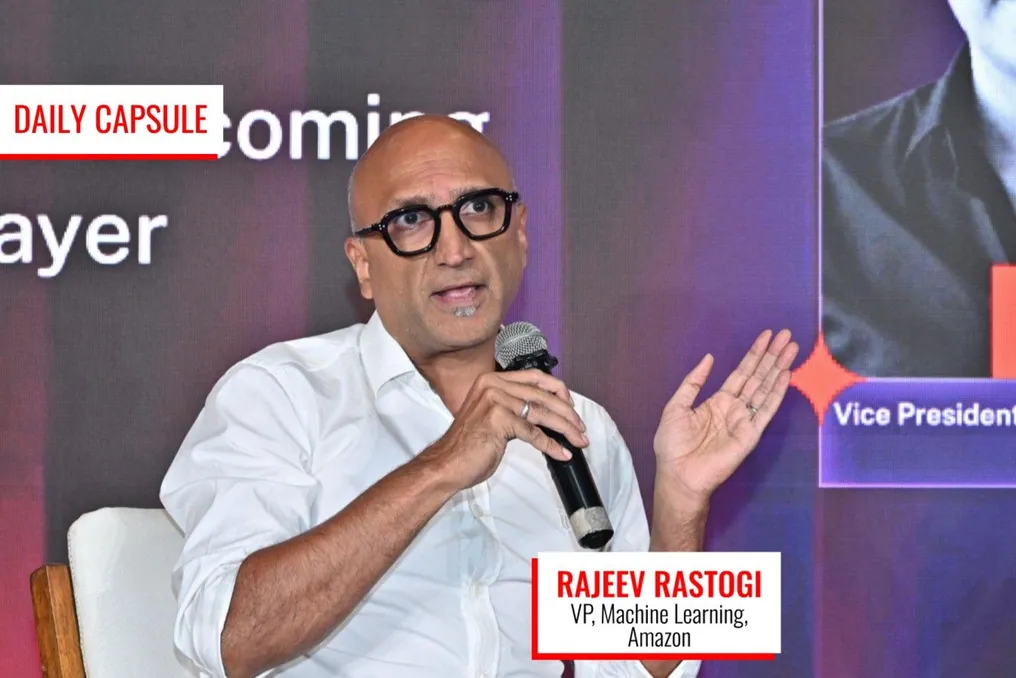
At the TechSparks 2026 event, Rajiv Rastogi, Vice President of Machine Learning at Amazon, emphasized the growing role of agentic AI across all layers of enterprise operations. He noted the shift from static software to autonomous systems capable of understanding natural language instructions.

Rastogi explained during a fireside chat at the 17th edition of the flagship tech startup event YourStory that 'agents dynamically prepare plans to solve problems and invoke relevant tools.'

Driving Force of Transformation

These autonomous agents can evaluate requests, formulate a sequence of actions, and call upon specialized digital tools to complete complex tasks end-to-end, rather than relying on human intervention at every stage. Within Amazon, this operational layer functions in systems like Rufus—a conversational shopping assistant that analyzes customer queries, applies price filters, calls search engines, and guides users through product comparison and checkout.

Similarly, autonomous seller assistants pre-fill product descriptions, monitor inventory, and help small businesses comply with international export requirements.

In Rastogi's view, the industry will ultimately move towards true global models that possess an intrinsic understanding of physical spaces and environmental behavior, creating a practical and economically viable foundation for business automation.

Marketing and Decision Making

At TechSparks 2026, Anand Jain, Co-founder and CMO of CleverTap, a marketing automation and customer engagement platform, elaborated on why marketing teams must move beyond basic generative AI productivity tools and transition to real-time autonomous decision-making systems that deliver tangible business profit.

During a marketing strategy masterclass, Jain urged leaders not to limit themselves to simple gimmicks but to move from using AI for entertainment to achieving actual business outcomes. He questioned whether AI-generated content creation truly contributes to growth, asking, 'Will this actually impact business results, or is it just the same thing?'

Instead of broadcasting generic promotional offers to wide audiences, modern marketing mechanisms must interpret customer actions in real time to meet individual needs. This approach signifies a transition to the highest level of AI maturity, known as 'real-time decision-making.'

The news and updates section noted the entry into force of a free trade agreement between India and New Zealand, which grants duty-free access to a range of Indian goods, including products from labor-intensive sectors such as textiles and leather. It was also reported that OYO's parent company, PRISM, plans to nearly halve the size of the new offering in the proposed IPO, reducing it from almost 6,650 crore to 3,350 crore rupees, due to strong cash generation and balance sheet improvement. Furthermore, US Secretary of State Marco Rubio arrived in India after President Donald Trump postponed US tariffs on imports from India, as both countries work to finalize a trade agreement. During his two-day visit to Mumbai and Jamnagar, Rubio will meet with government and business leaders.

Popular