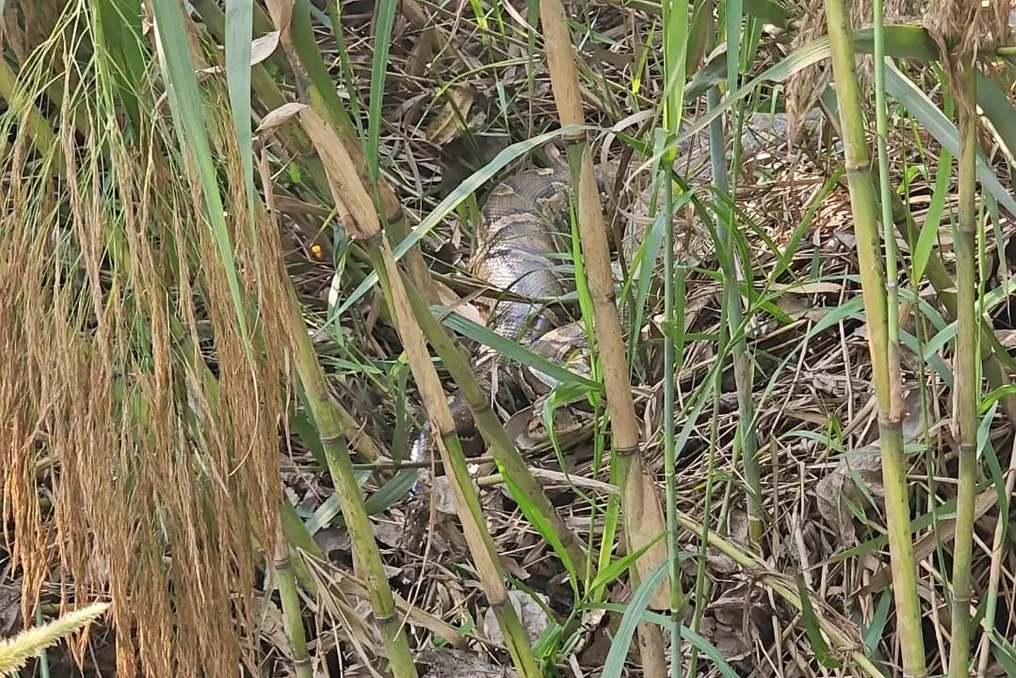
Giant python weighing about 100 kg found in Bijaunaur district; forest service staff attempted to catch it
Read more
Aaj Tak
www.aajtak.in

Giant python weighing about 100 kg found in Bijaunaur district; forest service staff attempted to catch it

In the village of Jalalpur Chhoya, which belongs to the Bijaunaur district, a huge python was spotted near the fields on Sunday evening, causing a great stir among local farmers. The size of this snake was so impressive that everyone present was astonished. According to forest department employees, the python weighed about 100 kilograms, or one quintal.

The farmers immediately reported this finding to the forest department. A team that arrived at the scene attempted to capture the snake, but dealing with such a giant proved difficult. Despite the efforts of three people, the snake slipped from their grasp and began crawling into the Chhoya river.

The incident occurred on Sunday evening when farmers were working in their fields near the village of Jalalpur Chhoya. While working, some of them noticed a large snake lying among the bushes. Upon approaching, they realized it was not an ordinary snake, but a giant python. The sight of the snake caused panic among the peasants, and the news quickly spread among local residents, attracting a crowd to watch.

After receiving the information, the farmers called the forest department. Regional forest official Maheshchandra Gautam dispatched a team to the site for the safe capture of the python. Forest department employees arrived at the field and began attempts to catch the snake.

However, due to the size and weight of the python, the team had to exert significant effort. It is reported that three people tried to catch it, but it resisted control. At that moment, the snake broke free and quickly slithered into the Chhoya river, where it soon disappeared into the water.

According to regional forest official Maheshchandra Gautam, the python weighed approximately one quintal. He noted that this is one of the healthiest pythons observed in the district so far. The discovery of such a massive snake sparked active discussions among rural residents.

Gautam also stated that over the past two years, large Rock Pythons have regularly appeared in fields in different parts of the district. Thus, sightings of pythons in rural areas happen periodically.

Forest department employees emphasized that pythons generally do not seek to harm humans. They inhabit forests, bushes, and areas near water in search of prey, and can be encountered even near agricultural lands.

The forest department advised residents to maintain distance when seeing such large snakes. They should avoid attempting to catch or provoke them themselves, and instead immediately report them to the forest department.

This giant python weighing about 100 kg, spotted in Jalalpur Chhoya, is now in the river, but the sight witnessed by the farmers on Sunday evening will remain in their memory for a long time.
Similar stories

Crocodile caught in Bettiah, Bihar; crowd made videos; Forest Department rescued it
Read more
www.aajtak.in

Crocodile caught in Bettiah, Bihar; crowd made videos; Forest Department rescued it

The desire to create reels on social media compels people to engage in many risky activities; sometimes they make videos in front of moving trains, or climb high buildings. In Bettiah, Bihar, some people crossed the limit. A crocodile was spotted in a village here, and instead of staying away from it, people went out to catch it.

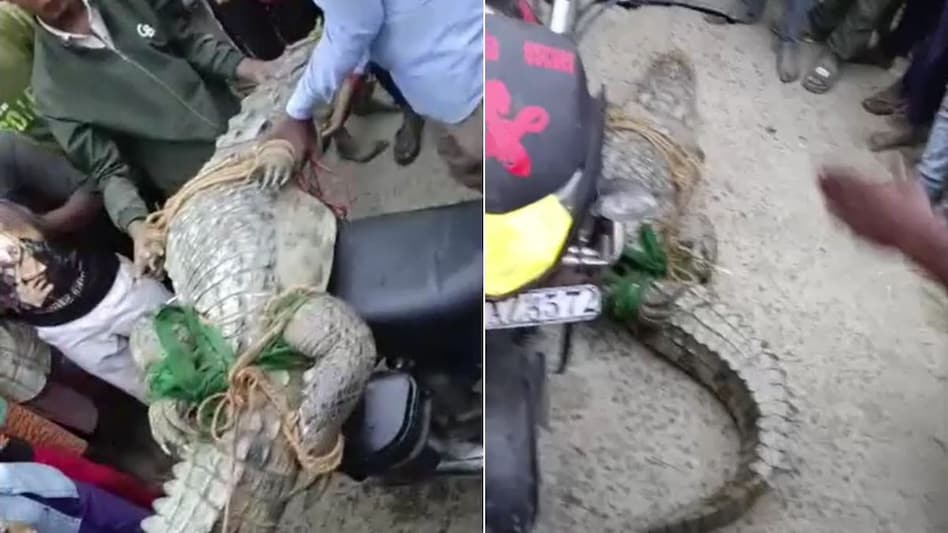
Villagers tied the crocodile with a rope and brought it to the village loaded on a bike. After this, a large crowd gathered in the village to see the crocodile. Some people started taking pictures with their mobile phones, while others turned on cameras. Some people even got busy making reels with the crocodile. The video of this entire incident is now going viral on social media.

This incident took place in Dudhiyawa village of Yogapatti block in Bettiah district of Bihar. It was evening when people near the school in Mahavir Ram's Tola saw the crocodile. As soon as the news of the crocodile appearing in the village spread, people started coming to see it. The action taken by the villagers gave the matter a new turn, as some people together caught the crocodile, tied it with a rope, and brought it to the village loaded on a bike.

When the crocodile reached the village, a crowd gathered there. People were taking its pictures and making videos. Some people were seen busy making reels with it. In the video that went viral on social media, people are seen lifting and walking around the crocodile tied with a rope. There was a rush to capture this entire sequence on camera. It is important to note that approaching an animal with which people are trying to gain likes and views on social media could have been dangerous for their lives.

When the Forest Department received information about this matter, a team reached the spot. CF Gaurav Ojha of Valmiki Tiger Reserve stated that the Forest Department team safely rescued the crocodile and released it into the river. The crocodile was removed from the village and transported to its natural habitat.

The Forest Department has appealed to the villagers not to approach or attempt to catch crocodiles or any other wild animals if they are sighted anywhere. In such situations, the Forest Department should be informed immediately. Only trained teams can safely catch such wildlife and transport them to their natural location.

Scientific explanation of gigantism in creatures inhabiting the deep ocean
Read more
super.abril.com.br

Scientific explanation of gigantism in creatures inhabiting the deep ocean

The origin of imagination regarding giant marine creatures dates back to various ancient mythologies. In Mesopotamian mythology, the sea serpent Tiamat was seen as a primary deity linked to chaos and the sea. Hebrew tradition presents the dragon Leviathan as an immense and threatening marine creature, while in Greek mythology, the giant whale Cetus and monsters like Scylla, with their twelve legs and six necks, symbolize aquatic dangers.

The belief in colossal sea beings likely arose from the combination of three elements: the fear of the unknown ocean, contact with little-known real animals, and the human tendency to transform natural forces into monstrous figures. However, these myths have parallels in current reality, as gigantism is an observable characteristic in various species residing in the deep ocean.

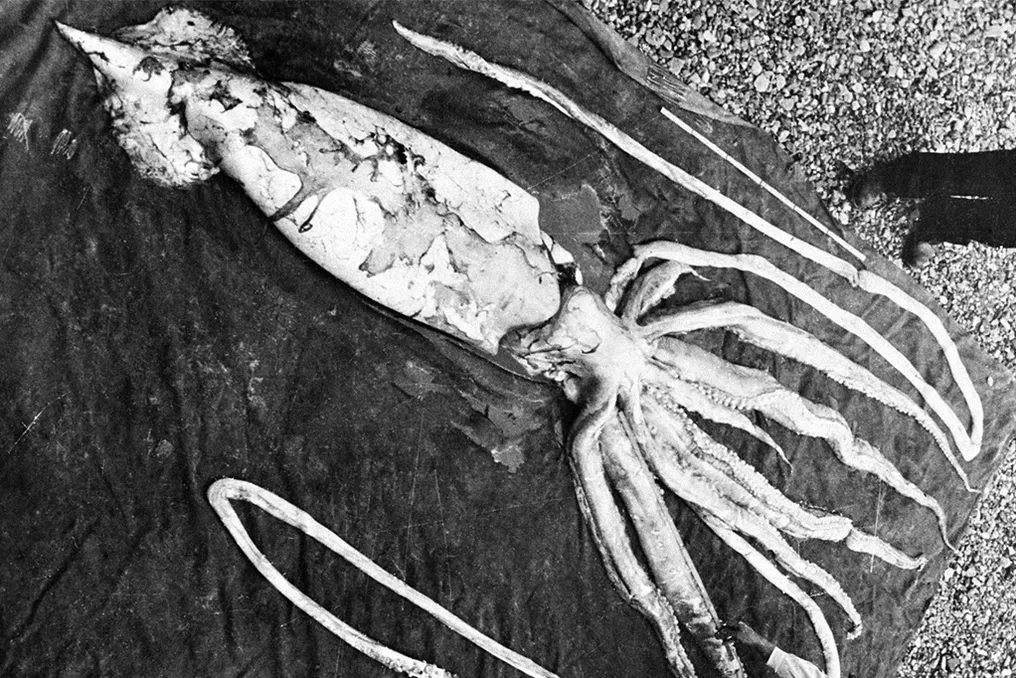
Notable examples include the giant squid, capable of exceeding ten meters in total length, and the giant isopod, a crustacean similar to a garden pill bug, which can reach approximately fifty centimeters. This phenomenon is called abyssal gigantism and follows a pattern where deep-water species tend to be significantly larger than their shallow-water relatives. This raises the question: why does this occur?

The Giants of the Seas

In a 2006 study, biologist Craig R. McClain suggested analyzing this phenomenon through the lens of surface islands. Islands generally follow the principle known as the Island Rule (or Foster's Rule), which posits that the body size of animals changes when living in isolated ecosystems, such as islands.

Large animals, such as elephants and hippos, tend to reduce their size over generations (insular dwarfism) due to limited food resources on the island. Conversely, smaller species, such as rodents and insects, tend to increase in size (insular gigantism) because, without the pressure of large predators, they can expand their growth and occupy new ecological niches.

According to McClain, the deep marine environment operates analogously to an island. After a mass extinction event during the Cenozoic, much of the deep-water fauna evolved from species originating in shallow waters. Some of these species decreased in size due to food scarcity, while others became giants.

For those that showed an increase in size, McClain and other researchers propose four possible explanations. It is important to note that there is no single proven cause for abyssal gigantism; the hypotheses raised may act together, justifying different cases. Additionally, inhabiting the abyss does not necessarily imply being gigantic, as the depths host organisms of various sizes, including many tiny species.

Giant Abyssal Animals

Below are some of the most notable examples of this group of creatures.

Popular