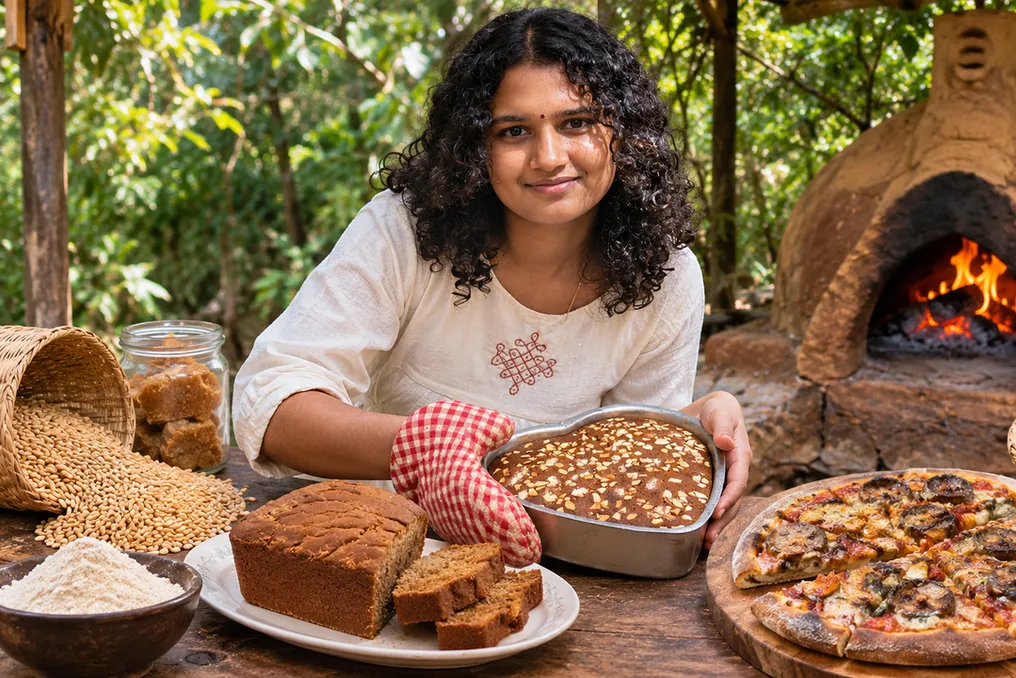
Visista, a twenty-year-old girl, is convinced that healthy food can be delicious. She recreates ancient recipes on her farm using whole grain products and tamarind berries.
Her interest in cooking began in early childhood. At the age of four, she helped her grandmother Lakshmi prepare chapati for lunch. Although she couldn't properly knead or roll the dough then, her desire to try was strong.
What started as a childhood love for cooking gradually grew into a deep interest in traditional dishes that are rarely cooked today. Visista began studying the original methods of preparing these dishes, the ingredients used, and the stories behind them.
Over the years, she has documented more than 250 recipes. She shares her work through the 'TRUE FOOD' section on the website of Aikanthika, the farm where she grew up in central Karnataka. There, she restores traditional dishes using methods and ingredients passed down through generations, allowing others to try these recipes at home.
Her curiosity about food was shaped by an unconventional lifestyle that gave her the freedom to explore everything that interested her. She never attended a conventional school but followed the principle of Swashikshan (self-learning) at Aikanthika, where education was part of daily life, not something confined to a classroom.
She learned through questions, books, the internet, conversations with her parents, farm life, and the freedom to independently try new things. Visista explains that she enjoyed not only tasting new dishes from childhood but also going through the entire cooking process from start to finish to then eat what she made herself.
This instinct of understanding things through practice remained with her. Today, when encountering an old recipe, she strives to learn its origin, the reason for using certain ingredients, and the possibility of reproducing it.
Lessons learned on the farm, from books, and daily life
The Aikanthika farm was established in 1996. Visista lives there as part of the Aikanthika tribe, participating in the daily life of the farm and events related to organic farming and natural living.
She notes that her learning process was always integrated into daily life, rather than happening at strictly set times. She studied what interested her, as well as what she considered necessary to know. If she had a question, she asked her parents; if they knew the answer, they taught her; if not, they helped her find it through books or the internet.
Her younger brother Varchas (17 years old) grew up in the same environment. He also follows the principle of Swashikshan and helps on the farm, engaging in natural construction and other tasks. He remembers his sister as a child as someone who almost never wanted to be just an observer. She always showed a drive to learn and loved to try things herself, experimenting and finding her own path instead of following others' instructions.
For Visista, the kitchen became one of her favorite places to apply this curiosity. Her earliest memories of cooking are associated with her mother Kruthii and her grandmother, who were often in the kitchen. She says she was drawn to the pleasure of mixing ingredients and watching them transform into something delightful. It brings her a special satisfaction that is hard to describe, and even more joy when her family tastes what she has cooked and praises it.
At the age of seven, she started baking. Before a traditional clay oven fueled by wood was built at Aikanthika around February or March 2017, she mainly cooked Indian sweets on the stove and sometimes baked cakes. The new oven opened up more possibilities, and she began making cakes, cookies, muffins, and other baked goods, although she remained focused on stovetop cooking until 2020.
Her habit of looking beyond the recipe began in 2018. She started researching old, traditional, and forgotten recipes from India and around the world, many of which were unrelated to baking. By 2020, she also began tracing the stories and origins of the dishes she cooked. This research gradually led her to traditional baking, especially when she started reading about sourdough and older baking methods. She discovered a growing interest in history and a desire to understand the roots of culinary traditions.
On the farm, the family does not use ingredients such as white flour, refined sugar, bottled sauces, flavorings, and packaged ready-made ingredients. Instead of trying to recreate every modern recipe without them, she began searching for recipes that existed before these ingredients became common. She particularly enjoys cooking traditional dishes that require a longer process and more time.
How an old recipe becomes part of her collection
As she continued to experiment with recipes, she began documenting the ones that were successful in a book. Eventually, she and her father, Raghava, decided that it would be meaningful to share this collection more widely, leading to the creation of TRUE FOOD. The idea was to create a place where people could find recipes prepared using traditional ingredients and methods. Some of these recipes are part of her family's own culinary traditions, passed down to her by her mother and grandmother.
When the family travels to rural areas, tribal villages, or other people's homes, Visista pays attention to what is being cooked. If she tries something special, she asks for the recipe and writes it down. Visitors and global volunteers on the farm also shared recipes with her. If she knows the name of a dish but doesn't have its recipe, she searches for information online, preferring recipes written by people from the region where the dish originates, as she believes they better reflect traditional preparation.
She also uses digital research to trace the history of a dish and understand what ingredients might have been used when it first appeared, which helps her assess how accurately the recipe matches its traditional form. After finding a recipe, she checks for the availability of ingredients in her region and their compliance with the principles adopted at Aikanthika. If something is unavailable or unsuitable, she looks for the most appropriate substitute.
She usually cooks a recipe once before documenting it. During the cooking and tasting of the final dish, she pays attention to the overall result, especially the taste, texture, and whether it seems cohesive. If something seems wrong, she cooks it again and adjusts it. Her mother, grandmother, and other family members taste what she cooks and provide feedback before she adds it to TRUE FOOD.
Giving a traditional touch to pizza and street food
She uses freshly ground whole grains, tamarind berries, unrefined oils, eggs from local chicken breeds, and farm produce instead of refined flour, white sugar, and preservatives. She emphasizes that using traditional ingredients is important because she has found that they give food much more flavor and nutritional value. Preparing the same dish using healthy traditional ingredients instead of highly refined and processed ones makes the food not only more nutritious but also much tastier.
This approach extends to familiar favorites like pizza and street food, which she also enjoys cooking at home. She argues that by cooking such dishes herself using produce from her farm or from organic/natural farmers, they can become much healthier while remaining tasty.
Varchas has seen this approach firsthand. He notes that she recreates their favorite dishes using fresh, natural ingredients instead of processed ones, and somehow manages to make them taste even better. His own role is usually that of a taster, as he loves her cooking very much and is always happy to be the first to try anything new she experiments with.
Recipes that taught her not to give up
Sourdough is one of the recipes that remains particularly important to Visista. The ability to bake bread and pizza using traditional and original methods was memorable for her. Jolada rotti (a sorghum flatbread from Karnataka) taught her another valuable lesson. She recalls hearing people say it was difficult to roll out, and thought it would be challenging. However, when she cooked it herself with her mother about five years ago, they not only succeeded but realized that no dish is difficult if you are genuinely interested and truly want to cook.
For Varchas, this willingness to experiment defines her approach. He says she first researches the recipe, then tries to cook it and sees how it turns out. If something goes wrong, she analyzes what went wrong, makes changes, and tries again. Sometimes several attempts are required to succeed. She applies the same approach to learning outside the kitchen.
Helping people revive traditional dishes
Volunteers and visitors from India and other countries get acquainted with the traditional ingredients and cooking methods of Aikanthika, including the clay oven. Varchas notes that visitors are usually fascinated because many of these methods are new to them. They can see and try traditional baking methods they have never encountered before.
People who have tried the TRUE FOOD recipes have also written to Visista about their experience. She feels that her work reaches people and makes an impact when she hears that people are cooking these dishes at home and are satisfied with the results. For Visista, sharing a recipe means giving another person the opportunity to cook it in their own kitchen. She hopes that people will understand that healthy food can also be exquisite, refuting the common belief that healthy food is uninteresting. She hopes that the traditional recipes she has documented will continue to be cooked and not be forgotten.
The same girl who once stood next to Lakshmi to learn how to make chapati is now researching old recipes, studying ingredients, cooking, tasting, and documenting what works. Her approach to learning followed a similar model: asking questions, finding answers, trying, and learning from the results. She is confident that when she is genuinely interested in something, she can learn and achieve much more than she initially expected. Her brother sees this thirst growing, noting that this trial-and-error method is an important part of Swashikshan. She plans to continue in the same vein, exploring traditional recipes from more regions and cuisines and continuing to enrich TRUE FOOD.