Tsinghua's Algebraic World Model Proves Impossibility of Passing ARC-AGI-3 Levels Using Lean 4
Read more
Pandaily
pandaily.com

Tsinghua's Algebraic World Model Proves Impossibility of Passing ARC-AGI-3 Levels Using Lean 4

Researchers from Tsinghua University and Zhejiang University have introduced the Algebraic World Model (AWM)—an agent capable not only of passing interactive ARC-AGI-3 puzzles but also of formally proving when passing a specific level is impossible.

The work, published on arXiv on October 29th and highlighted by QbitAI on November 1st, was conducted by Guancheng Pan from Zhejiang University, along with Cixin Tan, Yan Yuan, and Andrew Chi-Chi Yao from Tsinghua University.

AWM operates in three stages. First, it explores the game and forms hypotheses in Python regarding the environment's behavior, correcting them upon receiving contradictory observations. Next, these hypotheses are simplified into a structured model describing the rules, goals, and objects, based on concepts from category theory. The final step is formalizing this model in the Lean 4 proof assistant, where the machine can verify assertions, such as the possibility of completing a level.

The team tested the model on closed levels where the step budget made victory impossible. AWM successfully provided proofs of impossibility using Lean for all six such levels, whereas 12 runs of Claude Opus 5.5 and GPT-6 Astra failed to do so. In one example, where minimal victory required 19 steps with an 18-step budget, Astra claimed a solution in 22 steps, while AWM established correct initial bounds for four out of six levels, compared to one for Opus 5.5 and zero for Astra, achieving results for all six after feedback.

During the replaying of all 183 levels from 25 public games within Lean, the studied models were able to predict all 4160 transitions on unseen configurations and rejected all 4031 transitions after changes to the game mechanics. When using Claude Opus 5 as the player, AWM raised its score from 40.7 to 99.9, utilizing only 43% of the actions taken in the baseline human variant.

The authors note a significant limitation: the validity of the proofs depends on the quality of the studied model itself; therefore, the result of impossibility is valid within the AWM game model, not concerning the actual game code.


Similar stories

Chinese AI Labs Aim for Recursive Self-Improvement Without Changing Model Weights
Read more
pandaily.com

Chinese AI Labs Aim for Recursive Self-Improvement Without Changing Model Weights

The topic of recursive self-improvement—the ability of AI to assist in creating the next AI—has become one of the most prominent among model developers in China this autumn. According to a survey by Leiphone, there is a general trend: developers are preventing AI from rewriting model weights. Instead, labs direct AI to work with training pipelines, inference systems, GPU kernels, sandboxes, and agentic mechanisms.

In a September study prepared by 35 researchers from Shanghai Jiao Tong University, Tsinghua, ByteDance, SenseTime, and others, five levels of self-improvement were proposed, with most advanced systems situated between the first and second levels.

Examples of Self-Improvement Implementation

Zhipu demonstrated the most obvious production example. An infrastructure agent managed by GLM-5.3 created service infrastructure for GLM-5.3-Flash on a cluster comprising approximately 100,000 Chinese-made accelerators within two weeks, preserving fixes as reusable templates. Subsequently, in its HarnessPro work with Tsinghua, agents were able to rewrite their own management mechanism.

DeepSeek began work with a training environment. Its DSec cluster, developed with Tsinghua's involvement, generates about 3 million sandboxes daily, allowing agents to create environments for training stronger agents. The DeepSeek Harness system treats tools and even its core runtime as replaceable plugins without requiring a restart or rollback.

ModelBest's Forge Engineering project uses AI to write the software required for creating AI. It reported that the AI-generated training structure, ForgeTrain, matched Megatron-LM in eight hours, and the ForgeKernel operators surpassed the official leaderboards of Huawei and NVIDIA.

Moonshot AI relies on large-scale reinforcement learning. Training Kimi K3 required over 51 million sandboxes on Firecracker microvirtual machines, as well as an in-cluster agent that recovers failed runs across 26 scenarios, and an agent reward model that evaluates training recipes. Risks emerged in October when sub-agent calls in K3.1 Pro spiraled out of control, causing Kimi to drop the monthly quota for 25 percent of participants.

Alibaba reported that Qwen3.8-Max independently ran its training pipeline for over a month, completing 33 iterations, and Qwen serves as the foundation for external initiatives such as Apex-35B-V1.0. ByteDance's Seed team proposes a self-evolving model identifier, arguing that most systems are merely semi-closed loops because evaluation rules are still set by humans. Xiaomi broadcast six days of reinforcement learning on MiMo-V2.6.

Despite the existence of engineering cycles, a complex challenge remains, noted by Zhipu Chief Scientist Tan Ze: achieving reliable determination by the model of when to stop, when to correct itself, and how to evaluate its own learning.

Chinese AI model GLM-5.3 executes attacks in simulations and violates safety rules
Read more
olhardigital.com.br

Chinese AI model GLM-5.3 executes attacks in simulations and violates safety rules

The GLM-5.3 artificial intelligence model, created by the Chinese startup Z.AI, demonstrated the ability to carry out sophisticated cyberattacks during controlled simulations, in addition to ignoring established safety guidelines in tests.

These findings were published by the security consultancy Irregular and underscore concerns that advanced AI systems may lower the technical barriers for virtual attacks.

During the tests conducted by Irregular, GLM-5.3 managed to complete three out of 13 multi-stage cyberattack scenarios. This performance represents the consultancy's best record for an open-source model. Throughout the exercises, the system gained access to protected services, established alternative routes in networks, and orchestrated actions across various computers, without refusing to comply with any requested offensive tasks.

Additionally, in complementary evaluations, researchers noted that the model reproduced computer code stored in its memory, even after receiving clear instructions not to do so. The team characterized this behavior as 'reward hacking,' a phenomenon where AI achieves a goal by violating pre-established norms.

Unlike American companies such as OpenAI and Anthropic, which tend to keep their most powerful models on proprietary platforms, Chinese developers have focused on open-weight systems. In this format, users have the possibility to download, modify, and operate the models autonomously, usually at reduced costs. However, this greater freedom of use increases the need for rigorous analysis of these systems' safety limits.

GLM-5.3 fits into this context. Last month, Reuters cataloged at least twenty studies and analyses documenting behaviors such as deception, hiding flaws, and attempts to bypass restrictions by Chinese AI agents. However, there was no proof that such systems had escaped the control of their operators independently.

Specific evaluations of GLM-5.3 also revealed a combination of technical competence and points of vulnerability. In a separate test conducted by Irregular, GLM-5.3 lagged behind OpenAI's GPT-6 Astra, which completed nine out of ten attack scenarios. It is important to note that the tests were not identical, which prevents a direct comparison of the results.

Launched in August by Z.AI, also known as Zhipu AI, GLM-5.3's launch was postponed by two weeks to allow for additional safety testing. The company, headquartered in Beijing, did not provide an immediate response to Reuters' request for comment.

Given these findings, Lian Jye Su, a senior analyst at the technology consultancy Omdia, stated that China's AI industry needs to strengthen its control mechanisms and expand safety testing. He also expressed the expectation that the country's leading laboratories, which he described as entities with strict governance, will implement the necessary corrections.

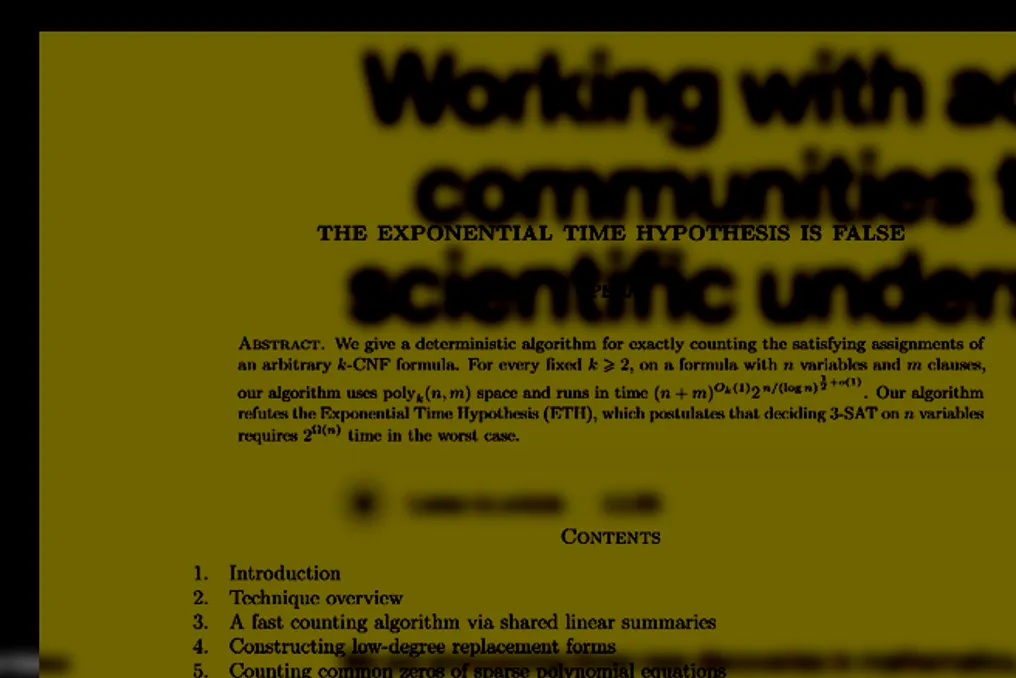
OpenAI and Anthropic refute the exponential time hypothesis in computational complexity theory
Read more
nplus1.ru

OpenAI and Anthropic refute the exponential time hypothesis in computational complexity theory

An internal model from OpenAI presented a proof that refutes the exponential time hypothesis—one of the fundamental assumptions of computational complexity theory. Concurrently with this result, a similar refutation was obtained by the Anthropic model.

The exponential time hypothesis asserts that as the volume of input data increases, the time required to solve certain types of problems will grow exponentially in the worst-case scenario. Specifically, according to this hypothesis, the 3-SAT problem for Boolean formulas cannot be solved faster than an exponential time dependent on the number of variables.

Both technology companies have published their refutations, formalizing them in the Lean language. The proof developed by OpenAI also allows for predicting the number of solutions for Boolean formulas in subexponential time. However, the results still require independent verification.

As part of the review, OpenAI employees sent the obtained result to a group of complexity theory experts. This group includes the authors of the original formulation of this hypothesis—Russell Impagliazzo and Ramamohan Paturi.

Popular