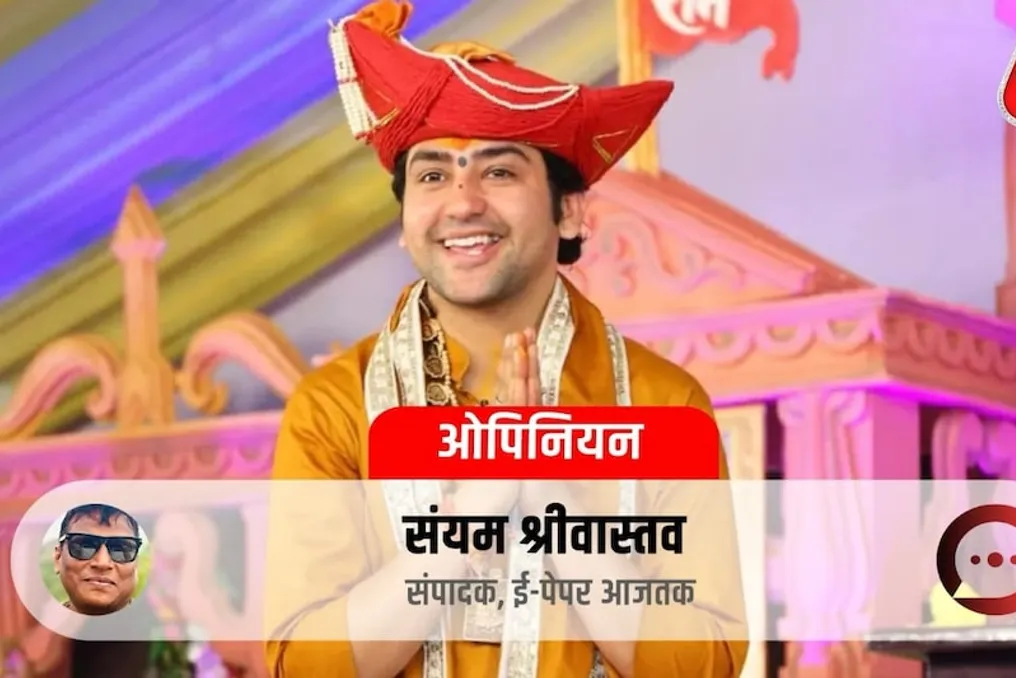
A recent episode from the discourse presented by Pt. Bagneshwar Dham, Pandit Dhirendra Krishna Shastri, has sparked wide discussions and disagreements. During a Shri Ram Katha in Karara, located in Shivpuri district of Madhya Pradesh, he declared God Rama as his patron, asserting that his appearance, name, gait, and abode (Ayodhya) are 'straight'. However, he made remarks regarding the Tribhangi mudra, the name, the abode of Vrindavan, and the posture of playing the flute of God Krishna (Takur Ji).
He stated that Takur Ji stands crookedly, bending his waist and tilting his head while playing the flute, whereas Rama stands straight. He also characterized playing the flute as a game and archery as a serious matter. Following the circulation of the video clip, many saints and followers from Mathura and other places perceived this as an insult to Shri Krishna.
Later, Shastri provided explanations. He clarified that his statements were made in the context of humor, feeling, and love, and should not be interpreted negatively. He cited the example of Gopis who addressed Krishna with such words out of love. He emphasized that he is not against Krishna, as the word 'Krishna' is present in his own name, and he has always supported Krishna's birthplace, having no intention of creating a division between Rama and Krishna. He also apologized if anyone's feelings were hurt, noting that a statement made on a public platform has a much wider reach than personal devotion.
In the tradition of Hindu faith, the choice of a deity for worship is personal and natural. There are followers of Rama, followers of Krishna, as well as devotees of Shiva or Devi. Rama is called Maripada Purushottam, a symbol of ideal conduct, duty, and self-control. Krishna Lila Purushottam, whose play, love, and knowledge (Bhagavad Gita) open infinite dimensions. Both are considered incarnations of Vishnu and represent two aspects of the same element in sacred scriptures. The traditions of Tulsidas and Suradasa complement each other.
The Tribhangi mudra is viewed as a celebration of Krishna's beauty and play, not a flaw. The flute symbolizes the love and music of Radha and Krishna, while Rama's bow symbolizes dignity and the protection of Dharma. Both hold their significance. Comparing one to the other, labeling it higher or lower, is based more on superficial understanding than on the depth of devotion.
The responsibility of a public preacher differs from that of an individual. Comments made on a platform reaching millions can easily be taken out of context and go viral. Social media clips often fail to convey the full meaning. Shastri's explanations and apologies are important because they refuted any intent to discriminate and highlighted unity. Furthermore, saints like Mahant Sitaram Das from Ayodhya assert that this is ignorance, reiterating that Rama and Krishna are the same, which aligns with the core idea of the tradition.
Political reactions, such as sharp comments from some politicians, often further polarize the issue, whereas religious discussions are better kept away from political gain. This incident serves as a reminder to Hindu society that diversity is its strength. It is important to maintain respect among different streams, such as Rama and Krishna, Shiva and Devi. When criticism or a light comment is made about one while praising another aspect, it can unintentionally create distance among followers. Many saints throughout history have emphasized the unity of various forms.
In the modern era, when faith faces numerous challenges, internal cohesion and sensitivity become even more crucial. The goal of discourses and sermons should be to awaken devotion, transmit knowledge, and unite society. There is no objection to glorifying one's personal patron, provided it does not diminish the dignity of another form. Shastri's explanations somewhat stabilized the situation, but in the future, careful word choice and contextual indication are necessary on such platforms. Followers should also get accustomed to viewing the full context.
Ultimately, both Rama and Krishna live in the hearts of millions of Indians. Devotion to one cannot be based on the condemnation of the other. The depth of faith is measured not by comparison, but by devotion and unity. The main lesson of this case is that the broader and more comprehensive the path of devotion, the stronger the society will be.
Shastri had previously issued clarifications regarding his statements. In September 2026, during a Hanuman Katha in Lilua, West Bengal, he visited the region. During Durga Puja, he expressed disagreement with the sale or consumption of meat and fish around the pavilions and idols of the goddesses, calling it unclean food and accusing such people of hypocrisy. He urged Hindus from Kolkata to oppose this practice during Navratri. However, in Bengal, Durga Puja is a cultural festival where fish and meat are traditional food and part of offerings in some places. In temples like Kalighat, fish is offered as sacrifice, which drew sharp opposition. A representative of BBDP Bengal, Samik Bhattacharya, clearly stated that no outsider can dictate the dietary habits of Bengalis. The tradition of eating rohu and mutton on Ashtami and Navami continues. Chief Minister Suvendu Adhikari demonstrated local tradition by accepting a fish offering at the Kalighat temple. Later, Shastri provided explanations, clarifying that his protest was directed against animal sacrifice and the consumption of meat near the pavilions, not against personal diet. Nevertheless, his statement clashed with Bengali identity and religious diversity.