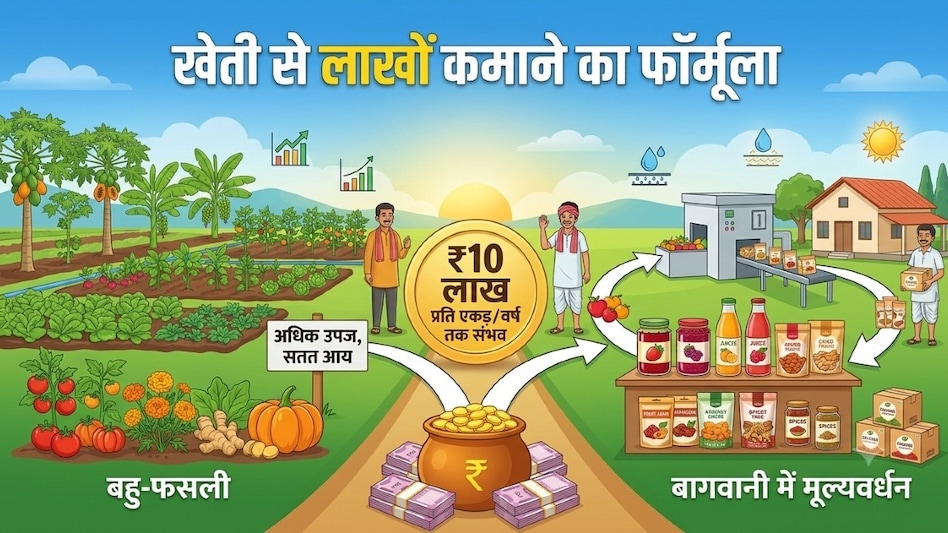
Agricultural producers can significantly increase their income by using new methods and diversifying crops, even with a small land area. During a discussion between farmers and agricultural specialists held on the second day of the Madhya Pradesh foundation day celebration, it was stated that multi-cropping can lead to an annual income of up to 10 lakh rupees per acre.
Experts emphasized the need to integrate value addition of agricultural crops with multi-cropping. It was noted that similar farming practices are also used in the northeastern states of India.
AS Rajput, Regional Director of the Regional Centre for Organic Farming in Nagpur, explained the difference between natural and organic farming. He noted that Madhya Pradesh is a leader in natural farming in the country. According to him, natural farming does not use market-acquired resources that harm the soil, water, environment, and living organisms; all resources used in the field must be environmentally safe.
Rajput also highlighted the importance of certifying natural farming produce, as this gives it special recognition in the market. The central government implements two systems for this: third-party certification and the Participatory Guarantee System (PGS). The third-party certification system involves 36 organizations and is linked to APEDA and the Central Government's Ministry of Commerce, while the PGS system is farmer-oriented and based on trust.
Providing information on the National Mission for Natural Farming, Rajput reported that farmers are increasingly turning to natural farming, guided by the condition of the field and market demand. He listed the main standards of natural farming, including the refusal to use artificial chemicals, fertilizers, and pesticides, the application of field-prepared jivamrut and nimastra, the use of mixtures of manure and cow urine, as well as multi-cropping and soil health management.
Professor Dr. Vinod Kumar from the Pokharcheda Agricultural College in Narmadapuram provided farmers with information on seed technology, explaining the definition of seeds and their various types. Dr. Kumar clarified how to recognize high-quality seeds and informed farmers about the importance of seed testing, as well as the possibility of conducting seed verification through legal methods.
Agriculture Director Ashutosh Pandey shared information about the fertilizer distribution organization and the e-vikas system. He mentioned that thanks to this system, farmers did not have to stand in long queues for fertilizers and received them on time, according to the field's needs. In his opinion, this also helped control fertilizer speculation.