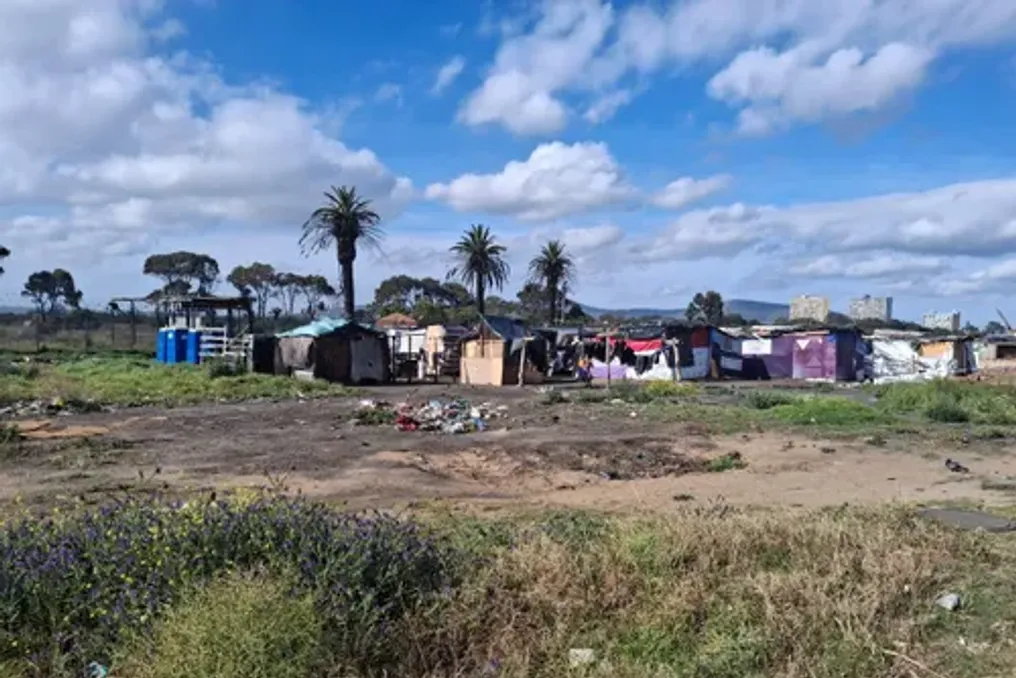
The City of Cape Town frequently declares itself a city that serves all its residents. However, the housing crisis casts doubt on these assertions, particularly concerning the most vulnerable segments of the population whose rights are often overlooked.
The recent demolition of occupied homes has raised serious questions regarding the City's commitment to the rule of law, its approach to housing issues, and respect for the dignity of people who have nowhere else to live.
Early Friday morning, October 23, 2026, law enforcement officers acting on behalf of the City of Cape Town began demolishing private homes at Gate 7, Wingfield Camp in Maitland. People, including young children, were inside during this incident.
The Human Cost of Demolitions
Did the City possess a court order authorizing the eviction of these individuals and the demolition of their homes? The answer is no. At a court hearing held on Friday, October 30, 2026, the City's legal representative admitted the absence of a legal basis for the demolition and the lack of an eviction order.
This is particularly alarming because, as reported, when the media contacted law enforcement officers after the incident, they told journalists they were acting under an eviction order. The discrepancy between the City's public explanation and the position later confirmed by its legal representatives raises serious questions about public information disclosure.
Section 26(3) of the Constitution is unequivocal: no one can be evicted from their home or have their home demolished without a court order made after considering all relevant circumstances. This protection extends even to those occupying land illegally. The Illegal Eviction and Land Occupation Prevention Act ensures the realization of this constitutional protection and requires evictions to follow a lawful process.
The Costly Cycle of Enforcement
These protective mechanisms exist for a reason. Our constitutional democracy arose from a deeply unjust past where people were forcibly removed from their homes, deemed undesirable in certain areas.
Constitutional protection against arbitrary evictions was intended to ensure that such history would not be repeated. The law cannot simply be ignored just because the affected people are vulnerable and have no other place to live.
Over the past week, affected residents have been forced to sleep on the streets, exposed to the cold. Young children, some under seven years old, have been left homeless. Older children taking important school exams are sleeping outdoors. A child with a disability has been left without even a bed for the night.
However, the City's actions were not limited to demolishing these homes. It is reported that law enforcement officers remained on site around the clock, preventing anyone from even restoring a roof over their heads. One must consider the consequences: public resources are being used to ensure that people who have lost their homes remain without shelter.
The Court Intervenes
Could these resources be used for something more beneficial? We know that Cape Town faces serious crime problems. Wouldn't residents prefer to see law enforcement resources directed towards combating crime? What is achieved when officers remain at a demolition site watching people who have nowhere to sleep? And does this approach contribute to solving the root causes that led to the initial occupation of the land?
Residents were forced to seek urgent assistance from the High Court. On Friday, August 30, 2026, the Court issued an interim order prohibiting the City and law enforcement from carrying out further demolitions and obstructing our clients from rebuilding their structures.
This is a small measure of justice and protection for homeless people who were prevented from restoring even the most basic shelter. It also demonstrates a fundamental principle: the City, like everyone else, is bound by the law and cannot simply take the law into its own hands.
Demolitions Do Not Solve Cape Town's Housing Crisis
Yet, the core problem remains. These people will not disappear. They will not vanish into thin air or move to another city or country. They will find another piece of land to live on, and the cycle will continue. Demolishing people's homes does not eliminate the root causes of why they have no other place to live.
The answer is not complicated: Cape Town needs affordable housing in good areas. People should live closer to where they work. This is not just a matter of convenience; it is a necessity. Many people cannot afford to spend 40% of their hard-earned income on commuting to work. They work in Cape Town, often starting early in the morning. Their children study here. They are part of the city's economy and community. They are not a problem to be removed from the city. They are people who deserve dignity, safety, and access to housing.
There is no clearer evidence of the need for affordable housing in good areas than the ongoing land occupations in Cape Town. These occupations do not happen in a vacuum. They are symptoms of a city where housing is becoming increasingly unaffordable, and well-located land remains inaccessible to many of its residents.
The Need for Affordable Housing in Good Areas
This is not a new problem, and the City cannot claim ignorance of it. In the landmark Adonis judgment, widely known as the Tafelberg case, the Constitutional Court affirmed the importance of affordable housing in good areas for addressing spatial inequality inherited from apartheid. The Court explicitly found that the City and Provincial Government had failed in their constitutional obligations in this regard.
The Court ordered the City and Provincial Government to submit reports on their policies, programs, and projects for affordable housing in the Cape Town CBD and Sea Point. These reports were due on October 2, 2026.
What did they show? That no affordable housing had been built or was even under construction in the Cape Town CBD and Sea Point.
What Does a City That Works for All Mean?
Both the City and the Provincial Government point to obstacles and the responsibility of other branches of government. But the question remains: what specific steps are being taken, and when will people in need of this housing actually benefit?
The contrast is difficult to ignore. Significant public resources can be directed towards evicting people from occupied land and preventing the restoration of shelter. Nevertheless, providing affordable housing in well-located areas continues to lag behind constitutional requirements.
A city that works for all must mean more than just a city with functioning infrastructure, efficient municipal services, and attractive public spaces. It must also be a city where people who cannot afford market-rate housing can live with dignity, close to their livelihoods.
The constitutional promise of housing cannot be fulfilled through demolitions. And land occupations cannot be solved by law enforcement without confronting the conditions that generate them. The City must uphold the law, respect the dignity of those affected, and take meaningful steps to provide affordable housing in places where people need to live.
Ultimately, the question is not whether people should choose between illegal land occupation and spending an unmanageable portion of their income on commuting to work. The question is why, decades into our constitutional democracy, so many people still have very few alternatives.
A city that works for all must work for those who need it most.