Trade turnover between Iran and Brazil, estimated at $10 billion, faces difficulties
Read more
Tehran Times
www.tehrantimes.com

Trade turnover between Iran and Brazil, estimated at $10 billion, faces difficulties

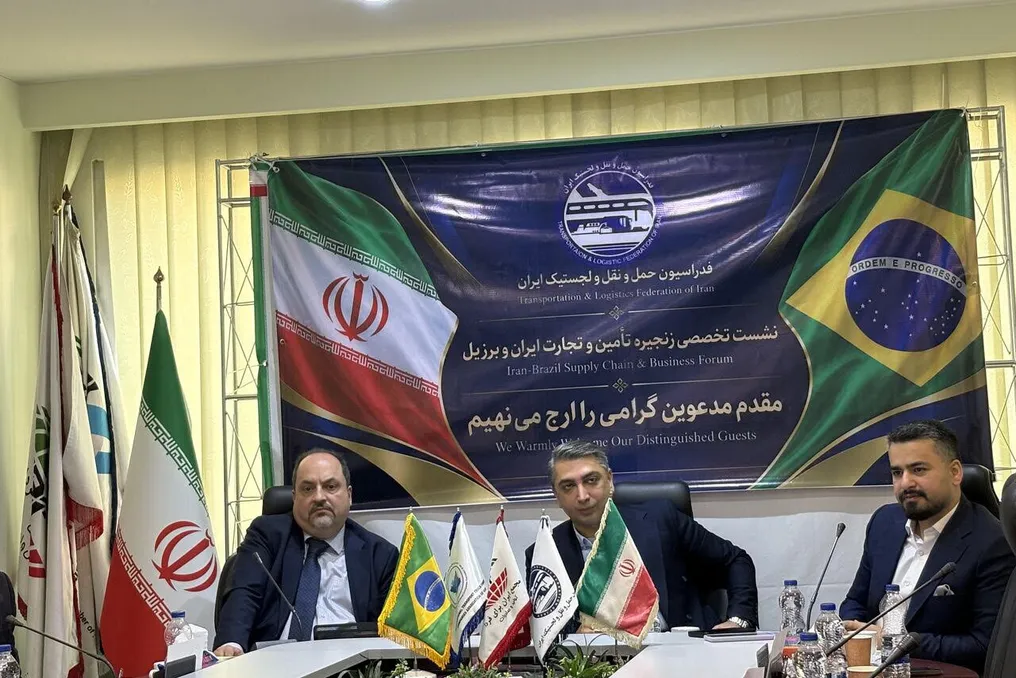
The Deputy for International Affairs of the Federation of Transport and Logistics noted that the volume of trade between Iran and Brazil has shown growth in recent years. He emphasized that Brazil's economic opportunities, especially in the supply of agricultural products and basic goods, create a favorable basis for expanding trade cooperation.

Iran-Brazil Trade Turnover of $10 Billion is at Risk

According to IRNA agency, Abazar Barari stated at a meeting on trade cooperation between Iran and Brazil that it is necessary to study existing problems and eliminate obstacles to forming stable relations between the two countries.

He pointed out that one of the key problems following the start of military actions is ensuring the supply of goods and the continuity of supply chains. Barari added that logistics has become an important aspect of global trade today, and in Iran-Brazil trade, this problem is exacerbated by the large geographical distance and the significant volume of cargo being transported.

Barari drew attention to the fact that a significant part of exchanges between the countries depends on bulky and staple goods such as sugar, corn, and grain. He noted that sea transport of such goods on large vessels cannot compare with land transport from an economic and operational point of view, and replacing sea routes with road transport entails serious costs and complexities for trade.

Explaining the changes in maritime transport corridors between Iran and Brazil, he reported that traditional shipping routes have faced restrictions due to the war. In the current situation, some exchanges are carried out through alternative routes and intermediate ports, including the route through Turkey. However, using these alternative routes involves issues of security, time, and economics.

The Deputy for International Affairs of the Federation of Transport and Logistics highlighted the significant increase in transportation costs. The cost of transporting a 40-foot container, which previously amounted to about $3000, now reaches at least $8000. Furthermore, ground transportation costs for goods along alternative routes have significantly increased.

He also stated that other ports in the country have significant potential for developing trade directions and reducing dependence on limited sea routes. Barari stressed the need to revise the country's infrastructure and logistical planning, noting that even after the end of military conditions, time will be required for the rapid restoration of normal functioning of sea routes and the removal of possible restrictions. Therefore, planning must begin now, with special attention to Chabahar Port.

Similar stories

Trade between Iran and Africa grew by 66% in nine months
Read more
www.tehrantimes.com

Trade between Iran and Africa grew by 66% in nine months

The Minister of Agriculture reported on the trend of increasing trade turnover between Iran and African states. According to customs exchange statistics, during the first nine months of the Iranian calendar year 1404 (the period from March 21 to December 21, 2025), the volume of trade between Iran and Africa reached approximately 940 million US dollars. This demonstrates an increase of 66% compared to the same period last year.

Speaking at the First National Council on Agricultural Cooperation between Iran and Africa, the minister noted that despite the significant growth, the current trade volume still falls far short of the potential of the vast African market, which has over a billion people. He emphasized that although the figure is small, the direction of movement is correct, and economic interaction between the parties requires expansion through careful planning.

Nouri Kazeljeh, commenting on the share of agricultural products in Iran-Africa trade, stated that about two-thirds of Iran's imports from Africa consist of food and agricultural products. Therefore, cooperation in this area should not be limited to unilateral trade; instead, it should develop towards creating joint value chains, mutual investments, and technology transfer.

The Minister of Agriculture also highlighted the priority of eliminating administrative obstacles and strengthening ties between responsible institutions. He added that for sustainable cooperation, economic actors require clear procedures, reliable logistics, practical payment mechanisms, insurance and investment coverage, as well as predictable regulation. In this regard, opportunities for bilateral agreements and regional mechanisms can be considered in the areas of tariffs and trade facilitation, with the participation of relevant bodies.

Nouri Kazeljeh, emphasizing the need for continuous monitoring of the elimination of administrative barriers, stressed that the problems of each project must be clearly defined and documented, a responsible party must be assigned to accompany them, and the progress of work must be evaluated within established deadlines.

At the beginning of the First National Council on Agricultural Cooperation, the minister particularly highlighted the opportunities for joint agricultural partnership with Africa that need to be transformed into concrete, actionable, and long-term economic ties. The council was attended by ambassadors, economic advisors, honorary consuls, executive body officials, economic associations, entrepreneurs, investors, and over 200 economic participants. The minister noted that such broad participation provided a valuable opportunity to translate the political will to expand Iran-Africa relations into concrete projects and strong economic partnerships.

Uzbekistan's foreign trade revenue reached $65.4 billion in 9 months
Read more
sputniknews.uz

Uzbekistan's foreign trade revenue reached $65.4 billion in 9 months

According to the National Statistical Committee, Uzbekistan's foreign trade revenue for the period from January to September 2026 amounted to $65.4 billion. This figure exceeds the same period in 2025 by $3.9 billion, which represents a growth of 6.3 percent.

However, the main growth was driven by imports. Imports increased by $5.36 billion compared to last year, reaching $39.6 billion. At the same time, exports decreased by $1.49 billion, totaling $25.8 billion.

As a result of this imbalance, the negative balance in foreign trade reached $13.7 billion. Nevertheless, if gold is excluded, the export of goods grew by 31.6% compared to the previous year, reaching $13.3 billion.

Popular