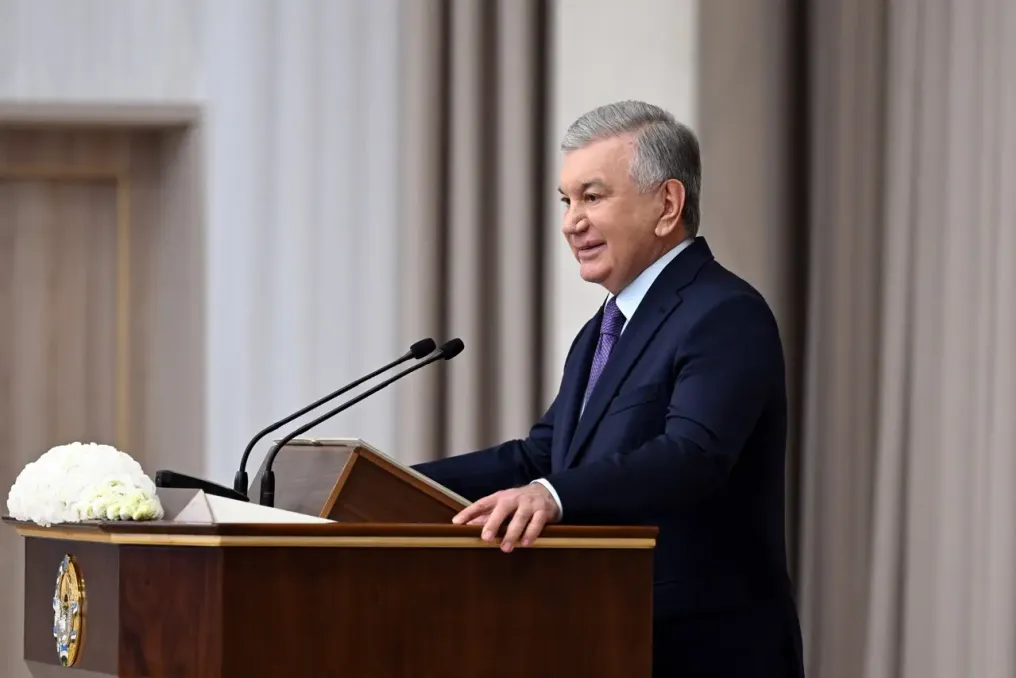
Uzbekistan will start paying private agencies 1.5 million sums for employing citizens abroad
Read more
UzDaily
uzdaily.uz

Uzbekistan will start paying private agencies 1.5 million sums for employing citizens abroad

Starting in 2027, private employment agencies that have received the status of a trusted organization will be responsible for finding jobs for Uzbek citizens abroad. For each citizen employed in a high-paying job, such agencies will receive an incentive payment of 1.5 million sums.

These measures were announced at a meeting chaired by President Shavkat Mirziyoyev dedicated to the priorities of labor migration. The President noted the significant development of private employment services.

Following the simplification of licensing requirements two years ago, the number of private agencies has tripled, and the number of citizens they sent to work abroad has increased fivefold.

Nevertheless, Mirziyoyev also drew attention to persistent problems in the sector, including errors by agencies, corruption, and cases of deception by applicants. A separate law was adopted to improve regulation and create a legal framework for existing organizations.

One of the new tools will be a rating system for private employment agencies. Its goal is to increase the transparency of their activities and assess their effectiveness. Key criteria will include compliance with stated working conditions, protection of migrant workers' rights, salary level, and availability of social guarantees.

Other initiatives focus on the professional training of youth planning to work abroad. Private training centers will receive free premises in technical college buildings to conduct courses on professional training and foreign languages.

Furthermore, these centers will be allowed to apply a reduced social tax rate of 1% to payments made to teachers and experts hired from abroad. Equipment imported by these centers for training will be exempt from customs duties.

Relevant state bodies have been instructed to prepare a draft resolution within a month for the further development of the employment services sector. It is proposed to classify the activities of these organizations as the provision of social services, which will simplify their tax regime.

Overall, the new measures are designed to improve the quality of employment services abroad, strengthen the accountability of private agencies, and expand citizens' access to professional training.

Similar stories

President of Uzbekistan announced the transfer of citizen employment abroad to private agencies by 2027
Read more
gazeta.uz

President of Uzbekistan announced the transfer of citizen employment abroad to private agencies by 2027

President Shavkat Mirziyoyev announced at a meeting on November 2nd plans to fully transfer the functions of directing citizens to work abroad to the most reliable private employment agencies starting in Uzbekistan in 2027.

According to the president, over the past two years, thanks to the simplification of licensing procedures for private employment agencies, their number has tripled, and the number of citizens who found jobs abroad through such structures has increased fivefold.

Nevertheless, Mirziyoyev emphasized that problems have arisen in this area, including cases of fraud and corruption among citizens. Previously, a special law was adopted to eliminate these shortcomings, regulating the activities of private employment agencies.

According to the stated intentions, by 2027, all functions for employing citizens abroad will be fully delegated to the most reliable private agencies. To encourage their work, a payment of 1.5 million soms is provided for each person successfully employed in a high-paying position.

In addition, private agencies are planned to be provided with free rent of part of technical school premises for professional and language training of citizens. It is also proposed to introduce a social tax rate of 1% for teachers and experts invited from abroad, and equipment necessary for training will be exempted from customs duties.

The activities of these agencies must be conducted within a transparent system that includes a rating system. The main parameters for evaluation will be the actual employment of citizens, ensuring their rights, the level of salary received, and the availability of guaranteed social protection.

The President instructed that a draft resolution detailing the further reform of the work of private employment agencies be submitted within a month. The possibility of recognizing this activity as a social service with subsequent simplification of the tax regime is also being considered.

It has not yet been determined how the powers will be divided between private agencies and the state Migration Agency after the proposed transfer of functions.

In Uzbekistan, the activities of private employment agencies are regulated by a law adopted on October 16, 2018. These organizations are obliged to have the corresponding license to provide employment services abroad.

A new law was adopted in November 2025, which tightened requirements for these agencies and expanded their competencies. In particular, they were allowed to conduct language and professional courses, as well as cooperate with foreign employers.

To increase client protection, additional financial guarantees were introduced: private agencies are now required to place a deposit of 4000 basic calculation units in a special bank account, the funds of which can be used to compensate citizens for damages.

In October 2026, the Migration Agency published the results of the assessment of private employment agencies for the third quarter. Out of 47 inspected organizations, 40 received an unsatisfactory rating, four received a satisfactory rating, and three received a good rating; none reached the 'exemplary' category.

The assessment was carried out based on 11 different indicators, including employment results, contract registration, preparation of citizens for travel, compliance with legal norms, and the number of complaints received.

The rating system has been operating since 2025, but the Migration Agency emphasized that the rating only reflects the results for a specific period and does not serve as confirmation of a license or a guarantee of service quality.

Previously, on October 12, the leadership of the Migration Agency met with representatives of private agencies to discuss citizen complaints regarding delays in service provision, non-fulfillment of contract terms, and difficulties with fund refunds in case of unsuccessful employment. The agency demanded that all contracts and employment data be registered in the Xorijda ish system, that deposit guarantees be provided, and that citizens be adequately prepared for departure.

Uzbekistan will provide financial aid of 1 million soums to families for the heating season
Read more
uzdaily.uz

Uzbekistan will provide financial aid of 1 million soums to families for the heating season

In November 2026, Uzbekistan will provide a one-time financial support of 1 million soums to low-income families who meet the criteria. This measure is introduced as part of the expansion of social protection for the 2026/2027 heating season, according to a presidential decree.

President Shavkat Mirziyoyev signed this decree on October 28, 2026. It provides for additional support measures for vulnerable households against the backdrop of the country's gradual transition to market mechanisms in the fuel and energy sector.

The decree establishes the possibility of direct cash payments, expands the selection criteria for state assistance, and extends existing programs for compensating household energy costs. The main recipients of the one-time payment will be families included in the Social Register.

Households not registered in the system can also apply for assistance if they meet the established financial requirements, which are determined after an assessment conducted by the local 'mahalla seven' body.

Criteria for receiving aid

General selection conditions require that the average per capita income of the household does not exceed twice the threshold of minimum consumer expenses. However, there are separate limits for families living in apartment buildings connected to centralized heating systems.

In the regions of Karakalpakstan and Uzbekistan, the maximum permissible income is double the threshold of minimum consumer expenses per person. In Tashkent, this limit is increased to three times this threshold.

The decree also allows financially vulnerable families whose income exceeds these limits to receive aid, provided their applications are approved by the district or city administrations responsible for creating sustainable employment and increasing household incomes.

Other eligible individuals include elderly people living alone and people with disabilities who require assistance from others and are included in the relevant register. Financial aid is also extended to families raising orphans and children deprived of parental care.

Expansion of existing social support measures

In addition to the November payments, the decree increases the allowable threshold for average per capita income to receive compensation for electricity and natural gas costs—it has been raised from 1.5 to twice the minimum consumer expenses level. A similar increase has occurred for the income criterion related to assistance in purchasing coal, which is now up to twice the minimum consumer expenses level.

The same adjustment applies to the financial support provided through the 'Sahovat va Kumak' fund. Funds from this fund can be used to repay utility debts, cover current household expenses, and purchase fuel.

Furthermore, the decree extends the validity of several existing social protection measures aimed at reducing the financial burden of energy costs for vulnerable groups. Compensation covering the difference between basic and higher tariffs for electricity and natural gas will be available until April 1, 2028.

Financial aid intended for partial compensation of coal purchase costs has been extended until January 1, 2029. These measures are designed to increase the number of low-income households receiving state support and mitigate the consequences of Uzbekistan's gradual transition to market tariffs for energy resources. The decree combines urgent winter aid with long-term compensation mechanisms, providing financial support to needy families throughout the process of changing the country's pricing system.

Popular