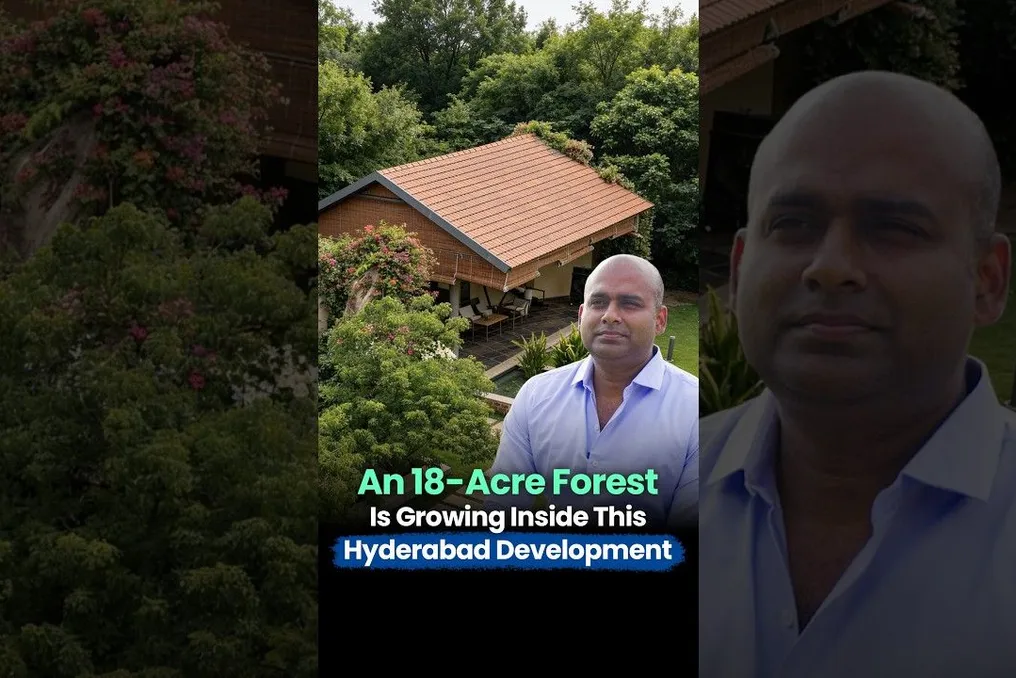
18-acre forest being developed in Hyderabad
Read more
The Better India
thebetterindia.com

18-acre forest being developed in Hyderabad

As Hyderabad expands, its meadow areas are shrinking. However, there is a possibility where urban development can contribute to the flourishing of nature.

In the Stonecraft Woods Shamshabad project, which covers a total area of 60 acres, 18 acres have been allocated for the creation of a Miyawaki forest. This forest mass is home to 450 thousand native trees, over 141 species of birds, and more than 153 species of medicinal, aromatic, fruit, and flowering plants, offering an alternative view on construction principles.

The process of forming this forest included identifying local plant species and saving centuries-old trees.

Similar stories

Macaé surpasses 3,6 thousand trees planted in 2026 and advances in afforestation projects
Read more
g1.globo.com

Macaé surpasses 3,6 thousand trees planted in 2026 and advances in afforestation projects

The municipality of Macaé has registered the planting of 3,660 new trees in avenues, squares, and public gathering areas since the beginning of 2026. This volume corresponds to an average daily rate of approximately 13 new specimens added to the urban network throughout the year.

To illustrate the scale of this progress, if these new trees were arranged in a continuous line, maintaining the technical spacing of eight meters between trunks, they would cover an extension close to 30 kilometers, which is equivalent to the distance between the city and the neighboring municipality of Rio das Ostras.

The progress of these activities is being monitored in real time through Arvômetro, a public transparency digital panel implemented by the municipal administration in September. When this tool was launched, the city had already counted 3,172 plantings carried out between January and August. In just over a month, the counter added another 488 seedlings, placing Macaé ahead of other larger population cities in Rio de Janeiro state during the same period.

According to the Secretariat of Environment, Sustainability, and Climate, the selection of seedlings follows the local Afforestation Manual, giving preference to native species or those adapted to the region's coastal climate.

Among the various varieties planted in the urban environment are yellow ipe, pau-mulato, jerivá palm, pau-formiga, pau-ferro, aroeira-salsa, jacaranda, extremosa, and embaúba. The responsible department emphasizes that expanding vegetation coverage is a fundamental strategy for public health and resilience against global climate change, as it helps reduce the sensation of heat, combat heat islands, and increase shade in public spaces.

In addition to afforestation on sidewalks and central planters, the municipality is investing in the creation of urban microforests—which are vegetative clusters based on rapid reforestation methods to accelerate water absorption in the soil and create more pleasant microclimates in densely populated neighborhoods—as well as promoting environmental recovery fronts in degraded areas.

Thanks to this set of actions, Macaé received, for the first time in 2026, the international Tree Cities of the World seal. This certification is granted by the Arbor Day Foundation, in collaboration with the Food and Agriculture Organization of the United Nations (FAO), recognizing cities that have continuous policies for forest management and expansion in urban areas.

So that the population can monitor the evolution of goals, view detailed data, and locate plantings in real time through a mobile device, the Arvômetro panel remains available for public consultation at the address macae.rj.gov.br/arvometro.
Seedling center established in Kashkadarya for neighborhood greening with plans to increase production
Read more
podrobno.uz

Seedling center established in Kashkadarya for neighborhood greening with plans to increase production

A center designed for propagating seedlings to improve local mahallas was opened in the Guzar district of Kashkadarya region. Initially, the production is planned for 1.6 million trees and plants, but in the future, the output volume is set to increase to five million seedlings annually.

President Shavkat Mirziyoyev inspected the work of this center as part of the nationwide 'Yashil Maqon' initiative during his visit to the region. The complex covers an area of 65 hectares, and the total project cost is estimated at 9.5 billion soms. The creation of the center has resulted in about 100 new jobs.

The center's territory is divided into zones: 50 hectares are allocated for growing ornamental trees, five hectares for fruit crops, and another three hectares are used for cultivating shrubs and flowers. The center features 41 varieties of ornamental and coniferous trees.

The center's infrastructure is equipped with a greenhouse, special cultivation plots, seed germination facilities, and protective structures. Three reservoirs with a total capacity of 4.2 thousand cubic meters have been installed for irrigation, and a drip irrigation system has been implemented on 20 hectares. Additionally, composting and mulching units are used, and some energy needs are covered by solar panels.

Thanks to the application of modern technologies, seedling cultivation is possible throughout the year, including periods outside the main planting season. Preliminary estimates suggest this allows for an 8–10 times increase in production volume compared to traditional methods and reduces water consumption threefold. It is projected that the cost of seedlings will decrease by 30–40%.

The center will also support mahallas in greening efforts: it will supply necessary trees and shrubs, manage the treatment of damaged plantings, soil mulching, and installation of drip irrigation systems. A mentor-forester will be assigned to each mahalla, and training is conducted for members of the 'mahalla seven' before the start of each planting season.

Residents can also participate in the project: they will be issued young plants based on cooperative agreements. After caring for these seedlings on their private plots for one or two seasons, the ready plants are guaranteed to be purchased, allowing families to earn additional income.

During his visit, the head of state noted that planting trees and creating gardens is a valuable tradition of the Uzbek people. He was also presented with information on the complex's potential to expand green areas in mahallas and increase the income level of the local population.

Popular