Deep within the Sierra Nevada de Santa Marta tropical forest in Colombia stand ancient stone terraces amidst tall trees, rushing rivers, and misty mountains. This outstanding archaeological site, known as Ciudad Perdida or the Lost City, offers insight into the achievements of the Tayrona civilization and the indigenous heritage that continues to shape the region.
This multi-day trek passes through the tropical forest, crosses rivers, and follows steep mountain trails before reaching a network of stone platforms built centuries ago. However, Ciudad Perdida is more than just a remote archaeological find. Local communities call it Tayrona, and it is located on ancestral lands where cultural traditions, spiritual beliefs, and environmental stewardship are closely intertwined with the land.
Ciudad Perdida is situated on the northern slopes of the Sierra Nevada de Santa Marta, a mountain range that rises sharply from the Caribbean coast of Colombia. Archaeologists generally date the earliest settlement of the site to the seventh or eighth century, although its development continued for several centuries.
Architecture and Settlement Structure
Built by the ancestors of the region's indigenous people, Tayrona became an important center in a wider network of settlements connected by mountain trails. Its elevated position above the Buritaca River basin placed it in a landscape of exceptional ecological diversity, where tropical forests meet changing mountain climates.
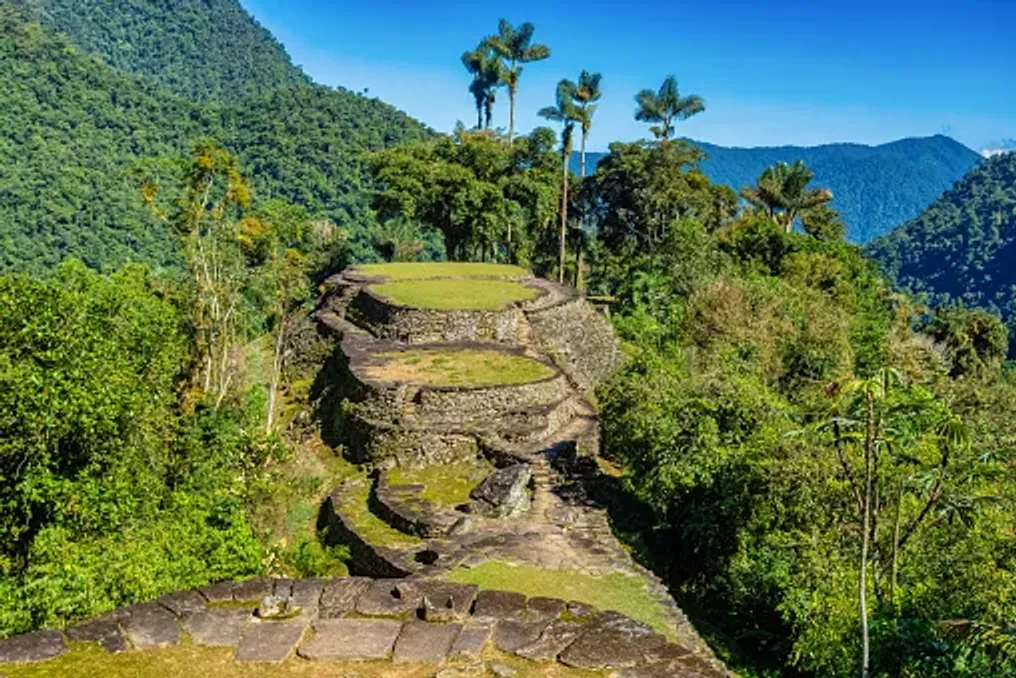
The settlement was not a city with monumental stone palaces. Instead, its architecture reflects a deep understanding of the terrain, including carefully designed terraces, stone staircases, retaining walls, and circular platforms adapted to the steep hillsides.
Over 200 archaeological structures have been identified at the site. The stone terraces supported round houses built from perishable materials such as wood and thatch, while paved paths connected different parts of the settlement.
The builders also developed systems for rainwater management and slope stabilization. Retaining walls supported the terraces, and stone pathways helped link residential areas, public spaces, and other structures on uneven terrain.
Rather than leveling the landscape, the builders worked in accordance with its natural contours. The result was a complex arrangement of platforms and paths that merge with the surrounding forest, demonstrating the engineering skills and ecological knowledge of the people who lived there.
Discovery and Scientific Study
Although local communities knew about the region and its history, Ciudad Perdida attracted widespread archaeological attention only in 1975 when remnants were discovered by individuals searching for pre-Columbian artifacts. This discovery followed a period of looting that damaged archaeological sites throughout the Sierra Nevada.
Subsequent archaeological expeditions documented the settlement, and the Institute of Anthropology and History of Colombia, known as ICANH, began a program of research, conservation, and restoration in 1976. This work helped establish Tayrona as one of Colombia's most important archaeological sites. Its terraces and paths provide valuable evidence of how communities organized settlements, managed steep topography, and maintained connections in the mountainous region.
Today, conservation remains a central element of site management. The stone structures are subject to heavy rainfall, vegetation growth, and human activity. Their protection requires careful visitor management and respect for the broader landscape.
Walking among the terraces offers a different experience compared to visiting archaeological sites dominated by monumental buildings. At Tayrona, the ruins are integrated into the forest, and the structures are interspersed with vegetation, uneven ground, and changes in elevation.
Circular foundations indicate where houses once stood, and larger platforms suggest areas used for public events and daily life. Stairs connect different levels, and paved paths show how people moved through the settlement.
Most information about the city's history comes from archaeological data rather than surviving written records. Therefore, the terraces are more than picturesque ruins; they offer clues about a society whose achievements were closely tied to the surrounding landscape.
Cultural Significance and Management
Ciudad Perdida is located on the ancestral territory of four indigenous peoples: the Kogi, also known as Kaggaba; the Arhuaco, or Iku; the Wiwa, and the Kankuamo. These communities maintain cultural, spiritual, and historical ties to the Sierra Nevada de Santa Marta. Their connection to the mountains extends beyond individual archaeological sites to encompass rivers, forests, peaks, and broader territories that sustain their traditions and way of life.
For these communities, the Sierra Nevada is not merely a scenic mountain range. It is part of a living cultural landscape where the health of the natural environment and the well-being of its inhabitants are closely interwoven. Consequently, Tayrona cannot be viewed simply as an abandoned city. Its importance continues through the living heritage of the indigenous peoples, who recognize the landscape as part of their ancestral world.
The Sierra Nevada is a place where environmental conservation and indigenous beliefs are closely linked. Traditional authorities continue to emphasize the importance of caring for the land and respecting sacred sites.
In October 2026, this interconnectedness was reflected in the temporary closure of the archaeological park. At the request of traditional indigenous authorities, ICANH announced that the site would be closed from October 1st to 15th to allow the land a period of rest and time for internal spiritual practices. The park subsequently reopened to visitors on October 16, 2026, with regular operating hours of 7:00 AM to 3:00 PM. This decision illustrates why access to Tayrona cannot be understood solely from a tourism schedule: the cultural and spiritual practices of the indigenous peoples are a vital consideration in site management.
Travelers can approach this experience with greater understanding by listening to authorized guides, adhering to local protocols, and recognizing that visiting an archaeological site does not mean the entire surrounding area is open for unrestricted exploration.
Journey to the Lost City
Reaching the Lost City requires significantly more effort than visiting a typical attraction. The journey usually begins in Santa Marta, a coastal town that serves as the main base for organizing treks into the Sierra Nevada. From Santa Marta, travelers travel by road to the rural settlement of Machete Pelao, also known as El Mamei, from where the route begins. The trail passes through forested hills, river valleys, and rural communities before reaching the archaeological park.
Most routes take four days round trip, although options ranging from three to six days may be available depending on the operator and itinerary. The hike involves humid conditions, steep ascents, muddy trails, and river crossings. Heavy rains can make certain sections particularly challenging.
Accommodation is typically provided in basic camps along the route, where tourists can rest, eat, and prepare for the next day. This experience differs greatly from a standard vacation, demanding physical exertion and readiness to move at the pace of the landscape.
One of the most memorable moments of the journey is approaching the archaeological settlement closer to the end, as tourists ascend approximately 1200 stone steps to the terraces. This climb serves as a fitting introduction to the city itself. After days spent navigating forest trails and crossing rivers, the stones lead to a network of meticulously formed platforms, winding paths, and green slopes.
It is best to explore the site slowly. Take time to observe the circular foundations, the layout of the terraces, and how the vegetation surrounds the archaeological remains. The setting helps visitors appreciate the practical difficulties faced by the builders and the scale of their achievements.
After touring the ruins, tourists return along the same general route to the start of the trail. Good preparation, appropriate footwear, and a realistic understanding of the terrain are necessary. The journey to Ciudad Perdida offers more than just the destination itself. The trail traverses tropical ecosystems shaped by variations in altitude, precipitation, and relief. Forest canopies, tangled roots, streams, and riverbanks create a constantly changing backdrop for the walk.
River crossings are part of the route, and conditions can change after heavy rain. Tourists must follow the instructions of their guides and avoid attempting crossings when water levels or currents make it unsafe. The birdlife, tropical vegetation, and sounds of running water complement the experience, although encounters with wildlife are never guaranteed. The forest is a living ecosystem, not a set piece created for visitors.
The route also passes through indigenous communities and territories, offering an opportunity to understand that the mountains are not desolate wilderness. Communities continue to live and work in the region, maintaining relationships with the land that predate modern tourism. Traveling with an authorized guide helps visitors navigate the route safely and provides context about the landscape and its cultural significance. Local guides, cooks, and other trekking staff also contribute to the visitors' experience, making responsible tourism an opportunity to support the people working in the region.
Visitors should ask permission before photographing people, homes, or culturally significant activities and respect any restrictions posted along the trail. The climate in the Sierra Nevada is humid and can be very rainy, so even a favorable forecast should not be considered a guarantee of dry conditions. Trails can become slippery, and the combination of heat, humidity, and steep terrain can make walking exhausting. Sufficient time must be allocated for the entire trek, provisions for rest must be made, and the route chosen must match your fitness level.
Tourists should book through authorized operators and check the latest access information before departure. The trail is not clearly marked throughout, and independent hiking is prohibited. A certified guide is required, so visitors must arrange their trek in advance and confirm what is included in the package. The announced reopening on October 16, 2026, is an important current update but should not be taken as a guarantee of uninterrupted access in the future. Temporary closures can occur for cultural and spiritual reasons, preservation, safety, or other operational reasons. Before leaving, check the latest announcements from ICANH and confirm arrangements with an authorized tour operator. The published park hours are from 7:00 AM to 3:00 PM, but multi-day trekking and accommodation must be arranged separately. Respecting closures and local instructions is part of responsible travel, not an inconvenience to be bypassed. The remote location of the site does not negate the responsibilities associated with visiting a protected cultural landscape. Stay on marked trails, avoid climbing on or moving stones, take all trash with you, and follow guidelines regarding photography and restricted areas. Tourists must also acknowledge that indigenous peoples have a voice in how their ancestral territory is cared for and used. Choosing an authorized operator, following the guide's instructions, and showing respect to local residents can help make this experience more respectful for all participants.