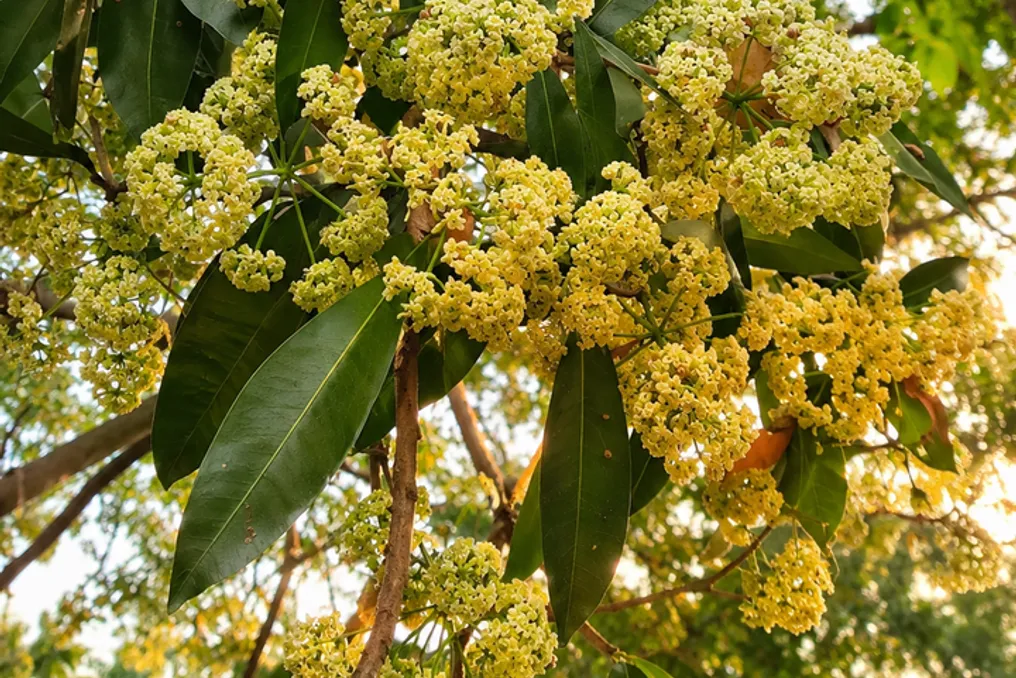
The Saptaparni flowering tree whose aromas fill the streets of Delhi in autumn
Read more
The Better India
thebetterindia.com

The Saptaparni flowering tree whose aromas fill the streets of Delhi in autumn

Every autumn season in Delhi, the streets, parks, and residential areas are filled with a strong aroma emanating from the Saptaparni tree. These tiny, greenish-white flowers that bloom in autumn create a recognizable scent, which is especially noticeable closer to evening.

Besides its characteristic smell, this tree has other features. Its leaves often grow in groups of seven, which is the origin of its name. The word 'sapta' in Sanskrit means 'seven', and 'parna' means 'leaf.'

The Saptaparni tree also holds historical significance related to school years. Its wood was traditionally used to make slate boards, leading it to receive nicknames such as 'Board' and 'Scholar's Tree.'

At Vishwa Bharati University in Santiniketan, Saptaparni leaves are traditionally given to graduates during the graduation ceremony, giving this familiar tree a special place in the university's history.

However, the most noticeable feature of the Saptaparni also elicits mixed reactions. The intense aroma associated with Delhi's festive season is pleasant and evokes nostalgia for some, while others find it too strong.

Thus, one tree is capable of holding many memories, and its fragrance serves as a signal of autumn's arrival in Delhi.

Similar stories

The reason for the unusual smell in Delhi during the cold season is the Saptaparni tree
Read more
www.aajtak.in

The reason for the unusual smell in Delhi during the cold season is the Saptaparni tree

As October and November arrive, the weather in Delhi changes, with a slight chill felt in the morning and evening. During this period, a distinct aroma appears in many areas of the city, parks, and residential zones. Some residents perceive this smell positively, while others find it strange. Sometimes it feels as if someone has sprayed perfume or that the air is filled with the scent of flowers.

However, this sudden scent in the atmosphere of Delhi is caused not by perfumes or flowers, but by a specific tree—the Saptaparni, also known as the Devil Tree. Although this tree looks ordinary for most of the year, before the onset of the cold weather, it changes the surrounding environment with its fragrance. The following discusses how the Saptaparni tree looks when its flowers appear and how far its scent spreads.

The scientific name of Saptaparni is Alstonia scholaris. It is an evergreen tree whose leaves remain green year-round. Its characteristic feature is that its flowering time differs from that of ordinary trees. Usually, flowers begin to appear on this tree in late September in Delhi, blooming from October to December. The flowers are quite small, having a light white, cream, or green hue, and they bloom not singly, but in clusters.

When thousands of tiny flowers bloom on one tree, their fragrance begins to spread over vast areas around it. In the evening, this scent can be even stronger. This is why people walking past the streets of Delhi often detect this tree's aroma.

It is difficult to describe the fragrance of Saptaparni flowers in a single word. Some people perceive a sweet, perfume-like scent in it, while others describe it as sharp, reminiscent of cardamom and spices. Some compare it to the scent of Ratrani flowers. Nevertheless, not everyone likes this smell; some find it too strong and heavy. People sensitive to this odor may experience headaches, nausea, or allergic reactions when near the tree. Thus, while for some the aroma of Saptaparni signals the approach of winter and holidays, others do not anticipate the flowering season of this plant.

The name of this tree is related to its distinctive feature. In Sanskrit, 'sapta' means seven, and 'parni' means leaf. Its leaves often appear in groups of seven. Although it is not necessary for every branch to have exactly seven leaves, the number can vary from four to eight. The leaves are long, smooth, and glossy, radiating outwards from a single point. From a distance, one can notice a round cluster of leaves on the branches.

Saptaparni is a plant native to India. It grows in various regions of the country, including many Himalayan areas. However, it was not originally part of the local flora of Delhi. The mass introduction of this tree into Delhi began in the 1940s, especially in areas like golf courses. Gradually, it started appearing on the streets, in parks, and residential areas of the capital. The reason for its popularity in cities also lies in its resilience: the tree is capable of growing in different climatic conditions and thrives well in an urban environment. Its evergreen leaves keep it in a green state year-round. Today, old and large Saptaparni trees can be seen in many parts of Delhi, such as near Lodhi Garden and golf courses.

The history of Saptaparni is not limited to its scent and leaves. In English, it is called the Devil Tree. This name is associated with various ancient folk tales and beliefs. In some regions of South India, there was a belief that Yakshinis inhabited this tree. In folklore, Yakshinis are depicted as mysterious and beautiful women, and in some stories, they are presented as spirits connected to forests and trees. It was said that a strange, strong aroma emanated from the Saptaparni trees at night. Due to this smell and the mysterious stories associated with the tree, fear arose among people. However, these stories lack scientific basis; they are old folk beliefs passed down through generations.

Saptaparni is also called the Blackboard Tree. An interesting reason for this is that in the past, its light wood was used to make writing slates and blackboards for children. The word 'scholaris' in its scientific name is also related to education. Furthermore, graduation ceremonies were held at Vishwavarti University in Santiniketan, West Bengal.

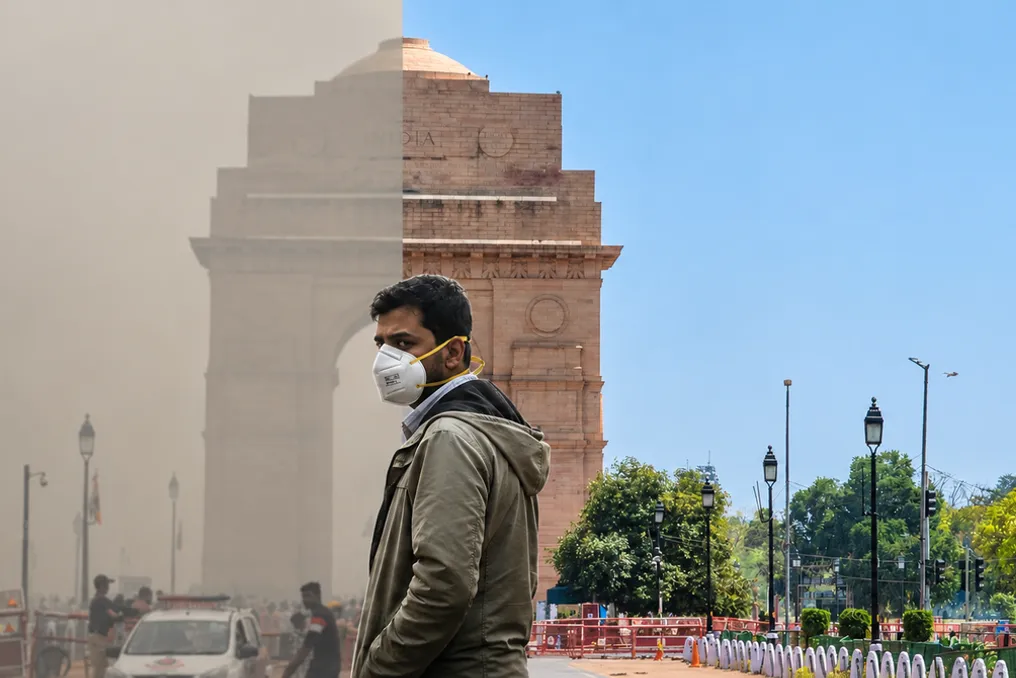
Analysis of Factors Causing High Air Pollution in Delhi Early Morning and Recommendations for Residents
Read more
thebetterindia.com

Analysis of Factors Causing High Air Pollution in Delhi Early Morning and Recommendations for Residents

Although the cool and quiet hour after sunrise seems like an ideal time for walks in October, the medical institute AIIMS indicates that air pollution levels remain highest during early morning hours, approximately until 8:30 or 9 am.

Air quality in Delhi shows rapid variability. For instance, on Tuesday, October 20, at 4:00 pm, the Central Pollution Control Board recorded an Air Quality Index (AQI) of 179, classified as moderate. However, by the next day at 7 am, the air quality early warning system showed a value of 219, corresponding to poor quality, and the forecast for October 22 was 342.

The Invisible Lid Over the City

The explanation for this phenomenon lies in physical processes. Typically, temperature decreases with altitude, which promotes air mixing near the ground and the rise of pollutants. Researchers from the University of Reading, Ankit Bhandekar and Laura Wilcox, explain that temperature inversion disrupts this natural process, placing warmer air above colder air, similar to a lid on a pot.

As a result, pollutants remain close to the ground, and the mixing height—the level up to which they can disperse—decreases from approximately one kilometer in summer to a few hundred meters in winter. This 'lid' sinks lowest after nightfall. Sarat Guttikunda, founder of UrbanEmissions.Info, told Frontline that in November and December, the inversion height can drop below 50 meters at night and remain within 200–500 meters during the day. As the sun rises, this layer lifts, and the smog dissipates, which explains why the heaviest periods occur in the early hours.

The Bowl Holding the Smoke

Delhi's geography exacerbates this problem. The city is located on the Indo-Gangetic Plain, surrounded by the Himalayas to the north and the smaller Aravalli range to the south, forming a kind of natural bowl. The Himalayas prevent air movement northward, forcing pollution to travel across North India before it can exit into the Bay of Bengal. The monsoon season, which cleans the air from July to September, has already passed by October, and wind speed slows down.

Thus, minor changes in weather can quickly change the situation. Bhandekar and Wilcox note that on January 5, 2025, favorable winds allowed authorities to ease some restrictions; however, by January 15, calmer winds and lower temperatures forced the introduction of the strictest restrictions in the city. Meanwhile, the city had not received any new cars, factories, or construction sites in a week. The Centre for Science and Environment also observed something similar in the winter of 2023, when slow winds seemingly triggered most smog episodes over six years, despite field fires in Punjab and Haryana being almost comparable to 2022 levels.

Weather-Dependent Solutions

Researchers from Reading argue that if weather dictates when pollution occurs, policy must follow forecasts rather than chasing smog. They suggest tightening construction restrictions when inversions are predicted, even on clear days, and developing measures for the entire Indo-Gangetic Plain, as many of India's most polluted cities share similar conditions.

Delhi's Graded Response Action Plan already allows authorities to act proactively based on forecasts, including restrictions ranging from dust control to limits on construction and transport. Another lever of influence is upstream, as smoke from cattle dung burning in Punjab and Haryana, where farmers quickly clear fields for wheat sowing, increases the load every October and November. Some farmers avoid this practice by direct seeding wheat using Happy Seeders, spraying a biodegradable substance solution on the straw, or selling rice straw for conversion into fuel pellets.

What Can Be Done During This Season

Firstly, the cool early hours should be considered risky, as AIIMS advises staying indoors during peak hours and preferring indoor exercise over running or cycling outdoors. Secondly, one must check the AQI daily in the SAMEER app, recommended by AIIMS, and use an N95 mask if going outside. Thirdly, special attention should be paid to children, the elderly, and anyone suffering from heart or lung diseases, whom AIIMS notes are the most vulnerable. Fourthly, AIIMS advises reducing local emissions by skipping one car trip per week.

However, these recommendations are not equally accessible to everyone. Business Standard reports that an air purifier costing between 12,000 to 15,000 rupees is unaffordable for many informal workers, and that even indoors, the air can contain up to 70% of the outdoor PM2.5 level without airtight windows and purifiers. This is why forecast-based measures and cleaner fields are as important as personal habits. Delhi cannot change the bowl it is in or the chill that settles every night, but it can change what it emits into the air under this lid. Given the forecast of poor air quality for October 21–23, the next fresh, quiet dawn should be viewed more as a warning than a relief.

Mother and daughter from Delhi create footwear from fallen leaves and tableware from eggshells
Read more
thebetterindia.com

Mother and daughter from Delhi create footwear from fallen leaves and tableware from eggshells

Designer Midushi Kochhar from Delhi, through her project YLEM, began exploring the possibility of using discarded materials, such as creating plates from eggshells or shoes from fallen leaves.

At the age of eight, Midushi's bedroom in Delhi contained many items she had collected, including shells, pebbles, dried flowers, and even snake skin gathered during excursions. She notes that her love for unusual things came naturally to her, and this curiosity later inspired her to create YLEM.

In 2017, while studying industrial design at Central Saint Martins in London, Midushi used discarded eggshells to make plates and spoons for her final project, although at the time she did not anticipate that this experiment would lead to starting her own business.

In 2020, Midushi launched a project in the Netherlands that collected waste for children's art activities. During the pandemic in India, she founded YLEM in June 2021 to transform waste into new products.

YLEM combined eggshells with a bio-binder to create a material resembling ceramics or concrete. Her shell products became custom-made decorative items, produced in batches of 20–30 units, rather than everyday tableware.

Initially, Midushi collected eggshells from breakfast cafes and grocery stores, cleaning and sterilizing them herself. By 2022, an egg processing company in Delhi began supplying powder and flakes, giving a second life to the waste.

Midushi's mother, Sakshi Kochhar, brought her experience in the fashion industry to the enterprise and suggested making footwear from fallen leaves. Together they created 'hasiru', sandals that turn discarded leaves into wearable items.

The mother and daughter collected and washed the fallen leaves, while the sandal production took place in Delhi. Since the leaves are seasonal raw material, careful production planning was required. In July 2022, Midushi reported having orders for over 400 pairs monthly at a price of 500 rupees per pair.

Midushi shares that the initial reaction of people is surprise and admiration. She hopes that her designs will prompt people to think about what they throw away. Her broader goal is to connect different industries so that the waste of one industry becomes a resource for another.

Popular