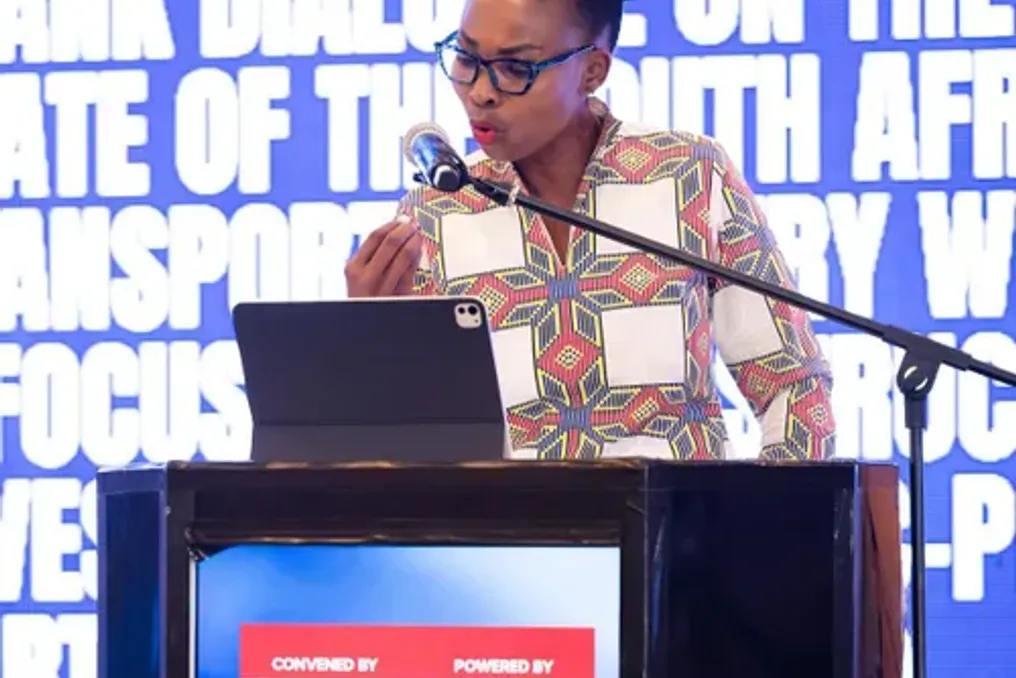
The conclusion of the Frank Dialogue on the South African transport industry in uMhlangi sent a clear message to government structures and decision-makers: it is necessary to move from discussions to practical implementation of solutions to overcome the country's transport problems.
The event, held at the Radisson Blu hotel, was moderated by Professor Nkgotetse J.J. Tabane and attended by Minister of Transport Barbara Crisi, Dr. Nishal Husiala, Cyber Security Advisor to the Department of Transport, Msesela Nhlapo, Chairperson of the Integrated Transport Sector Charter Council, Mark Goliath, Acting Executive Director of Production at the Industrial Development Corporation (IDC), Hishamam Emeran, CEO of the Passenger Rail Agency of South Africa (Prasa), Charles Shilowy, Acting CEO of Airports Company South Africa (Acsa), and Letsoalo, Chief Operating Officer of Transnet, alongside representatives from the taxi industry.
Nhlapo referenced industrial engineer Hendrik van der Bijl, known for creating Eskom and Iscor, stating that true national transformation cannot rely on symbolic inclusion. She declared: 'Presence is not power. Usage is not ownership. Procurement is not industrialization, and financial closure is not proof that a project has transformed the country, bearing its costs,' urging delegates to evaluate large infrastructure deals not by participant scores, but by what repeatable technical capability remains within South Africa after the project concludes.
B-BBEE Commissioner Tshediso Matona supported these concerns, presenting the results of a ten-year compliance data analysis covering over 28,000 certificates. He noted: 'The problem with B-BBEE is that measurement is based on investments, expenditures, events, accrued points, rather than measuring what is truly important. Are we measuring what is easy to count, or what is significant in terms of growth?' Matona also pointed to legislative limitations, jokingly complaining that he is a 'commissioner without handcuffs' when dealing with organizations that do not report compliance or engage in fronting.
The afternoon session began with an examination of the minivan taxi sector and its complex coexistence with rapid transit systems and digital ride-sharing platforms. This was followed by presentations from working groups with recommendations for the Department of Transport and state-owned enterprises.
Taxi Economy: Huge Cash Flows, Limited Inclusion
Opening the urban transport panel, co-moderated by coach and pastor Thomas Radabe, Vuyi Madjola, Head of Integrated Public Transport Systems at CityCon Africa, highlighted the scale of the informal transport economy. Conservative estimates suggest that with a trip cost of 15 rand for 10 million daily trips, the minivan taxi sector generates approximately 750 million rand per week.
Despite this significant turnover, Madjola noted that commercial banks continue to classify taxi drivers as high-risk, and urban planning largely views this industry as secondary. She stated: 'It is very sad to say that the government let down the taxi industry, but the taxi industry itself also let itself down by failing to consolidate resources to gain greater bargaining power.' Madjola also warned about the rapid expansion of the domestic ride-sharing sector. It is currently estimated at around 26 billion rand with 70,000 vehicles, and is projected to reach 70 billion rand in five years, demonstrating a compound annual growth rate of 17%.
She strongly urged traditional taxi drivers to adapt and utilize profitable suburban and feeder routes instead of viewing new platforms merely as competitors. In response to these concerns, provincial secretary of the South African Taxi Council (Santaco) and chairperson of the eThekwini taxi council, Matula Mkhize, emphasized that the sector is actively modernizing and moving away from violent territorial disputes toward formal business structures, despite various difficulties caused by the Covid-19 pandemic and the government's reluctance to transform the industry.
Addressing passenger dissatisfaction due to unpredictable driver behavior, Mkhize attributed it to the legacy of apartheid-era structural and spatial planning. He questioned the government: 'Is it realistically possible to move a million people from a place that Santaco did not design to our industrial zones? (S) for everyone to get there by eight in the morning, including your gardeners and cleaners, while you complain that taxis break rules and run red lights?' Mkhize added that Santaco is transitioning family taxi operations into registered companies and strengthening specialized structures, including a Women's Department, to protect widows inheriting taxi fleets from exploitation. He also apologized for the unpredictable behavior of drivers on the roads, acknowledging that the pressure for timely arrival often comes from taxi owners and bosses.
Prasa Defends Intercity Bus Services
In response to concerns raised during the dialogue that Prasa was 'stealing passengers' on long routes by introducing new buses between Durban and Johannesburg, Emeran clarified the agency's strategy. The CEO indicated that Prasa and its subsidiaries, including Translux and City to City, have provided intercity bus services for decades. He stated that the recent introduction of new buses represents fleet modernization, not an attempt to aggressively compete with the taxi industry.
He stressed: 'We do not operate passenger [bus operations]. We manage long-distance intercity bus services... this is not aimed at competing with taxis. We coexist in an ecosystem where integration is key: trunk, feeder, and distribution.'
Working groups identified five priorities for action within 90 days: combating fronting and non-performing contractors under B-BBEE, restoring domestic refineries to lower fuel prices, introducing fairer public transport subsidies that include the taxi industry, integrating small carriers into rail-road freight operations, and restoring government engineering capacity.