In recent years, improving AI performance has depended on the ability to write higher-quality prompts. However, this paradigm is rapidly changing as AI systems begin to reason, make decisions, and perform actions within entire workflows autonomously.
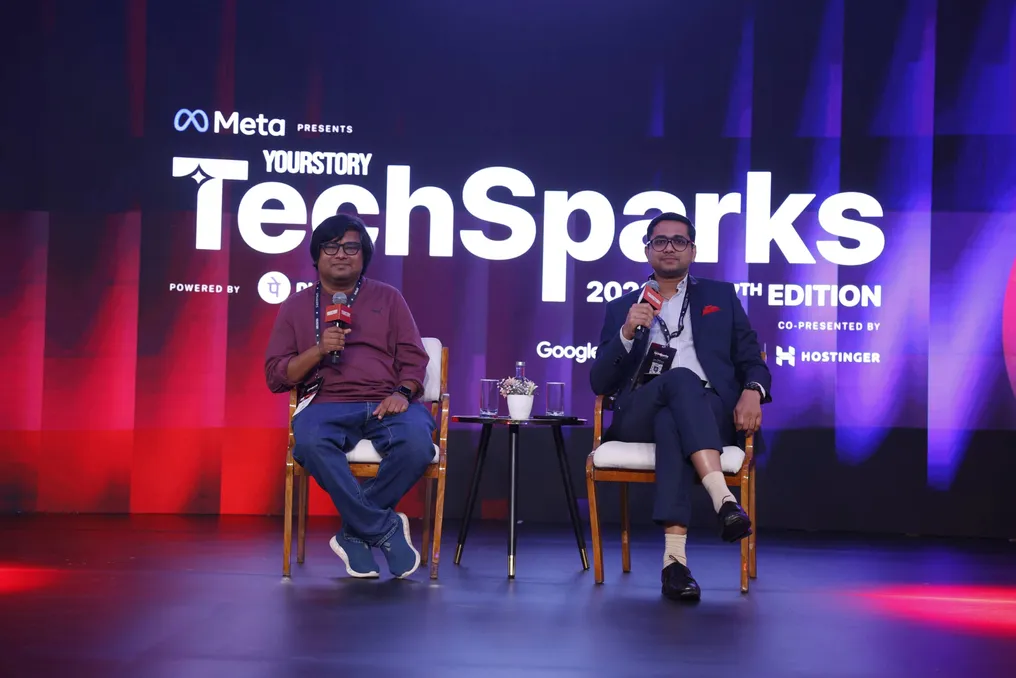
At the TechSparks 2026 event, YourStory's flagship event, Dr. Vignesh Subrahmaniam, an AI lead scientist at Intuit, held a discussion with Aditya Charlie, Editor-in-Chief of YourStory and The CapTable. The discussion, titled 'Beyond the Prompt: Building AI That Thinks, Acts, and Learns,' focused on what developers need to rethink as intelligence becomes increasingly autonomous.
The session began with questions about Subrahmaniam's typical workday and a request to simplify fintech and AI concepts for the audience. He used a chess analogy, asking: if an algorithm is not taught the rules of chess but shown a million completed games with winners, can it deduce both the rules and the most probable winning strategies?
Intuit's team applies a similar approach to support small businesses, as the company serves both consumers and accountants. Subrahmaniam noted: 'We study the game of business by analyzing data, real actions, and the results that enterprises undertake.' The goal is to understand the factors that contribute to business success in customer acquisition, rapid growth, and improved cash flow.
The conversation then shifted to the paradigm shift for developers: moving from years of studying how to write smarter prompts to designing agents given a goal, which they determine the steps to achieve themselves. Subrahmaniam compared prompt engineering to the long history of programming languages, starting from binary code and assembly up to Fortran, C, and Python. Large language models have allowed anyone to program in simple English, but this method has its limitations.
Researchers quickly realized that intelligence should not reside only within the model. The model must act as an orchestrator, breaking down a complex task into a sequence of actions and tool calls. Real intelligence moves into the called tools; and these tools must also be designed differently: 'not so that a human, or a software developer, or anyone else can use them, but in such a way that the LLM orchestrator can actually use them.'
This requires creating highly precise tools with extremely deterministic outcomes. For developers, mastery shifts from clever phrasing to reliable components that the model can call repeatedly without surprises.
Regarding sources of new data, Subrahmaniam openly stated that training on text data is largely solved. The more complex task is training on multimodal sources and real-world actions. He cited the example of how a young child primarily learns through what they see, hear, and observe, rather than reading, asserting that incorporating such real-world signals into AI systems will help models move beyond text generation and start suggesting actions. He called this the next frontier.
When considering regulated industries, he took the audience back 18 years, to one of the first machine learning labs in Bangalore where he worked on logistic regression and multilayer perceptrons. Back then, the biggest problem was not the algorithm itself. He recalled: 'Actually, it was the quality of the data.'
This problem has not changed. Whether a team is training simple regression or fine-tuning a transformer, the principle of 'garbage in, garbage out' remains valid. According to him, companies capable of collecting, aggregating, and storing the highest quality data will gain an advantage.
During a short Q&A session, one participant asked how restrictions on storing financial data affect Intuit's operations. Subrahmaniam named consent as the foundation of any training system and referenced the Framingham study, where residents of Massachusetts were allowed to track their health over time, which shaped the modern understanding of cardiovascular disease. He added that companies are also obligated to explain the benefits of data usage to the general public.
As the conversation concluded, the overarching idea was that as AI transitions from reacting to acting, foundations become more important than interfaces. Prompts will remain a starting point, but the real work now lies in creating robust tools that agents can call, supplying systems with high-quality data, and obtaining the consent that allows them to learn. It is here, beyond the prompt, that the next wave of AI will be won for developers.