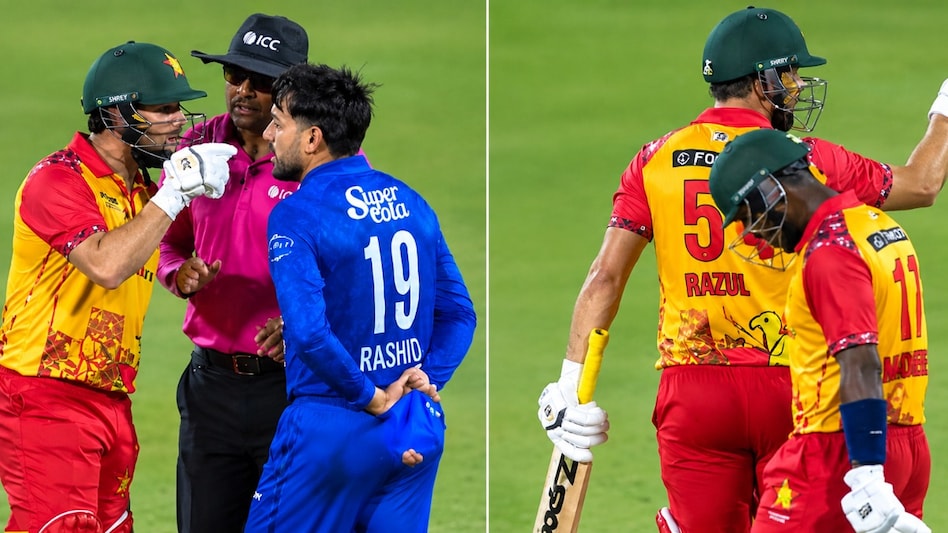
Conflict between Rashid Khan and Ryan Berle during Zimbabwe vs Afghanistan match
Read more
Aaj Tak
www.aajtak.in

Conflict between Rashid Khan and Ryan Berle during Zimbabwe vs Afghanistan match

The third and final T20 match of the series between Afghanistan and Zimbabwe took place on November 1st at the Sharjah Cricket Stadium in Sharjah. In this game, Afghanistan won by seven wickets, thus concluding the series with a 3-0 result in favor of Afghanistan.

During the match, the atmosphere on the field intensified. A tense verbal altercation occurred between Afghanistan's star leg spinner, Rashid Khan, and Zimbabwe batsman Ryan Berle. Both players were face-to-face on the field, requiring intervention from the umpires.

This incident happened in the ninth over of Zimbabwe's innings. On the second ball of that over, Rashid Khan appealed for LBW against Ryan Berle, but the umpire ruled that the Zimbabwean batsman was not out. Since the DRS system was not available in the series, Rashid appeared dissatisfied with the decision. The dispute between the two players began after the fifth ball of the over.

As the situation escalated, umpire Ahmed Shah Pathan separated the players. The tension persisted even after the end of the over, necessitating the intervention of the second umpire, Farouk Khan. However, interestingly, the tension on the field later resolved in a lighter manner: Rashid sent Ryan Berle, who was sitting on the bench, an air kiss, a video of which became a topic of discussion on social media.

Ryan Berle scored the most runs for Zimbabwe, making 30 runs. Nevertheless, he did not receive sufficient support from the other side, and the Zimbabwe team was dismissed in just 14.3 overs, having scored 79 runs. For Afghanistan, Nur Ahmad delivered a brilliant performance, taking five wickets for 13 runs in 3.3 overs. This marked his first five-wicket haul in his T20 International career.

In response, Afghanistan reached the target of 80 runs in just 49 balls, easily concluding the series and securing a clean sweep against Zimbabwe. Besides Afghanistan's brilliant victory, the incident between Rashid Khan and Ryan Berle also attracted public attention.

Similar stories

Team management's decision to exclude Vaibha called into question Gautam Gambhir's aggressive strategy
Read more
www.aajtak.in

Team management's decision to exclude Vaibha called into question Gautam Gambhir's aggressive strategy

The Indian team under the leadership of Gautam Gambhir is supposed to play aggressively, dominate opponents, and leave no chance for the rival. However, the team management's decision in the fourth T20 match in Auckland called this philosophy into question. Former player Vaibha Suryawanshi, who created history with Abhishek Sharma by scoring 118 runs in the powerplay in the previous match, was excluded from the starting lineup.

Captain Shreyas Iyer stated the need to remain 'ruthless,' but facing a mountain of 260 runs, the Indian team's game turned chaotic: two wickets fell in the very first over, undermining hopes of victory. The question arises: what kind of aggressive strategy excludes the most explosive player?

When the fielding team New Zealand set a target of 260 runs, the Indian batsmen found themselves in a difficult position. The hosts secured a convincing victory by 87 runs, and India could not get close to the target score. The team, which hoped for a 4-0 win, was forced to accept a bitter defeat.

Gautam Gambhir prefers aggressive cricket, and his team is not afraid to pursue big goals. Batsmen are given the freedom to play openly, and players are expected to take wickets from bowlers. Nevertheless, there is a fine line between aggression and blind experimentation, which the team management may have forgotten to observe in Auckland.

India already had an undisputed advantage of 3-0 in the series. The fourth match provided an opportunity to solidify the success and take the lead at 4-0. However, Gambhir and his colleagues made a decision that caused the most surprise.

In the previous match, Abhishek Sharma and Vaibha Suryawanshi demonstrated excellent performance against the New Zealand bowlers, scoring 118 runs in 6 overs during the powerplay. This was the highest score in the powerplay for any team in T20 international matches. This figure was not just a record; it testified to the strength of the batsman combination that took the opponent out of the game in the first overs. Vaibha and Abhishek understood each other's game and attacked the bowlers.

However, in the next match, this pair was separated: Vaibha was excluded, and Ishan Kishan came in his place. The question is not about Ishan's ability, as he is also capable of winning a match. The question is why Vaibha had to be excluded? Does the record of the previous match hold so little value for the team management? Should a player have to prove their worth in every match, yet historical performance is insufficient to maintain a spot in the team?

Gambhir should ask himself: what was the basis for breaking up the batting pair that set the record?

During the toss, captain Shreyas Iyer stated: 'We don't want to leave any chances. We have already won the series, but I think our half of the job is done. It is important to remain ruthless.' The captain's words sounded impressive, but ruthless play is not achieved through statements alone; it requires clarity in decisions. If the team's goal is not to give the opponent any chances, then why was the opening pair that destroyed the opponent in the previous match broken up?

Iyer is the captain, and the responsibility for team selection decisions lies jointly with the coach and the captain. Therefore, the captain cannot avoid questions about this change. Did he support the decision to exclude Vaibha? Did he not feel that the pair that scored 118 runs should have been retained?

The captain's task is not only to choose between bowling or batting after the toss. He is also responsible for the team's on-field strategy and for trusting the players. When you talk about ruthless play, you must show the same clarity regarding your successful players.

New Zealand, batting first, scored 259 runs in 20 overs, losing 7 wickets. Glenn Phillips scored 107 runs off 49 balls, and Michael Bresshaw complicated matters for the Indian bowlers, scoring 65 runs off 25 balls.

India faced a target of 260 runs. It was a serious challenge, but not insurmountable. Based on how the Indian batsmen behaved when chasing big targets in previous matches, it was expected that the team would start aggressively again. However, Sanju Samson was dismissed after scoring 4 runs in the second ball. Ishan Kishan also returned to the dressing room without scoring a single run on the fifth ball. Abhishek Sharma (27) was dismissed in the fifth over.

The team that habitually scored 118 runs in the powerplay lost three major wickets already in the fifth over. Here arises the biggest question regarding Gambhir's strategy: if the team relied on aggressive play, why was the batsman who best executed this strategy excluded?

India's defeat was not only caused by the decision to exclude Vaibha. The Indian bowlers also failed to cope...

_
After defeating New Zealand, Abhishek Sharma reveals details of Vaibhav Suryavanshi's game
Read more
www.aajtak.in

After defeating New Zealand, Abhishek Sharma reveals details of Vaibhav Suryavanshi's game

The Indian team secured a convincing victory over New Zealand in Wellington. Both the team's leading batsmen, Abhishek Sharma and Vaibhav Suryavanshi, demonstrated explosive batting, ensuring a one-sided win for the team.

After the match, Abhishek Sharma and Vaibhav Suryavanshi shared several interesting and amusing details. During the post-match interview, Vaibhav spoke about how he changed his approach to the game and how he managed to dominate the bowlers on the field.

Abhishek Sharma made an interesting statement about what Vaibhav told him just a day before the match. According to Abhishek, Vaibhav repeated the famous phrase from the movie 'Bhaag Milkha Bhaag', stating that he would play the same way. This signified his firm intention to leave past failures behind and step onto the field with full commitment and an aggressive mindset.

Vaibhav explained that in previous matches of the series, he tried to play more cautiously, which contradicted his natural T20 style. However, this time he decided to fully utilize the powerplay advantage and intentionally attack the opponents from the first delivery, which gave the team a powerful start.

Abhishek Sharma highly praised the young Vaibhav, noting that when Vaibhav showed such aggression against the bowlers from the first over while chasing a large target of 199 runs, it gave him a huge surge of energy while standing at the non-striker's end. He joked that his playing style resembled street cricket on a village rooftop.

During the conversation, the players mentioned Sanju Samson. Vaibhav noted that all players in the team are dedicated, and Sanju allowed others to get a chance to play, which indicates a great atmosphere within the squad.

Furthermore, Abhishek Sharma complimented the Indian bowling team. He observed that at one point it seemed like New Zealand might score 220-230 runs, but Akshar Patel and the other bowlers managed to brilliantly recover and stop the score.

After defeat to South Africa, Australian team considering major squad changes, says captain Pat Cummins
Read more
www.aajtak.in

After defeat to South Africa, Australian team considering major squad changes, says captain Pat Cummins

Following the Australian team's defeat to South Africa in the second Test match of the series, losing by one innings and 31 runs, questions have arisen regarding the team's composition. Captain Pat Cummins admitted that the team management now needs to conduct a new analysis of the players' squad.

The availability of Cameron Green and Josh Inglis may also influence player selection ahead of the decisive Test starting in Cape Town on October 27. In the second match, where the Australian team played a follow-on, they managed to score only 295 runs in the second innings. Marnus Labuschagne was dropped after scoring 39 runs, while Nick Maddinson and Beau Webster were unable to play a major innings; Maddinson scored zero in the first match and eight in the second, and Webster scored 13 and 8 runs respectively.

The Australian team management must decide whether to give another chance to players who are consistently performing poorly or replace them with new players. Cummins noted: 'There is always the task of deciding whether to give a player another match or if now is the right time for changes. This will be discussed in the coming days.'

He also stated that Cameron Green and Josh Inglis might be available for the third Test. According to Pat Cummins, both players will be considered when forming the squad.

Previously, the 'Kangaroo' team had won the first Test by a score of 214 runs. In that match, Matt Renshaw achieved his first Test century in ten years, but Pat Cummins admitted that the team's batting performance did not meet expectations at that time. He emphasized: 'Renshaw performed brilliantly in Durban, but I believe that especially in batting, we were not at our best. Considering the potential of our batsmen and their own standards, we are scoring less than expected.'

Pat Cummins added that the Australian team has several days to prepare and analyze its mistakes before the Cape Town Test. The Australian side is now aiming to show better batting performance in the decisive confrontation to win the series.

Popular