China Telecom, YOFC, and ZTE Demonstrate Bidirectional 800G Transmission over Over 1007 km Fiber Optic Cable
Read more
Pandaily
pandaily.com

China Telecom, YOFC, and ZTE Demonstrate Bidirectional 800G Transmission over Over 1007 km Fiber Optic Cable

The research institutes of China Telecom, YOFC, and ZTE have completed the implementation of what they call the world's first real-time bidirectional data transmission over fiber optic cable spanning over 1000 kilometers, as announced by the China Telecom Research Institute on November 2, according to sources IT Home and C114.

On a line measuring 1007.48 km, the partners achieved a speed of 800 Gbps per wavelength using PCS-16QAM modulation in the extended C+L band, transmitting signals in both directions through a single optical fiber cable, resulting in a total capacity of 128 Tbps. These three organizations collaborated as joint builders of a national key laboratory.

The partners reported three significant achievements. This experiment set a record for the longest single-point, non-loop real-time data transmission over fiber optic cable while maintaining a loss margin of at least 3 dB on each segment and an Optical Signal-to-Noise Ratio (OSNR) margin of at least 3 dB for system operation. Furthermore, it became the first real-time bidirectional transmission over a single optical fiber line at the 1000 km scale.

Although reflections reduced the OSNR by between 0.5 dB and 4 dB, the team believes this proves the feasibility of long-haul bidirectional operations. Finally, the longest fiber optic line in the extended C+L band free from gas line absorption was constructed.

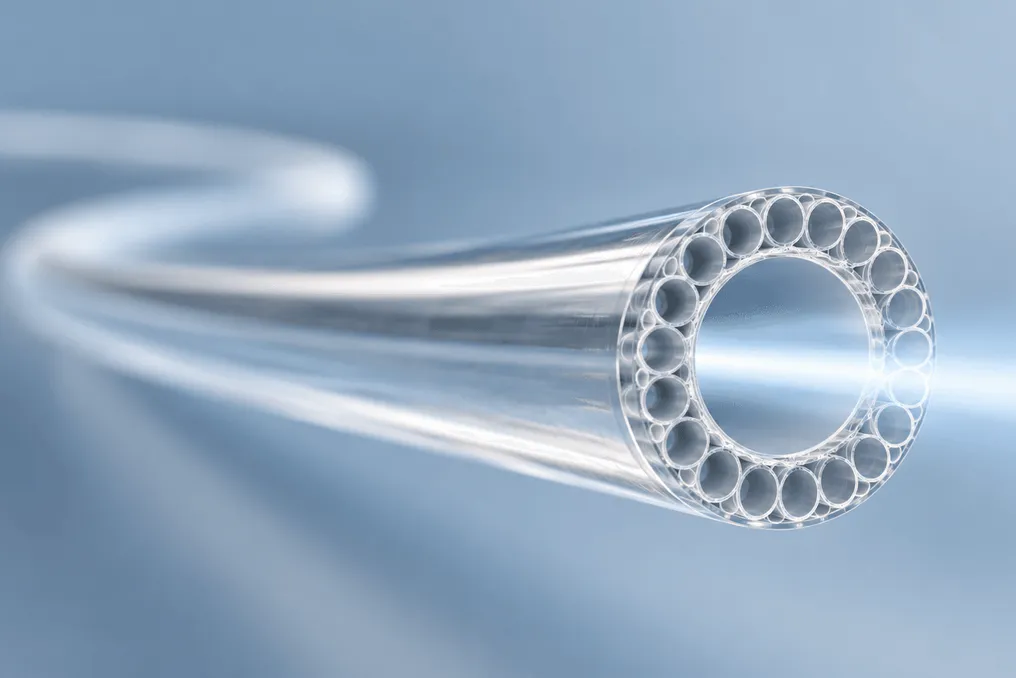
The last point concerns an issue specific to this technology. Since light in hollow-core fiber passes through gas rather than solid glass, traces of carbon dioxide and carbon monoxide in the core can absorb certain wavelengths and degrade transmission. To solve this problem, the team improved the manufacturing process to eliminate these absorption lines across the entire extended C+L band.

Regarding equipment, the partners eschewed high-power amplifiers and used commercial amplifiers with standard output power, matched to the fiber loss profile, to achieve optimal performance from a fully loaded 800G system. Light pre-equalization at the transmitter level maintained channel stability across the entire band. The team also developed an end-to-end model of the impact of reflections and intermodal interference on the line and tested an extreme scenario where part of the band failed without detecting any performance loss.

Operators are most interested in latency. Light in hollow-core fiber travels almost at the speed of a vacuum, approximately 30% faster than in traditional glass fiber, saving about 1.5 milliseconds in each direction over a 1000 km route. The announcement did not specify the measured latency value. Until now, hollow-core fiber in China has mainly been used for short connections, such as between data centers in Chunwei, Ningxia, whereas computing clusters in the west are often more than 1000 km away from demand in the east. China Telecom stated that the result provides a practical technical basis for creating high-capacity, long-distance, and low-latency backbone networks based on fiber optic cable.
Similar stories

Huawei introduces VitaAAU, bringing RetinaMIMO technology to the upper 6 GHz band with 256 channels and over 1500 antenna elements
Read more
pandaily.com

Huawei introduces VitaAAU, bringing RetinaMIMO technology to the upper 6 GHz band with 256 channels and over 1500 antenna elements

At the Decoding China 2026 event, held at Huawei's research center in Lianqiu Hu, Shanghai, on October 27, Huawei introduced a new generation of products for mobile networks. The centerpiece of the presentation was the Huawei VitaAAU—a base station block antenna unit designed for the upper half of the 6 GHz band, known as U6GHz.

The VitaAAU is an active antenna unit that integrates radio modules and antenna arrays. Huawei positions this product as the successor to the MetaAAU, which was used for sub-bands below 6 GHz. This is the first product to implement Huawei's RetinaMIMO technology in the U6GHz band. RetinaMIMO is based on three key parameters: 256 transmit and receive channels, over 1500 antenna elements, and high-speed beam scanning, which Huawei calls HBF.

The main goal of this technology is to ensure more precise control over beams and spectrum, allowing the network to handle a larger volume of traffic and provide more uniform user service. Furthermore, Huawei notes that this unit features a simplified and more eco-friendly hardware architecture.

The U6GHz band is important because it provides wide contiguous blocks of spectrum that operators can use to achieve very high throughput. Huawei reports that the VitaAAU supports peak user speeds of up to 10 Gbps and has already begun commercial operation, having been deployed in the United Arab Emirates, Hong Kong, and Macau.

Focus on the uplink channel

Fang Xiang, Vice President of Huawei and Director of the Wireless Network Management Committee, emphasized that artificial intelligence is transforming the nature of mobile traffic. As AI moves from the digital world into physical devices, and services become accessible to all types of terminals, networks originally designed primarily for downloads must now handle uploads on a similar scale. He suggested that the value of a network should be measured not only by the number of connections, according to Metcalfe's law, but also by the average quality of those connections.

Huawei also stated that it applies the principles of Tao's Law when designing base stations. This approach is used at the system level: the network is viewed as a single cell, which allows planning tasks to be solved compactly at the entire system level, reducing the time required for radio decision calculations and increasing overall performance.

The event will run until October 29, during which Huawei's division demonstrated a wide range of products in addition to the VitaAAU.

Openserve and Huawei test readiness of state housing for fiber optic connection in KZN
Read more
techcentral.co.za

Openserve and Huawei test readiness of state housing for fiber optic connection in KZN

Openserve, Huawei, and the KwaZulu-Natal government are working on laying fiber optic channels in 405 state houses currently under construction in Empangeni. This project is viewed as a demonstration of the concept of creating housing that is initially ready for connection to fiber optic networks. Fiber optic services have not yet been activated.

The project started last Friday at the Phase 1A mega-housing complex in the uMhlathuze municipality. It uses a 'pipe and box' method to place physical fiber optic infrastructure parallel to the construction of homes, roads, water supply systems, and electricity supply. This complex is part of an integrated housing development program, which is a mixed-income housing scheme implemented by the state.

KwaZulu-Natal Governor Thamsanqa Ntuli stated in his announcement that while this concept demonstration itself does not provide fiber optic services, it creates the necessary physical foundation for future connectivity.

Huawei provides technical support, assists in implementing the program, and facilitates knowledge transfer. In turn, Openserve, Telkom's wholesale infrastructure division, is responsible for network planning and infrastructure. Pearl Shrimpton, Head of Corporate and Government Sector Relations at Openserve, noted: 'We are building this right, we are measuring it openly, and we will share what we learn with our government partners so that the country can make decisions based on facts, not assumptions.'

Partners did not disclose information regarding the cost of preliminary connection per house compared to installing fiber optics later when the houses are connected, nor did they specify which operator will provide the services or how much residents will have to pay.

Huawei South Africa Vice President Charles Cheng expressed a desire for this approach to become 'standard national policy, integrated into municipal building codes and the national housing strategy across South Africa.'

This call came amid efforts by Communications Minister Solly Malatsi to accelerate network deployment through Icasa, aligning with a political direction that recognizes that differences in municipal processes and levies slow down the implementation process.

Huawei and Shaanxi Telecom implement Dual-Band Massive MIMO on High-Speed Railways
Read more
pandaily.com

Huawei and Shaanxi Telecom implement Dual-Band Massive MIMO on High-Speed Railways

Huawei, in collaboration with the China Telecom branch in Shaanxi Province, has commercially deployed 32T32R FDD Massive MIMO technology on the Shu-Lan and Yinxi high-speed railway lines. This equipment operates simultaneously on 1.8 GHz and 2.1 GHz frequencies.

Huawei states that this is the first commercial use of FDD Massive MIMO in a high-speed railway environment in China. High-speed rail networks present significant challenges for mobile coverage due to the large distance between towers, train speeds up to 350 km/h, and penetration losses caused by metal carriages.

Massive MIMO technology, which is often used to increase capacity in densely populated urban areas, forms narrower beams compared to traditional wide-beam antennas. Huawei asserts that this beam shape is suitable for a linear route: the beams can be directed along the tracks, follow the train through cells, and adapt to compensate for the Doppler effect, which could degrade the connection.

The company highlighted three key design aspects for railway application. Adaptive beams are designed to limit frequency shift effects at high speeds. Inter-cell beam tracking and coordinated planning aim to reduce the number of handovers when a train crosses multiple cells. Furthermore, broadcast beams and pilots are configured to ensure linear coverage so that energy remains within the corridor rather than scattering in open terrain.

According to the statement, measurements conducted on the Yinxi section in Shaanxi showed an approximate 200-meter expansion of cell coverage after modernization, a 24% increase in average 5G uplink speed, and an increase in average downlink speed of over 50%. User experience improvements were even more pronounced: uplink speed at the zone boundary increased by 95%, and downlink speed by over 100%.

Although FDD Massive MIMO has long served as a tool for increasing capacity in urban macrocells, deploying 32 transmit and 32 receive chains on a high-speed corridor represents an attempt to apply this urban capacity model to a fast-moving linear cell. Huawei and Shaanxi Telecom present the deployment in Shaanxi as an operational commercial network, not a laboratory experiment. It should be noted that all claimed gains in coverage and throughput are assertions made by the company and operator from the announcement in October and have not undergone independent verification.

Popular