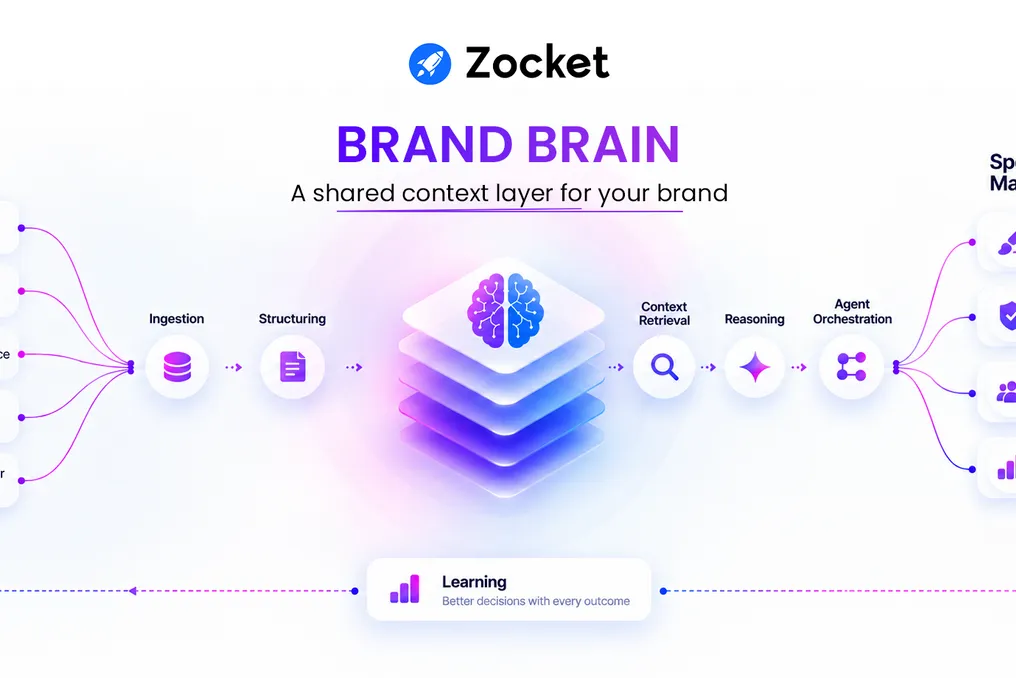
Zocket develops a system that uses context to improve marketing efficiency in large companies
Read more
YourStory [india, en]
yourstory.com

Zocket develops a system that uses context to improve marketing efficiency in large companies

For the past three years, one idea has dominated the field of corporate artificial intelligence: the winner is the one who chooses the most powerful model. Every new release set a new benchmark, increased the context window, and improved reasoning accuracy. Board members discussed which model to bet on, as if making a decision about infrastructure for the next decade.

However, this paradigm is coming to an end. The gap between leading models is shrinking quarterly, and most enterprises can now access nearly cutting-edge intelligence with just one API call. When everyone has access to the same 'brain,' that 'brain' ceases to be a competitive advantage.

The next battle in enterprise AI will be won through context: proprietary knowledge, history, signals, and judgments that explain to the models exactly what the business needs. Models become the engine, and context becomes the fuel, map, and ultimate goal.

The landscape has fundamentally changed. A capability that seemed like magic just eighteen months ago, such as summarizing a 100-page contract or writing production-ready code, is now a standard requirement for many vendors. Open-weight models have significantly narrowed the gap with proprietary counterparts, and inference costs continue to fall. Switching from one model to another, which used to be a painful migration, is becoming an increasingly simple configuration change.

This is the classic trajectory of any fundamental technology, similar to electricity, cloud computing, and bandwidth. First comes a period of scarcity and differentiation, followed by abundance and standardization. Today, no one wins by having the best power source; those who build upon it win.

For business leaders, this brings discomfort, but also liberation. If your AI strategy is based predominantly on choosing a model, your competitors can copy it over the weekend. Long-term advantage must come from somewhere else.

Although AI models possess immense power, intelligence alone is not enough to understand how a business operates. The true utility of AI comes from the context surrounding every decision: the brand, its customers, business priorities, and governing processes.

For corporate marketing, context goes beyond simply inputting information into a model. It implies connecting four critical levels of intelligence:


Similar stories

Jiang Guanjun from the Qwen team presented a personal agent framework based on models, memory, and ecosystem
Read more
pandaily.com

Jiang Guanjun from the Qwen team presented a personal agent framework based on models, memory, and ecosystem

The Qwen team from Alibaba described the process of creating a personal agent, asserting that the next stage in the development of AI assistants depends on the coordinated operation of three components: the model, memory, and service ecosystem. Jiang Guanjun, Head of AI Algorithms Department in Qwen Alibaba's business unit, presented this concept on October 22 at the China National Computer Congress (CNCC) in Chengdu.

Jiang divided the evolution of AI applications into three stages: chat, agent, and assistant. In the chat stage, AI responds to user queries. In the agent stage, the system performs assigned tasks. The assistant, which he says is where the industry is heading, combines professional knowledge with the user's personal context, plans actions around the user's goals, and detects needs they have not noticed. He emphasized that a true personal agent must provide added value and offer proactive, individualized service.

He suggested that theoretically, a personal agent is capable of solving almost all daily problems in work, study, and personal life. However, the main obstacle is the system's ability to correlate its capabilities with the optimal path to solving each specific problem.

Model Development Approach

Regarding the model, Qwen focuses on stable task execution. The team developed what is called a user needs map covering over 30 major industries and detailed it down to more than 8000 atomic requirements for the model's capabilities. Industry experts were involved in evaluating and tuning the model.

Memory Mechanism

Jiang noted that a personal agent must ensure long-term understanding of the user, avoiding the simple accumulation of chat history, which increases noise and computational costs. Qwen constructs its memory based on the degree of event interconnectedness, storing and retrieving them at various levels. For example, an assistant that remembers an elderly user mentioned their pension can give more relevant advice when the same family later asks about finding a job for a child.

Role of the Ecosystem

Concerning the ecosystem, Jiang stated that as models and management methods improve, the ability to link and coordinate external services becomes crucial. Qwen creates a model-oriented open service ecosystem that integrates professional knowledge, tools, industry skills, and third-party agents, while also connecting to e-commerce, local services, healthcare, and education.

In his view, these three elements combine to provide proactive service: memory provides personal information, the model uses expert knowledge to determine needs and plan, and the ecosystem executes the work, such as tracking a patient's rehabilitation schedule or alerting to new financial risks for the user. This report represents the most detailed public description of the technical concept behind the Qwen Go! personal agent, which Alibaba opened for registration this month.

Vacancies for Junior Specialists: Employment Opportunities and Salary Levels
Read more
www.aajtak.in

Vacancies for Junior Specialists: Employment Opportunities and Salary Levels

For young people who have completed their education and are looking for a job, the most difficult task is often securing the first position. Many companies prefer candidates with experience, which makes it difficult for graduates to start. However, this does not mean that finding a job without experience is impossible. There are entry-level positions, such as customer support, data entry, process assistant, and sales, where applicants have a chance. Furthermore, the requirements for these roles depend on the needs of the specific company. For these roles, a specific specialty or an expensive professional course is not always required.

Let's look at what positions newcomers can look for, what income they can expect, and what skills they need to acquire.

If you have graduated from college or high school (12th grade), a customer support specialist position can be an option for you. This job involves listening to customer problems, answering calls, and assisting them via email or chat. Some companies hire newcomers for these positions, although training is provided before starting work. At the initial stage, young people can expect a salary of approximately 12,000 – 18,000 rupees per month. However, this depends on the company, city, shift, as well as the candidate's language and communication skills.

What course should I take?

For this position, it is not necessary to have any single specific degree. Many vacancies require a secondary education certificate (12th grade) or a higher education diploma. Important skills include reading and writing in English, basic computer knowledge, and the ability to communicate properly with customers.

The role of a process assistant involves helping the company perform daily procedures. This may include data verification, record updates, document processing, and completing tasks according to established rules. Such positions are found in banking support, BPO, IT services, and other business operations. The salary for beginners or interns in process assistance can be around 10,000 – 20,000 rupees per month, although this varies across companies.

What course should I take?

Although higher education is required for many positions, the qualification depends on the type of work and the company. Learning MS Excel, email writing, data organization, and basic computer operations can be useful.

If you are good at communicating with people and building relationships with new people, you can consider positions related to sales or business development. This job involves presenting products or services to clients, understanding their needs, attracting new clients, and achieving sales targets. The starting salary for such positions can range from 13,000 to 25,000 rupees per month. Some companies provide bonuses in addition to the base salary. However, it should be remembered that bonuses depend on sales targets and company policy, so they cannot be considered guaranteed income.

What course should I take?

Many entry-level positions require a higher education, while some roles may accept candidates with a secondary education certificate. Courses in sales, marketing, or business communication can be helpful but are not mandatory for every job. Key skills in this job include communication, manner of speaking, and product knowledge.

Popular